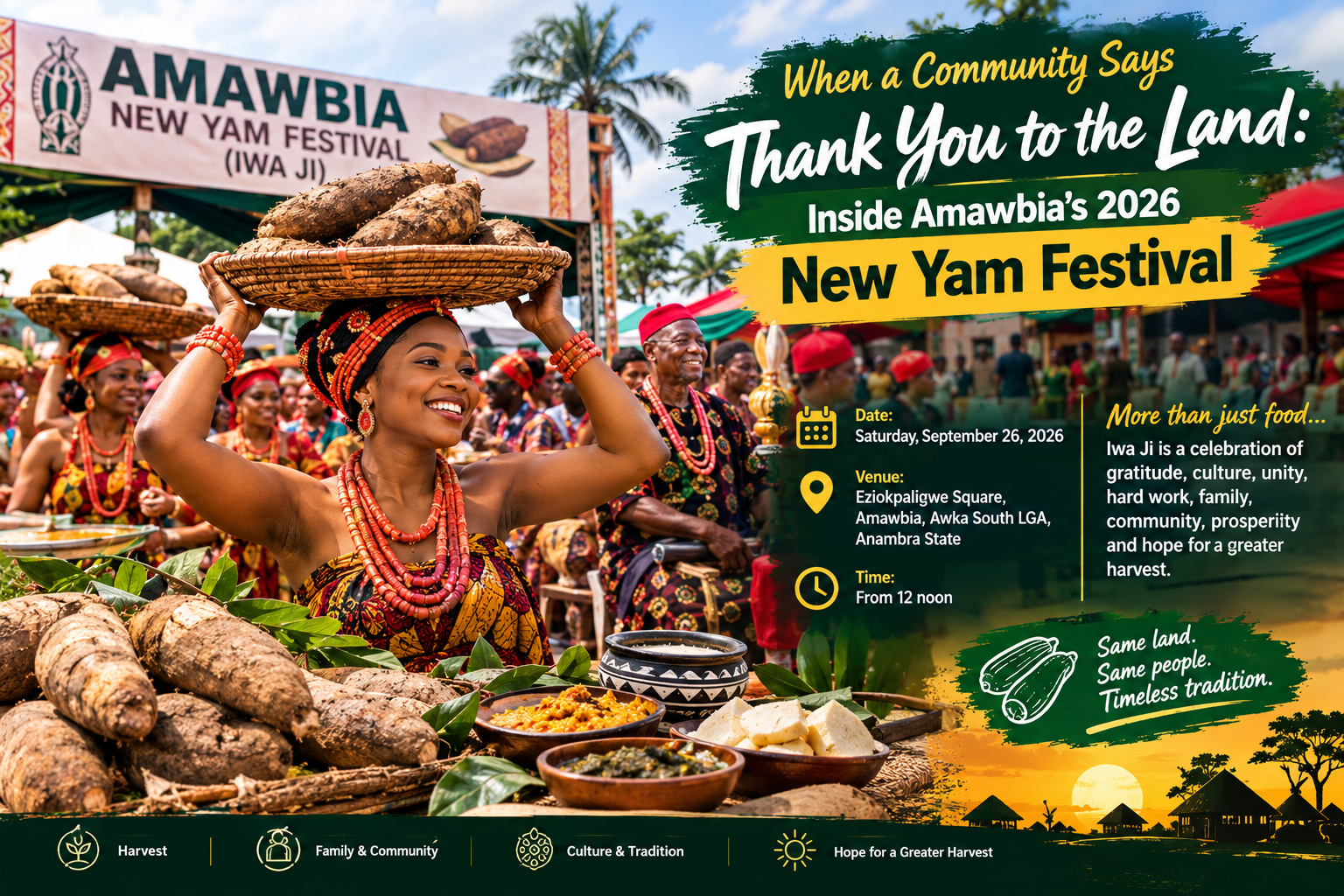
There are celebrations where the food on the table is simply food, and then there are celebrations where food carries a story. For many Igbo communities, yam belongs to the second category, it can represent harvest, it can represent hard work, it can represent family. And during the New Yam Festival, it becomes part of a much larger celebration of community and thanksgiving. On September 26, 2026, the ancient town of Amawbia in Awka South Local Government Area of Anambra State is scheduled to celebrate its New Yam Festival, known as Iwa Ji. But if you think the celebration is simply about eating fresh yam, there is much more to the story. Yam has long held an important place in many Igbo communities. It is associated with farming, harvest and prosperity, that is why the arrival of a new harvest can become an occasion for the entire community to gather. The Anambra State Government describes Amawbia’s New Yam Festival as a celebration of Igbo culture, unity and tradition, it also describes the festival as representing thanksgiving, abundance, hard work, renewal, family, community and hope for a greater harvest. So when people gather for Iwa Ji, they are not merely celebrating a crop, they are celebrating the work that produced it. This year’s celebration is scheduled to take place at Eziokpaligwe Square on Saturday, September 26, beginning at noon. Traditional rulers, community leaders, sons and daughters of Amawbia at home and in the diaspora, friends and well-wishers are expected to be part of the celebration. Because festivals often do something modern life sometimes makes difficult, they bring people home, someone who has spent months in Lagos may return to Amawbia, another person may travel from Abuja, someone else may come from outside Nigeria. For a few hours, people who live completely different lives can find themselves standing in the same community square. And the reason for the gathering is something that their ancestors also understood: harvest is worth giving thanks for. The New Yam Festival is sometimes reduced to one simple image: people eating yam. But the meaning behind the celebration is wider, the official description of the Amawbia event places emphasis on gratitude, prosperity, renewal, family and community, it is also presented as a way of transmitting cultural values from one generation to another. That transmission is perhaps one of the most important parts. A child who attends the festival today may not fully understand its significance, but they see their parents participate, they see their grandparents, they hear the language, they see traditional clothing, they watch community leaders, they eat food associated with the celebration, and slowly, the meaning becomes familiar. A tradition that involves more than one day.
Amawbia’s relationship with farming and traditional agricultural celebrations is also reflected in the community’s Eziokpaligwe Festival. Earlier in 2026, the community held the Eziokpaligwe Festival, during which the traditional ruler blessed the land, people and seedlings and declared the farming season open, Farm inputs were blessed and shared among the six villages of Amawbia, while prizes were announced for leading yam producers, seen alongside the New Yam Festival, this gives a fuller picture of the community’s agricultural calendar.
There is a beginning.
There is work.
There is a harvest.
And then there is thanksgiving. The celebration therefore becomes part of a cycle rather than an isolated party.
Traditional festivals also create a social space. People who may have disagreements in ordinary life can still gather for a common celebration, families meet, friends reconnect, community leaders address their people, children observe traditions, visitors experience local culture, and food becomes part of the way people communicate hospitality. That is one reason festivals remain important even in an increasingly modern society. They provide a sense of belonging that cannot easily be recreated online. Avideo of a festival can show you what happened, but it cannot completely reproduce the experience of standing among hundreds of people from the same community. The question of preserving culture
For communities like Amawbia, the challenge is not simply organising another festival. The bigger question is whether younger generations will continue to understand why the tradition exists.
Modern agriculture is changing.
Cities are expanding.
Young people are moving away.
Technology is changing the way people communicate, Yet the New Yam Festival continues to provide an opportunity to place traditional identity in front of a new generation, that is why the festival matters beyond the food. It tells young people that the culture they inherited has a history, it tells them that the people before them had their own way of marking important moments, and it gives them the opportunity to decide what parts of that heritage they will carry forward.
On September 26, Amawbia gathered together at Eziokpaligwe Square for another celebration of Iwa Ji.
A community pausing to give thanks.
Families came back home.
Elders passing memories to younger people.
And a tradition that reminds everyone that before the modern world became so busy, there were already ways for communities to celebrate life, work and harvest.
That is the deeper story of Iwa Ji.
The yam is eaten.
The celebration ends.
People eventually return to their different lives, bt the message remains:
A harvest is not only something to consume. Sometimes, it is something to remember, appreciate and celebrate together.
Similar Posts
Has Dating Become the Ultimate Unregulated Investment Scam?
In modern romance, a growing trend has left many questioning whether emotional involvement is turning into a calculated financial enterprise. Across online forums and social media platforms, stories circulate about partners who pour significant financial, academic, and emotional support into a relationship, only to be abruptly discarded once the recipient reaches stability or success. Sponsoring…
Over 200 Articles in One Month: Meet One of SHAST News’ Most Consistent Authors
sometimes, you don’t really notice someone at the beginning. They are just there, doing their thing, writing, posting and slowly building momentum. Then one day you look at the numbers and you’re like, “Wait… when did this person do all this?”That is exactly what happened with Aruma Maryann Uchenna here at Shast News.She didn’t start…
7 Things Every 100-Level Student Should Know Before Their First Semester
100 Level Students, Freshers, University Life, Student Tips, Academic Success, First Semester, Study Tips, Undergraduate Students, Education, AE-FUNAI
FBI IN NIGERIA? YAHOO BOYS HAVE BEEN CAPTURED
The question has been spreading across social media: “Is the FBI now in Nigeria?”For many young Nigerians, the question is no longer just a topic for online discussion. Recent arrests, extraditions and investigations involving Nigerian internet-fraud suspects have brought the issue much closer to home. The Federal Bureau of Investigation (FBI) is not a new…
BEFORE THE FACTORIES WENT SILENT: 5 NIGERIAN INDUSTRIAL GIANTS THAT ONCE EMPLOYED THOUSANDS
There was a time when Nigeria wasn’t just a huge market for imported products. The country had factories producing cars, tyres, shoes, paper and textiles with thousands of Nigerians working in them.Here are five companies that tell the story of that era.
The Future of Medical Education in the Light of Evolving Career Dynamics.
The roots of medical education in Nigeria can be dated back to 1930. Before the establishment of the MBBS programme, medical training was offered in Yaba Training College as a diploma course and it was run by the colonial masters- the British Colonial government. The graduates were awarded Licentiate of Medicine and Surgery (LMS) and…