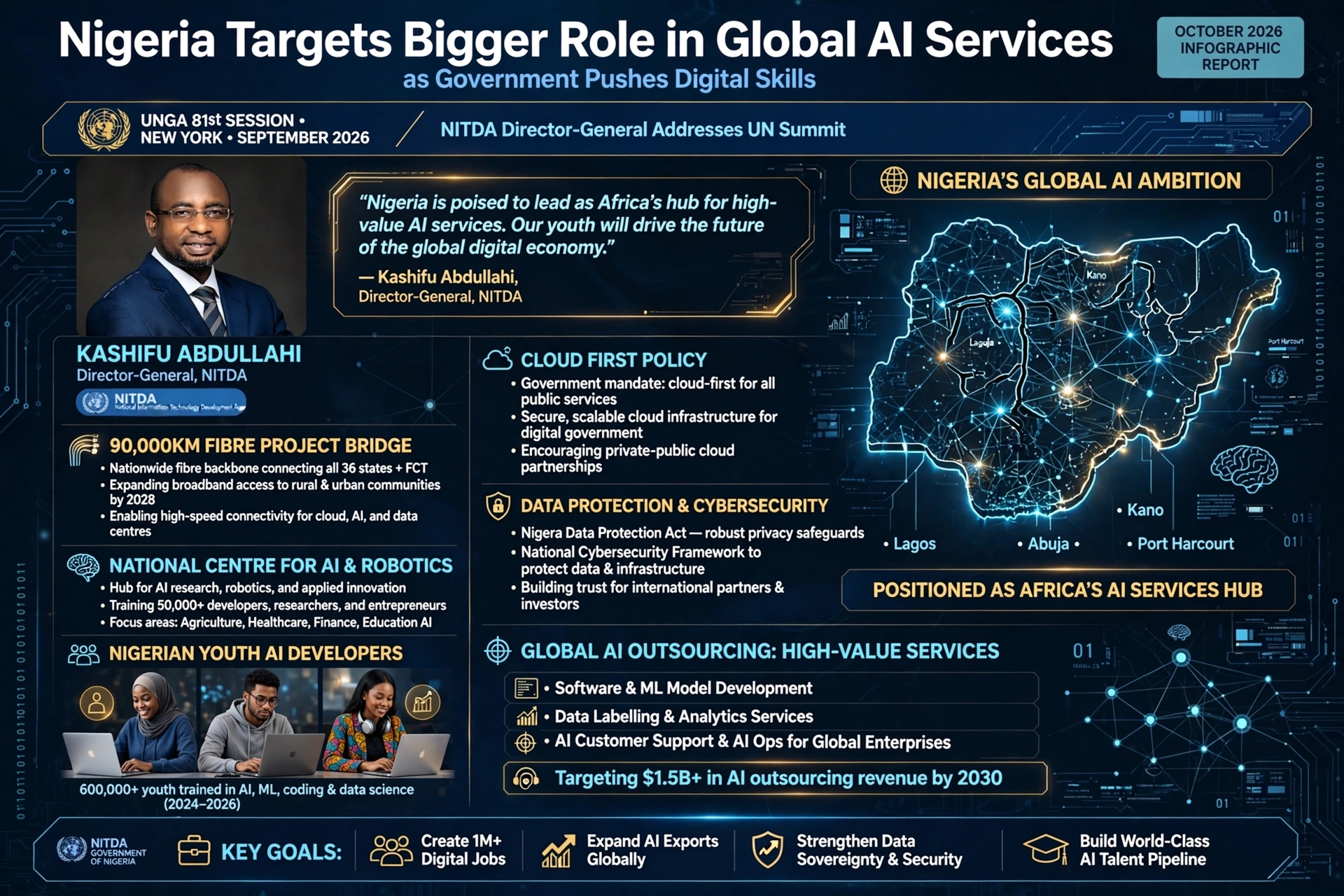
Nigeria is seeking to expand its position in the global digital economy by moving beyond traditional outsourcing and developing the skills and infrastructure required to provide higher-value artificial intelligence services. The plan was highlighted during a “Hire from Nigeria” session organised by the Nigeria Economic and Trade Advancement Programme on the sidelines of the recently concluded 81st United Nations General Assembly. The Director-General of the National Information Technology Development Agency, Kashifu Abdullahi, said Nigeria’s opportunity lies not only in training people to use artificial intelligence but also in developing workers capable of building and deploying AI solutions for international markets. The government’s approach combines digital skills development with investments in infrastructure. One of the major infrastructure projects being highlighted is the planned deployment of 90,000 kilometres of fibre infrastructure under Project BRIDGE. The objective is to improve connectivity and create an environment where technology companies can expand their operations, while also supporting increased investment in computing infrastructure and AI-related facilities. Nigeria is also pursuing a Cloud First Policy and developing frameworks covering data protection, digital identity, cybersecurity, data classification, sovereign cloud and software quality assurance. These areas are increasingly important as businesses and governments rely on digital systems to store, process and exchange sensitive information. AI-enabled services require more than a large workforce. Companies need reliable internet connections, secure cloud infrastructure, computing capacity, cybersecurity protections and clear rules governing data. Nigeria’s ability to provide those conditions could determine whether its large population of young technology workers can be converted into a major source of digital export earnings. The government has also highlighted the need for Nigerian and African realities to be properly represented in AI systems. According to Abdullahi, communities that are poorly represented in the datasets used to train artificial intelligence risk having their languages, economic realities and social contexts under-represented in technologies that increasingly influence decisions. Nigeria has already established initiatives aimed at strengthening domestic AI capabilities, including the National Centre for Artificial Intelligence and Robotics and the National Artificial Intelligence Strategy. The broader objective is to ensure that Nigeria does not remain only a consumer of technologies developed elsewhere. Instead, policymakers want the country to develop talent capable of creating, supervising and integrating emerging technologies. The shift comes as artificial intelligence begins to change traditional outsourcing models. Some routine customer service and back-office functions can increasingly be automated, while demand is growing for people with specialised skills in AI development, data, cybersecurity, software engineering and technology integration. Nigeria’s large workforce provides an opportunity, but infrastructure and skills remain important factors. A stronger fibre network could improve connectivity, while cloud and computing investments could help technology companies establish more advanced operations within the country. The government will also need to address the rapidly changing nature of AI skills, as technologies continue to evolve. For Nigerian workers, the emerging global AI market could create opportunities beyond traditional employment if they acquire specialised skills that are competitive internationally. For the country, the challenge will be turning that potential into sustainable exports, investment and jobs. Nigeria’s latest push therefore represents an attempt to position the country not simply as a source of affordable labour, but as a provider of higher-value technology services in a global economy increasingly shaped by artificial intelligence.
Similar Posts
More Than 80 Reportedly Abducted as Fresh Security Incidents Raise Concern Across Nigeria
Fresh reports of abductions in parts of northern Nigeria, alongside the discovery of suspected human remains in a separate police operation in Abia State, have renewed attention on the country’s security challenges. More than 80 people, including farmers and women, were reportedly abducted in separate incidents in Niger and Zamfara states, according to reports published…
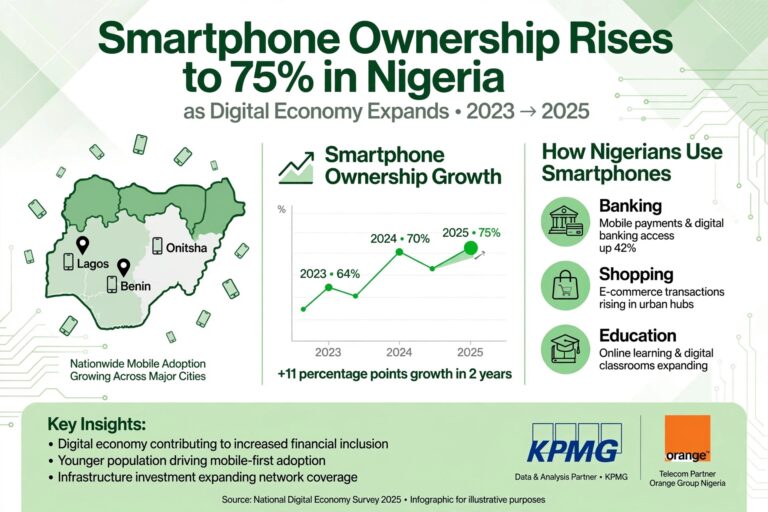
Smartphone Ownership Rises to 75% in Nigeria as Digital Economy Expands
Smartphone ownership in Nigeria has risen significantly, reaching 75 percent in 2025 compared with 64 percent in 2023, according to findings from a nationwide study. The increase represents an 11-percentage-point rise over the two-year period and highlights the growing role of smartphones in Nigerians’ daily lives. The findings were contained in the Nigeria Smartphone Study:…
FG Domestic Borrowing Surges 90% to ₦24.7 Trillion in Eight Months
Nigeria’s Federal Government has dramatically increased its reliance on domestic borrowing, raising ₦24.7 trillion from local investors in the first eight months of 2026 — a staggering 90.5% increase compared with the same period last year. The figure, reported from government public-finance data, represents a sharp jump from the ₦12.98 trillion borrowed between January and…
FG Domestic Borrowing Surges 90% to ₦24.7tn in Eight Months as Businesses Face Credit Pressure
Nigeria’s Federal Government borrowed ₦24.7 trillion from domestic investors in the first eight months of 2026, representing a 90.5 per cent increase compared with the ₦12.98 trillion recorded during the corresponding period of 2025. The sharp increase in domestic borrowing has renewed attention on the government’s financing needs and the availability of credit for businesses…
Tinubu Tells Nigerians: Nigeria Has Moved From Reform to Prosperity
President Bola Ahmed Tinubu has assured Nigerians that the country is entering a new phase of economic development, declaring that Nigeria has moved beyond the difficult period of reforms and is now focused on achieving broader prosperity. Tinubu made the declaration on Thursday, October 1, 2026, during his nationwide Independence Day address to mark Nigeria’s…
The Real Reason Tech Giants Accepted Teen App Caps
A historic legal settlement reached with Meta over the systemic impact of its social media platforms on adolescent mental health has exposed deep divisions between corporate compliance officers and clinical psychologists. The agreement, which resolves an extensive multi-state judicial battle, forces Meta to integrate structural usage restrictions directly into Instagram and Facebook. However, whistleblowers and…