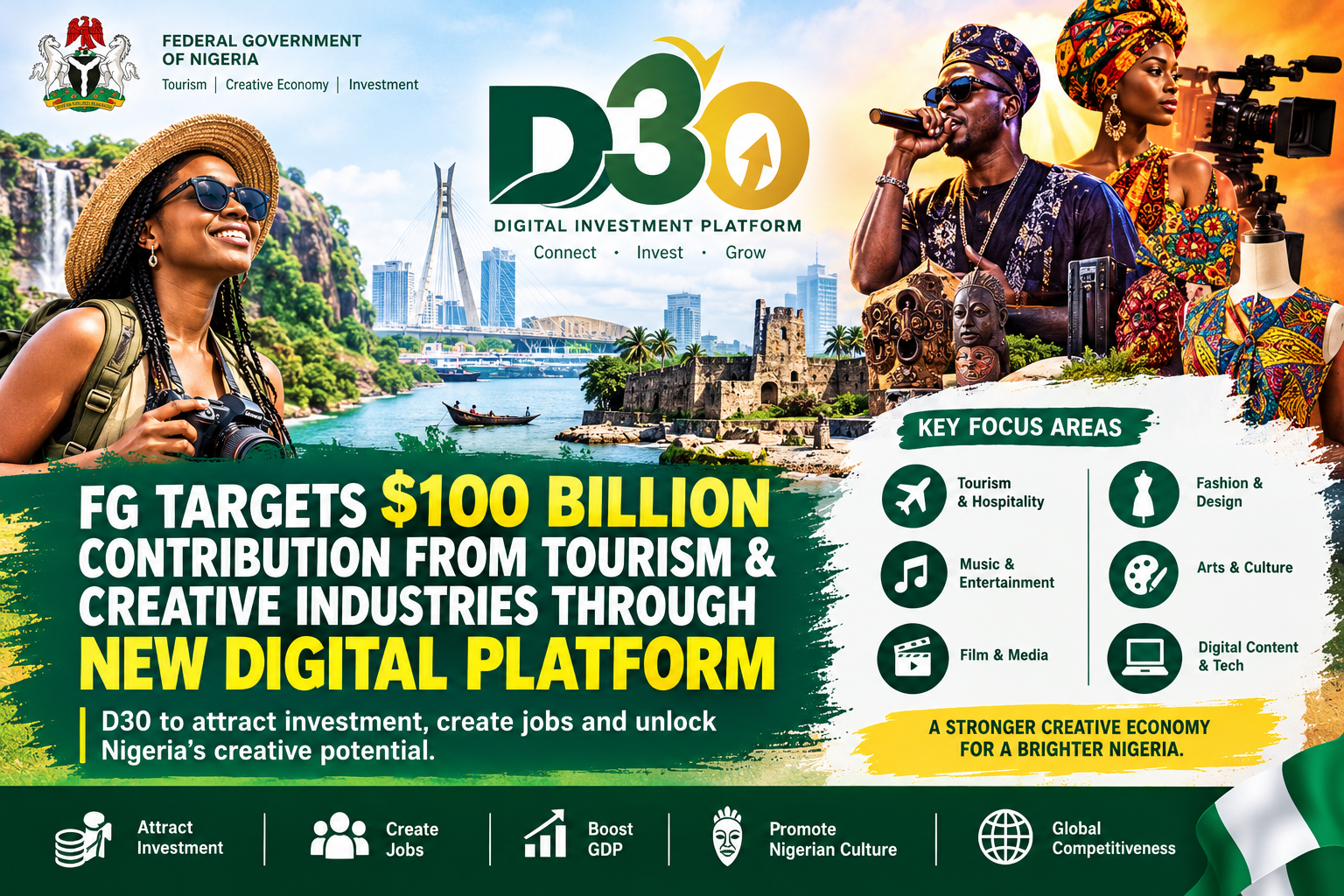
The Federal Government has reportedly introduced a digital investment platform known as D30 as part of efforts to attract investment into Nigeria’s tourism and creative industries. The initiative is said to target a $100 billion contribution to gross domestic product from the sectors, highlighting the government’s ambition to expand economic opportunities beyond traditional industries. Tourism, entertainment, film, music, fashion and other creative activities have the potential to generate employment, attract investment and promote Nigerian culture to international audiences. However, the success of the initiative will depend on the platform’s actual structure, the investment opportunities available and the extent to which businesses can turn the initiative into sustainable economic activity. Nigeria has a large population, diverse cultural traditions and an entertainment industry with an international audience. Its music, film, fashion and digital-content sectors have helped bring Nigerian talent to global markets. Tourism also offers opportunities through cultural festivals, historical sites, hospitality businesses, natural attractions and local experiences. When properly developed, these industries can support employment for people with different skills, including performers, filmmakers, designers, tour operators, hotel workers, event organisers and technology professionals. They can also create opportunities for small businesses supplying food, transport, accommodation and other services. A digital platform can potentially make information about investment opportunities easier to access and help connect businesses with investors. Depending on how it is designed, such a platform may provide project information, investment proposals, industry data and channels through which interested parties can seek further details. It could also help improve visibility for businesses that struggle to reach potential investors through conventional channels. However, the existence of a digital platform does not automatically guarantee investment. Investors typically require credible financial information, transparent governance, evidence of market demand and confidence that projects can operate within the applicable legal framework. The platform’s practical value will therefore depend on the quality of the opportunities it presents and the support available to participating businesses. The reported $100 billion target is ambitious and requires careful interpretation. It is important to establish whether the figure refers to annual GDP contribution, cumulative investment, projected economic output or another measure. These measures are not interchangeable. A credible assessment would require a clearly defined timeframe, a baseline against which progress can be measured and transparent reporting of the sectors included in the calculation. Tourism and creative industries also face structural challenges that may limit their growth if left unresolved. These include infrastructure gaps, unreliable electricity, access to financing, limited training opportunities and difficulties in protecting intellectual property. Addressing such barriers will be important if the government hopes to expand the sectors’ contribution to the economy. The development could attract interest from young Nigerians seeking opportunities in creative and tourism-related businesses. Entrepreneurs may explore areas such as digital marketing, film production, event management, hospitality, fashion, cultural tourism and online content creation. However, participation in any government-backed platform should be based on verified information about its eligibility requirements, application procedures and any associated costs. Applicants should also confirm whether the platform provides investment funding, merely advertises investment opportunities or serves another purpose. Those distinctions are important because a platform that connects businesses with investors does not necessarily provide grants or guaranteed financing. To build investor confidence, the government will need to provide clear information about the programme’s objectives, participating agencies, eligibility criteria and performance indicators. It will also need to address the wider business environment affecting tourism and creative enterprises. This includes infrastructure, skills development, access to finance, intellectual-property protection and predictable regulation. Regular progress reports would help the public determine whether the initiative is attracting actual investment and creating jobs. Nigeria’s tourism and creative industries have significant potential, but realising that potential requires sustained investment and effective implementation. A digital platform may help bring opportunities to investors’ attention, yet the lasting results will depend on whether businesses receive the resources and support needed to grow. The real measure of the initiative will not be the size of its financial target, but whether it creates jobs, attracts verifiable investment and enables Nigerian creative businesses to compete more effectively at home and abroad.
Similar Posts
AYRA STARR TAKES AFROBEATS TO THE NFL STAGE IN LONDON, PUTTING NIGERIAN MUSIC IN THE GLOBAL SPOTLIGHT
XANDERXO ENTERTAINMENT Nigerian music continues to reach new international audiences, and Ayra Starr has added another major platform to her growing list of global appearances. The award-winning singer headlined the halftime entertainment at the National Football League’s London game between the Philadelphia Eagles and the Jacksonville Jaguars on October 11, 2026. The performance took place…
FUNKE AKINDELE PARTNERS WITH FACEBOOK TO PROMOTE UPCOMING FILM, ‘THE FOUR: NO ONE FIGHTS ALONE’
XANDERXO ENTERTAINMENT Nollywood filmmaker and actress Funke Akindele has announced a partnership with Facebook to promote her forthcoming film, The Four: No One Fights Alone, as she expands efforts to connect the production with audiences beyond Nigeria. Akindele disclosed the collaboration through her social media platforms, describing it as an opportunity to take the film…
AYO EDEBIRI, DAVID OYELOWO AND SOPHIE OKONEDO LEAD STAR-STUDDED CAST OF ‘CLARISSA,’ A BOLD REIMAGINING OF VIRGINIA WOOLF’S CLASSIC
Nigerian twin filmmakers Arie and Chuko Esiri are bringing a distinctly Nigerian interpretation of Virginia Woolf’s celebrated classic Mrs. Dalloway to the screen with “Clarissa,” an ambitious Lagos-set drama featuring an impressive international cast led by Sophie Okonedo, Ayo Edebiri and David Oyelowo. The newly released trailer offers a glimpse into the visually rich film,…
Jorja Smith Reveals Wizkid Originally Had ‘Alive’ Before She Took Over the Song
British singer Jorja Smith has revealed that her song “Alive,” featuring Nigerian Afrobeats superstar Wizkid, was originally recorded as a Wizkid song before she eventually made it her own. Smith made the revelation while discussing the making of her latest album, What Are The Odds, shedding light on the unexpected journey behind one of the…
PELLER & JARVIS RELOCATE TO CANADA AS JARVIS REVEALS MASTER’S PLANS
Nigerian content creator and streamer Peller and his wife, Jarvis, have begun a new chapter in Canada, with education emerging as a key reason behind their move. Peller recently announced their departure from Nigeria in a social-media post, telling his followers: “WE DON RELOCATE FROM NIGERIA BYE BYE WE’RE GOING TO SCHOOL IN CANADA! CANADA,…
ROMANDA HOMBIR CROWNED MISS WORLD AFRICA 2026 AFTER TOP 6 FINISH IN VIETNAM
South Africa’s Romanda Hombir turns a standout Miss World campaign into a continental triumph, combining pageant excellence with a strong record of community health advocacy. South Africa is celebrating a major moment on the global pageant stage as Romanda Hombir has been crowned Miss World Africa 2026 after reaching the Top 6 at the Miss…