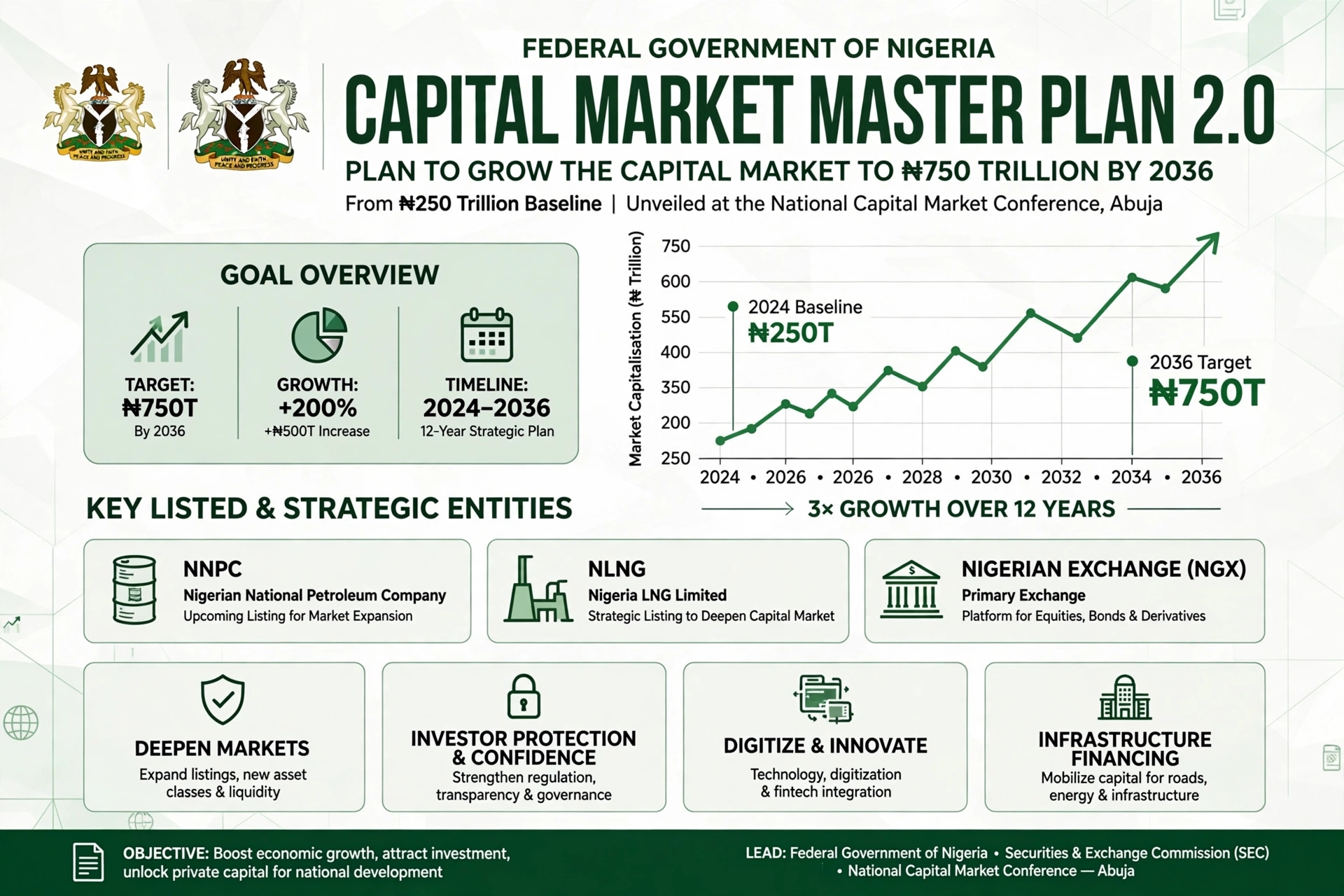
The Federal Government has unveiled a ten-year strategy aimed at expanding Nigeria’s capital market to ₦750 trillion by 2036, with the proposed listing of selected state-owned enterprises among the measures expected to deepen investment opportunities. The Federal Government has announced an ambitious plan to grow Nigeria’s capital market to ₦750 trillion by 2036, setting out a long-term target for mobilising investment and supporting economic development. The plan was announced by Vice-President Kashim Shettima during the unveiling of the Nigerian Capital Market Master Plan 2.0 at the National Capital Market Conference in Abuja. According to reports published on October 20, the strategy aims to increase the market from a baseline of approximately ₦250 trillion to ₦750 trillion over the next decade. The proposal places the capital market at the centre of the government’s broader economic development ambitions, capital market enables governments, businesses and other eligible organisations to raise long-term funds from investors, companies may obtain financing by issuing shares or debt instruments, while investors can purchase these instruments in pursuit of income and potential capital appreciation. A deeper and more active market can provide businesses with alternatives to conventional bank loans and create additional opportunities for investors. The government’s plan seeks to expand the scale of Nigeria’s market and strengthen its capacity to support infrastructure development and productive economic activity. However, achieving the target will depend on investor confidence, economic stability, effective regulation and the availability of attractive investment opportunities. One of the proposals associated with the plan is the listing of selected state-owned enterprises, including the Nigerian National Petroleum Company Limited and Nigeria LNG Limited, on the Nigerian Exchange, a listing can allow eligible investors to acquire shares in a company, subject to the structure and terms of the offer. If implemented, the proposed listings could broaden the range of companies represented on the exchange and attract additional investment. However, the proposal should not be confused with a completed transaction. The timing, structure, regulatory requirements and other details would need to be established through formal announcements. Any eventual offer would also need to clarify the rights of investors and the arrangements governing ownership and corporate accountability. A larger capital market could improve access to long-term funding for companies seeking to expand their operations, it could also provide investors with a broader range of financial instruments, although investment returns would not be guaranteed. For businesses, equity financing may reduce dependence on borrowing and provide capital for expansion, for the government, a stronger market could create additional channels for mobilising domestic savings and attracting foreign investment. Nevertheless, market growth alone does not guarantee that investment will translate into broad-based economic benefits. The quality of the investments, the strength of corporate governance and the productive use of funds will remain important considerations, investors need reliable information, transparent transactions and confidence that market rules will be enforced. The Securities and Exchange Commission and other relevant institutions therefore have important roles in protecting investors and supporting the credibility of the market. Public participation in investment opportunities also depends on financial literacy and access to accurate information, potential investors should understand the risks associated with shares and other financial instruments rather than assuming that government-backed or high-profile offers guarantee profits. The proposed ₦750 trillion target represents a significant ambition for Nigeria’s financial sector. Achieving it will require sustained economic growth, greater participation by businesses and investors, effective regulation and the development of a stronger investment culture. The government’s strategy also raises questions about how quickly the proposed reforms will be implemented and which measures will deliver the greatest impact. For now, the master plan sets out the direction of policy rather than guaranteeing a particular market outcome, Its success will ultimately depend on implementation and whether a larger capital market can provide sustainable financing for businesses, infrastructure and long-term economic development.
Similar Posts
🇳🇬 FG Announces 100MB Free Daily Data for Nigerian Students From October 1
Nigerian students in public senior secondary and tertiary institutions are set to receive 100MB of free daily data from October 1, 2026, for accessing approved educational platforms and digital learning content.
UBEC Raises Alarm as 10 Million Nigerian Children Miss Early Childhood Education
The Universal Basic Education Commission has raised concerns over the number of Nigerian children who are currently outside the country’s early childhood education system. UBEC estimates that approximately 10 million children are not captured in early childhood care, development and education programmes across the country. The commission disclosed the figure during a capacity-building programme for…
FG Domestic Borrowing Surges 90% to ₦24.7 Trillion in Eight Months
Nigeria’s Federal Government has dramatically increased its reliance on domestic borrowing, raising ₦24.7 trillion from local investors in the first eight months of 2026 — a staggering 90.5% increase compared with the same period last year. The figure, reported from government public-finance data, represents a sharp jump from the ₦12.98 trillion borrowed between January and…
Tinubu Booed at Abuja Mosque as Security Restrictions Spark Public Reactions.
President Bola Ahmed Tinubu faced protest chants from some worshippers during Friday prayers in Abuja. While eyewitnesses linked the incident to security restrictions at the mosque, the Presidency disputed claims that his convoy was attacked.
Nigeria Targets Bigger Role in Global AI Services as Government Pushes Digital Skills
Nigeria is seeking to expand its position in the global digital economy by moving beyond traditional outsourcing and developing the skills and infrastructure required to provide higher-value artificial intelligence services. The plan was highlighted during a “Hire from Nigeria” session organised by the Nigeria Economic and Trade Advancement Programme on the sidelines of the recently…
FIVE SUSPECTS ARRAIGNED OVER ALLEGED KIDNAPPING OF 20 PROSPECTIVE CORPS MEMBERS IN IMO
Five men have been arraigned before the Imo State High Court over separate alleged kidnapping incidents, including the abduction of 20 prospective members of the National Youth Service Corps. The cases have renewed concerns about the safety of young Nigerians travelling to orientation camps and other destinations for national service. According to reports published on…