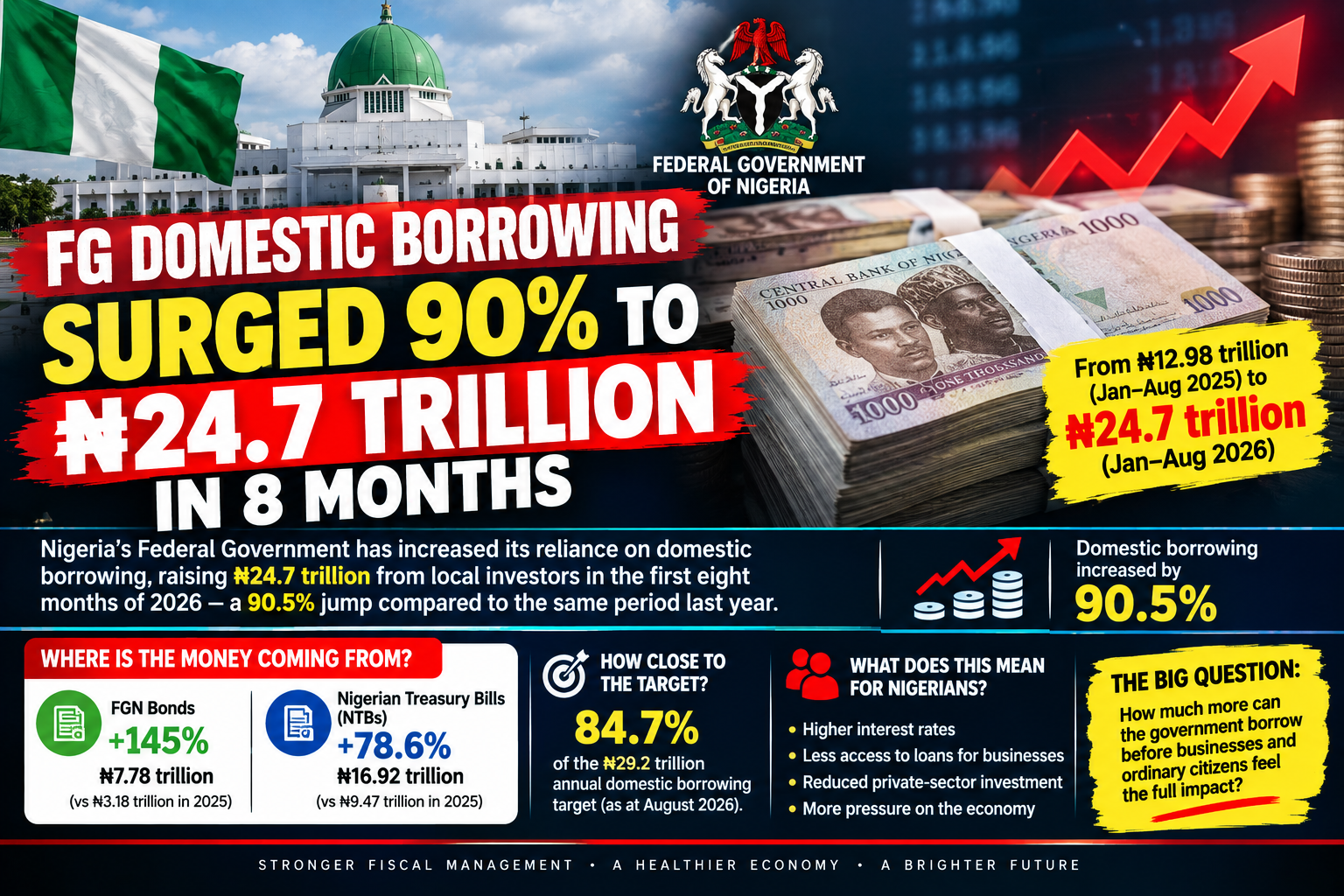
Nigeria’s Federal Government has dramatically increased its reliance on domestic borrowing, raising ₦24.7 trillion from local investors in the first eight months of 2026 — a staggering 90.5% increase compared with the same period last year. The figure, reported from government public-finance data, represents a sharp jump from the ₦12.98 trillion borrowed between January and August 2025. The development is already raising concerns over the availability and cost of credit for businesses and households. Data cited from the Debt Management Office (DMO) and the Central Bank of Nigeria (CBN) show that credit to the government has been growing much faster than credit to the private sector. By July 2026, credit to government had risen 43% year-on-year to ₦33.92 trillion, while private-sector credit increased by only 9.6% to ₦83.43 trillion. That disparity has fuelled concerns about a possible crowding-out effect, where government borrowing absorbs funds that could otherwise be available to businesses seeking loans for expansion, investment and job creation. Asignificant portion of the borrowing surge has come through government debt instruments. According to the reported data, borrowing through FGN bonds increased by 145% year-on-year to ₦7.78 trillion, compared with ₦3.18 trillion during the corresponding period of 2025. Borrowing through Nigerian Treasury Bills (NTBs) also rose sharply, increasing by 78.6% to ₦16.92 trillion, from ₦9.47 trillion a year earlier. FGGN Savings Bonds contributed another ₦40.56 billion during the eight-month period. The numbers are particularly significant when compared with the government’s annual target. The ₦24.7 trillion raised in the first eight months represents approximately 84.7% of the ₦29.2 trillion domestic borrowing target for the year. With four months still remaining, maintaining the same pace of borrowing could push the government beyond its planned domestic borrowing limit. For ordinary Nigerians, the concern goes beyond government debt figures. Heavy domestic borrowing can put pressure on interest rates and make it more expensive for businesses and individuals to obtain loans. Small businesses that need bank financing to expand, purchase equipment or employ more workers could find themselves competing with the government for available funds. Economists and analysts have therefore raised concerns that continued heavy domestic borrowing could weaken private-sector investment and make economic expansion more difficult. The latest figures come despite increased government revenues reported by several major agencies, including the tax and customs authorities and the Nigerian National Petroleum Company. This has intensified debate over why the Federal Government continues to rely so heavily on borrowing to finance its spending needs. The government faces significant expenditure commitments and debt-service obligations, making fiscal management increasingly important. For now, the ₦24.7 trillion figure is another major warning sign for Nigeria’s finances
Similar Posts
Police Issue Nationwide Security Alert Over Planned Attacks on Schools, Churches and NYSC Camps
The Nigeria Police Force has placed its formations across the country on heightened alert following intelligence indicating possible coordinated terrorist attacks on schools, places of worship, NYSC orientation camps and other vulnerable locations. The security warning comes as schools prepare for the commencement of the 2026/2027 academic session, raising fresh concerns about the safety of…
Nigeria Launches New Digital Postcode System for Buildings Nationwide
Nigeria is set to introduce a new National Digital Alphanumeric Postcode System, giving addressable buildings across the country unique digital codes. The system officially launches on October 1, 2026, as part of efforts to modernise Nigeria’s addressing infrastructure and make it easier to identify and locate buildings. According to the official National Digital Postcode platform…
VDM QUESTIONS SENATOR NATASHA OVER PURPORTED LEAKED VOICE NOTE: “IS THIS YOUR VOICE?”
Social media activist Martins Vincent Otse, popularly known as VeryDarkMan (VDM), has reacted to a purported leaked voice recording allegedly involving Senator Natasha Akpoti-Uduaghan, reigniting discussions surrounding the long-running controversy involving the senator, Senate President Godswill Akpabio and US-based activist Sandra Duru.In a video shared on social media, VDM addressed the recording after Duru released…
Police Seek Personnel With Advanced Degrees as IGP Orders Urgent Submission of Names
The Inspector-General of Police, Kayode Egbetokun, has directed police commands and formations across Nigeria to compile and submit details of serving personnel who possess advanced academic qualifications. The directive specifically covers inspectors and rank-and-file officers holding PhD, master’s degrees or Bachelor of Laws (LLB) certificates. The order was contained in a police wireless message dated…
Why the US Just Abruptly Suspended Global Visa Appointments
The United States State Department has implemented a sudden, global suspension of visa appointments at its embassies and consulates worldwide. This unannounced freeze represents a significant escalation in international immigration enforcement during President Donald Trump’s second administration. Rather than targeting standard border entry points, this mechanism alters the processing infrastructure at the origin of travel,…
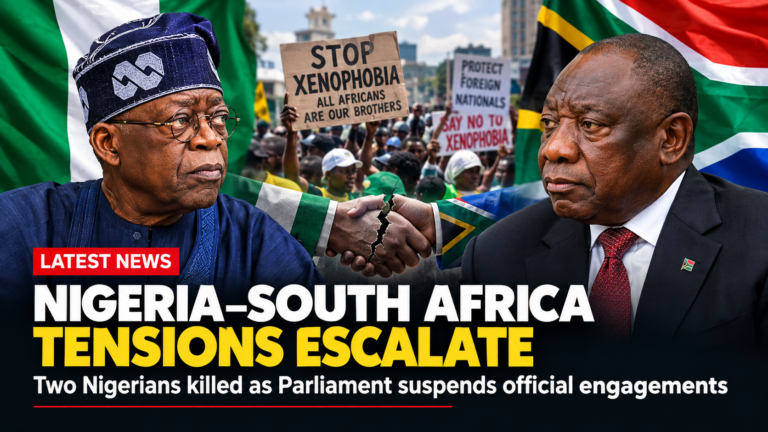
Nigeria-South Africa Tensions Escalate as Two Nigerians Are Killed Amid Anti-Migrant Violence
Tensions between Nigeria and South Africa have intensified following the reported deaths of two Nigerian nationals in South Africa, as concerns over the safety of Nigerians living and doing business in the country continue to grow. Nigeria’s Ministry of Foreign Affairs confirmed that two Nigerian citizens, James Uchechukwu Nwankwo and Bishop Taiwo Michael Fakunle, were…