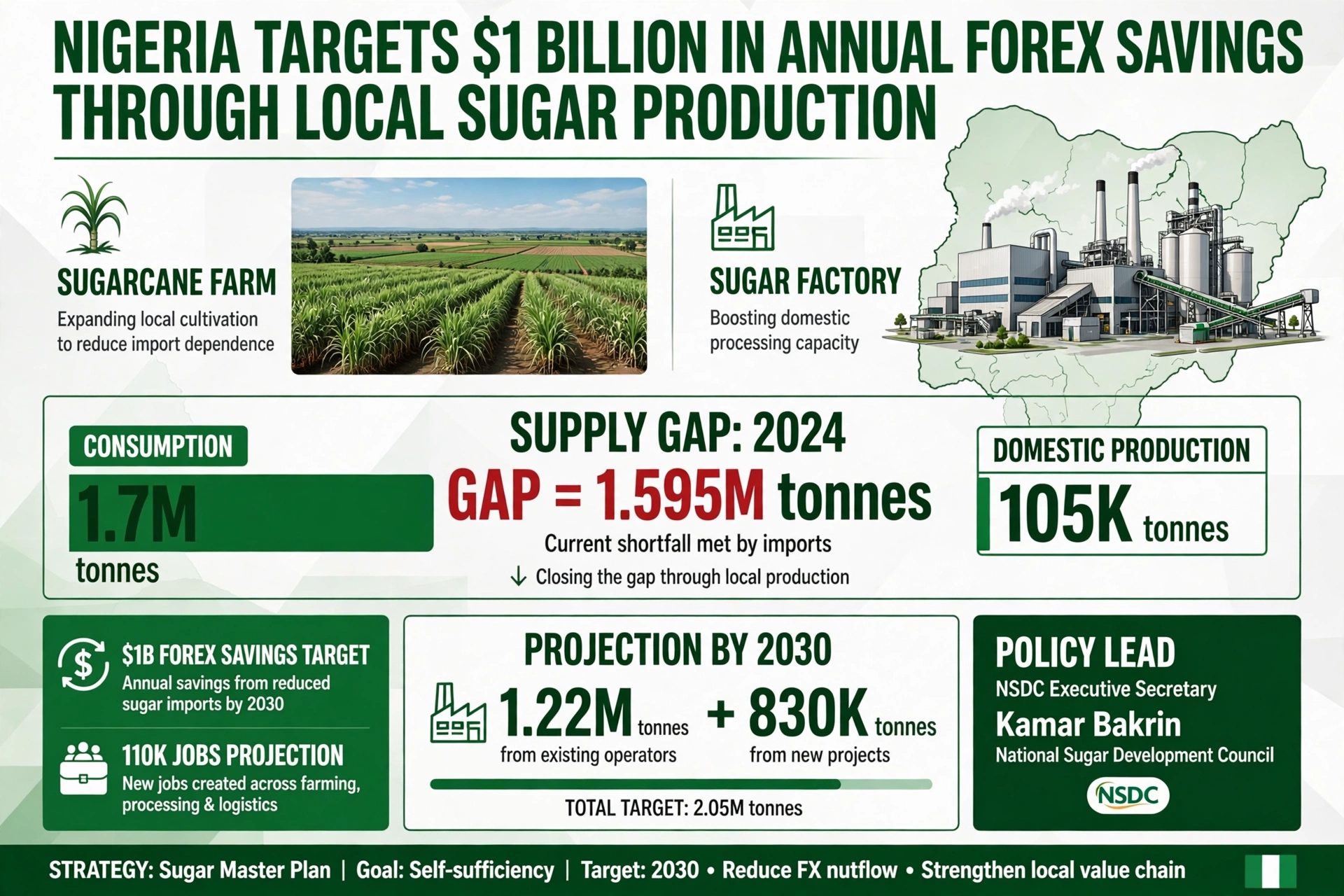
Nigeria could save approximately $1 billion in foreign exchange annually and create 110,000 direct jobs if the country achieves self-sufficiency in sugar production, according to projections attributed to the National Sugar Development Council. The council’s Executive Secretary and Chief Executive, Kamar Bakrin, outlined the potential benefits as the government seeks to reduce dependence on imported sugar and expand domestic manufacturing. The initiative forms part of wider efforts to strengthen local production, encourage industrial investment and reduce the pressure that imports place on foreign-exchange resources. However, the projected savings and employment opportunities depend on the successful expansion of sugarcane cultivation, processing capacity and the wider domestic supply chain. Nigeria remains a major sugar-consuming market but continues to rely heavily on imported supplies, figures cited in the report put annual consumption at approximately 1.7 million metric tonnes, while domestic output was estimated at about 105,000 tonnes during the 2025/2026 marketing year, the gap between local production and consumption highlights the scale of the challenge facing the industry, dependence on imported sugar exposes manufacturers and other users to international market conditions and foreign-exchange pressures. Beverage producers, food manufacturers and other businesses that use sugar as an industrial input can be affected by changes in the price and availability of the commodity, expanding domestic production could help reduce this exposure while creating additional economic opportunities. Sugar production involves more than processing the finished product, a functioning domestic industry requires farmers, agricultural workers, equipment operators, transport services, processing facilities and distribution networks, if production expands, these activities could create employment opportunities in rural communities and stimulate local economic activity. The National Sugar Development Council’s projections include the potential for 110,000 direct jobs if the country achieves its production objectives, the figure represents a projected outcome rather than a report of jobs already created, the number of jobs ultimately generated will depend on investment, agricultural output, the number of operational estates and the capacity of processing plants. Nigeria’s sugar-development strategy is intended to encourage investment in sugarcane cultivation and processing. The reported plans involve improving existing operations, expanding production by established companies and attracting investors to new projects. According to the figures cited in the report, existing operators have committed to reaching annual production of approximately 1.22 million tonnes by 2030, while new projects could contribute another 830,000 tonnes of annual capacity, if completed and fully operational, these projects could significantly increase domestic output. Nevertheless, projected capacity should not be confused with actual production. Investors must still overcome financing, infrastructure, agricultural and operational challenges. Nigeria’s sugar industry faces several constraints, including high production costs, inadequate infrastructure, limited investment and difficulties maintaining consistent agricultural and industrial operations. Sugarcane cultivation requires suitable land, dependable water supplies, effective farming practices and access to processing facilities, even where projects are announced, implementation may take years, the success of the national strategy will therefore depend on whether investment commitments translate into completed facilities, higher output and a dependable supply of locally produced sugar. Reducing sugar imports could help conserve foreign exchange and strengthen domestic manufacturing, it could also support farmers and businesses connected to agricultural production and processing. However, achieving these benefits will require consistent implementation, adequate funding and improvements across the production chain, for now, the projected $1 billion in annual foreign-exchange savings and 110,000 direct jobs represent the potential benefits of achieving self-sufficiency, not outcomes that have already been realised.
Similar Posts
Olu Jacobs: Remembering a Legend Who Gave Over Five Decades to Acting
The Nigerian entertainment industry has lost one of its most respected veterans. Veteran actor Oludotun Baiyewu Jacobs, popularly known as Olu Jacobs, died on Wednesday, September 16, 2026, at the age of 84. His death was announced by his family through his son, Olusoji Jacobs, who described him as “The Lion of Lufodo.” The family…
NIGERIA’S OIL OUTPUT RISES BY MORE THAN 80%
MINISTER SAYS Nigeria’s crude oil production has increased by more than 80 per cent since 2023, according to Minister of State for Petroleum Resources (Oil), Heineken Lokpobiri. Lokpobiri made the statement in Yenagoa, Bayelsa State, while discussing developments in the country’s oil and gas industry. According to the minister, Nigeria was producing less than one…
AFRICA CDC CALLS EMERGENCY MEETING AS EBOLA OUTBREAK SPREADS ACROSS COUNTRIES
The Africa Centres for Disease Control and Prevention has called an extraordinary virtual meeting of African health ministers for 28 October following the spread of Ebola and Nigeria’s confirmation of an infection in Abuja, the meeting is intended to strengthen regional coordination as public health authorities respond to an outbreak that has affected multiple countries.Nigeria’s…
Nigeria Raises ₦748.6bn Through FGN Bonds as Investor Demand Remains Strong
The Federal Government has raised ₦748.64 billion through its latest Federal Government of Nigeria (FGN) bond auction, with investors placing significantly more bids than the government offered. The September 2026 auction featured two long-term securities: a new 10-year FGN bond and a reopening of a 15-year FGN bond. According to the Debt Management Office (DMO),…
ALLEGED PLOT AGAINST ATIKU: APC CAMPAIGN COUNCIL DEMANDS EVIDENCE
The All Progressives Congress Presidential Campaign Council has rejected allegations that the Federal Government is plotting to assassinate former Vice-President Atiku Abubakar and has called for the claims to be substantiated.The controversy emerged after Timi Frank, a former deputy national publicity secretary of the APC, reportedly raised concerns about alleged threats to Atiku’s safety and…
NIGERIA’S STATE POLICE PROPOSAL: WHAT THE NEW DEVELOPMENTS MEAN FOR CITIZENS
The proposed establishment of state police has returned to the centre of Nigeria’s national debate after additional state assemblies backed the constitutional changes required for the reform. The development comes as citizens continue to demand more effective responses to kidnapping, banditry, terrorism and other security threats, while supporters say state police could improve local intelligence…