By XanderXO Entertainment | October 13, 2026
The global economy is projected to grow slightly faster than previously anticipated in 2026, as surging investment in artificial intelligence helps sustain economic activity despite mounting geopolitical tensions, elevated energy prices and growing concerns over public debt.
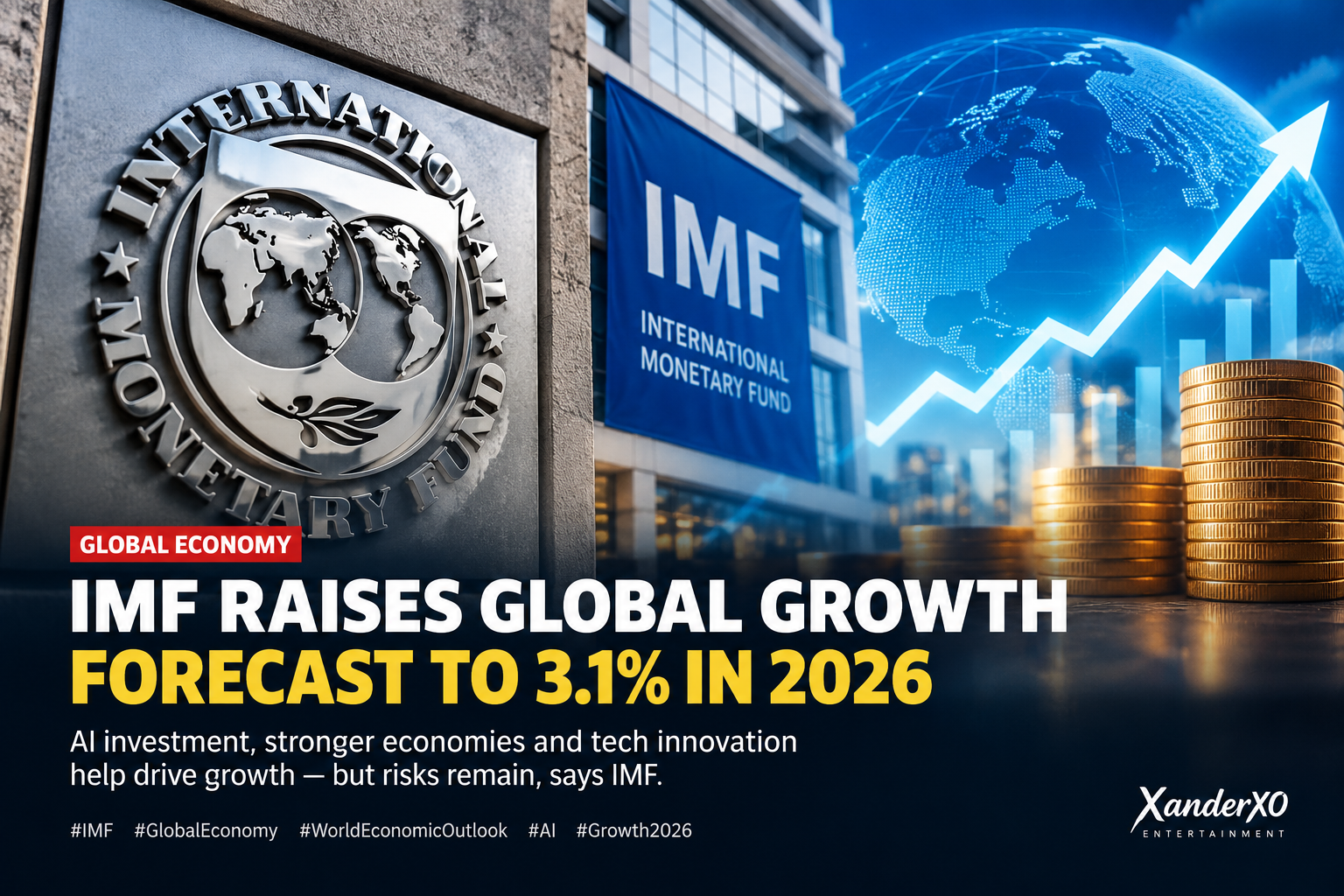
In its latest World Economic Outlook, released on Tuesday, October 13, the International Monetary Fund (IMF) raised its global economic growth forecast for 2026 to 3.1%, up from the 3.0% projected in July. However, the revised outlook remains below the estimated 3.5% growth recorded in 2025, highlighting the challenges confronting the world economy.
The report presents a global economic picture defined by two competing forces: the opportunities created by technological innovation and the persistent risks associated with geopolitical instability.
AI INVESTMENT EMERGES AS A MAJOR GROWTH DRIVER
Artificial intelligence has become an increasingly important contributor to economic activity, with substantial investment in computing infrastructure, advanced chips and digital platforms supporting growth across several economies.
According to Reuters’ report on the IMF outlook, countries involved in supplying AI hardware, including South Korea, Malaysia, Mexico and Thailand, are among those benefiting from the expansion of the technology sector.
The IMF projects global economic growth of 3.4% in 2027, maintaining its July forecast for that year.
Nevertheless, the growing influence of AI on economic performance raises questions about how widely its benefits will be shared. Economies with the infrastructure, capital and industrial capacity to participate in the AI supply chain may be better positioned to benefit than countries with limited technological investment.
For developing economies, the challenge extends beyond adopting new technology. It also involves building the infrastructure, workforce skills and productive industries necessary to translate technological advances into sustainable economic opportunities.
MIDDLE EAST CONFLICT THREATENS ECONOMIC STABILITY
Despite the improved growth projection, geopolitical tensions remain a significant source of uncertainty.
The ongoing conflict in the Middle East has contributed to elevated oil prices, increasing pressure on energy-importing economies, businesses and households.
Higher energy costs can raise transportation and production expenses, contribute to inflation and reduce consumers’ purchasing power. Governments may also face additional pressure to support vulnerable households while managing public spending and debt obligations.
The IMF has warned that a prolonged or intensified conflict could further increase inflationary pressures and weaken global economic growth.
Its latest projections also point to significant economic difficulties for several Gulf economies affected by the conflict, illustrating how regional instability can have consequences far beyond the immediate battlefield.
GROWTH REMAINS UNEVEN ACROSS THE WORLD
The IMF’s outlook highlights an increasingly uneven global recovery.
While some economies benefit from AI investment and resilient domestic demand, others face weaker growth prospects because of high energy costs, limited technological participation and financial vulnerabilities.
India remains a notable growth performer, with the IMF projecting economic expansion of 7.0% in 2026. The United States is projected to grow by 2.3%, while China’s growth forecast stands at 4.5%.
These differences underscore the fact that a positive global growth forecast does not necessarily mean that households, businesses and governments in every country will experience improving economic conditions.
The IMF also identifies rising government borrowing costs, extreme weather risks and the possibility of disappointing returns on AI investment as threats to the outlook.
If expectations surrounding AI prove overly optimistic, a sharp reassessment of investment and asset valuations could undermine some of the growth currently supporting the global economy.
WHAT THE OUTLOOK MEANS FOR AFRICA
For African economies, the global outlook presents both opportunities and challenges.
Growing demand for digital services, data infrastructure and AI-related technologies could create new avenues for investment, entrepreneurship and employment.
However, countries that depend heavily on imported energy may remain vulnerable to oil-price shocks, while limited access to reliable electricity, financing and digital infrastructure could restrict their ability to benefit from the AI-driven expansion.
African governments and businesses therefore face an important challenge: ensuring that technological progress translates into productive investment, employment opportunities and stronger local industries rather than leaving the continent further behind in an increasingly digital global economy.
The implications will vary considerably across countries, depending on their economic structures, energy policies, infrastructure and capacity to attract investment.
A RESILIENT ECONOMY FACING GROWING RISKS
The IMF’s revised forecast offers a measure of optimism, but it is not a declaration that the global economy is out of danger.
Artificial intelligence is helping sustain growth, yet geopolitical conflict, energy-market volatility, public debt and uneven technological development continue to threaten economic stability.
The central question is whether the current wave of technological investment can support lasting productivity gains while governments address the vulnerabilities that could undermine the recovery.
For now, the global economy is demonstrating resilience. Whether that resilience can be sustained will depend on decisions made by governments, businesses and financial institutions in the months ahead.
Source: International Monetary Fund’s World Economic Outlook, as reported by Reuters on October 13, 2026.
#XanderXO #GlobalEconomy #IMF #ArtificialIntelligence #WorldEconomicOutlook #GlobalMarkets #EconomicGrowth #Technology #Africa #InternationalNews