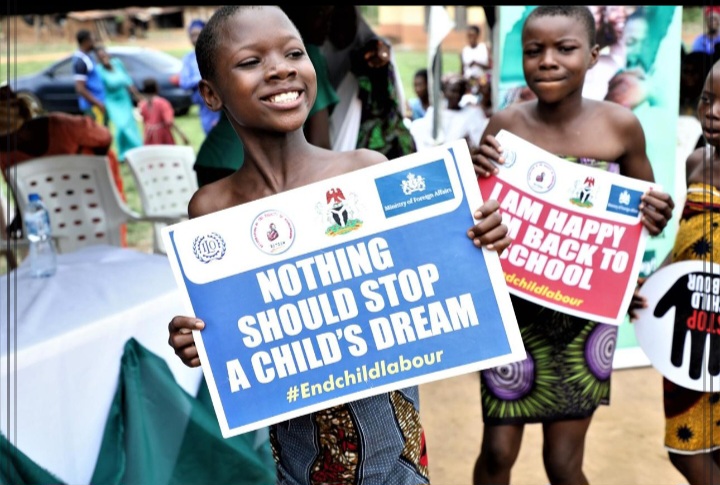
President Bola Tinubu has launched a new four-year National Action Plan aimed at eliminating child labour in Nigeria, declaring the issue a national development priority. The plan, covering 2026 to 2030, was unveiled on Wednesday in Abuja during the National Dialogue on Advancing the Implementation of Nigeria’s National Child Labour Policy and National Action Plan. The President, who was represented at the event by the Secretary to the Government of the Federation, George Akume, also launched the 2024 National Child Labour Survey Report. According to Tinubu, child labour goes beyond a labour issue because it affects education, poverty reduction, economic growth, food security, human capital development and national security. The Federal Government plans to strengthen labour inspection and child-protection systems while addressing factors that can push children into work, including poverty, unemployment, limited access to quality education and social exclusion. Education has been identified as one of the major tools for tackling the problem. The administration said it is pursuing measures targeting out-of-school children, teacher development, education data and skills acquisition. The government also pointed to the Renewed Hope National Home-Grown School Feeding Programme as part of efforts to encourage school attendance while supporting vulnerable children. The plan also places attention on household economic security. Tinubu said programmes including NG-CARES and the Human Capital Opportunities for Prosperity and Equity (HOPE) Programme are intended to expand economic opportunities for parents and caregivers, reducing the pressure that can force children to work to support their families. The President also called on employers to ensure their supply chains are free from child labour and urged state governments, communities, parents, religious and traditional leaders, workers’ organisations and civil society groups to support implementation of the plan. The scale of the issue remains significant. The 2022 National Child Labour Survey by Nigeria’s National Bureau of Statistics and the International Labour Organization estimated that 24.67 million Nigerian children were engaged in child labour, including about 14.39 million involved in hazardous work. The new 2026–2030 action plan is therefore expected to serve as a framework for coordinating government and other stakeholders’ efforts to reduce child labour and protect children from exploitation. Tinubu directed government ministries, departments and agencies, as well as state governments and other stakeholders, to work toward full implementation of the policy and action plan. The Federal Government says the goal is to move from policy commitments to practical action so that more Nigerian children can remain in school and grow up free from exploitation.
Similar Posts
The 7-Billion-Naira Enterprise: Documenting Nigeria’s Exponential Kidnapping Crisis
Internal intelligence and security sector consensus figures have confirmed a devastating 66% surge in kidnapping incidents across Nigeria, illustrating a total breakdown of local containment strategies. Comprehensive data tracking abductions between July 2025 and mid-2026 reveals that Nigerian citizens paid a staggering minimum of 7.78 billion naira in direct cash ransoms to criminal syndicates and…
🇳🇬 FG Announces 100MB Free Daily Data for Nigerian Students From October 1
Nigerian students in public senior secondary and tertiary institutions are set to receive 100MB of free daily data from October 1, 2026, for accessing approved educational platforms and digital learning content.
FG TARGETS 14 GERMAN COMPANIES FOR FRESH INVESTMENTS IN NIGERIA
The Federal Government has intensified efforts to attract German investors into Nigeria as it seeks fresh capital and technology for key sectors of the economy. About 14 German companies are reportedly exploring investment opportunities in areas including cement, mining, construction and industrial technology. The development follows renewed discussions between Nigerian officials and German business representatives…
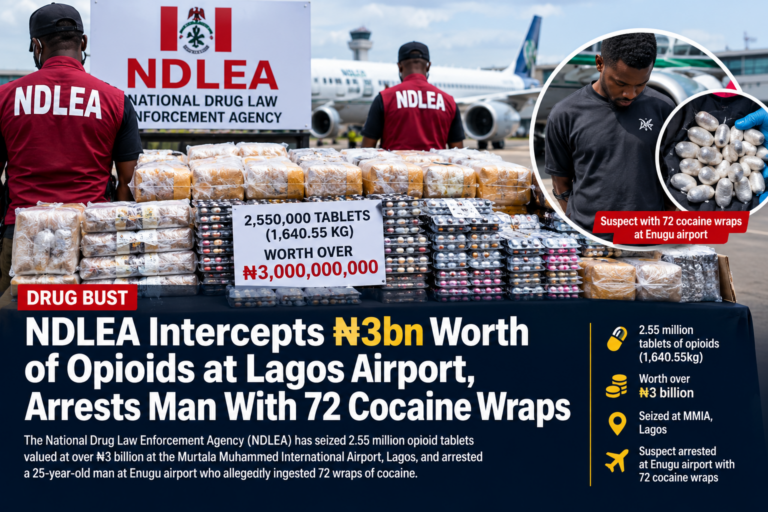
NDLEA Intercepts ₦3bn Worth of Opioids at Lagos Airport, Arrests Man With 72 Cocaine Wraps
The National Drug Law Enforcement Agency (NDLEA) has announced the interception of 2.55 million tablets of opioids valued at more than ₦3 billion at the Murtala Muhammed International Airport in Lagos. The agency said the drugs, weighing 1,640.55 kilogrammes, were seized on September 22 during the examination of three consignments at the airport’s import shed….
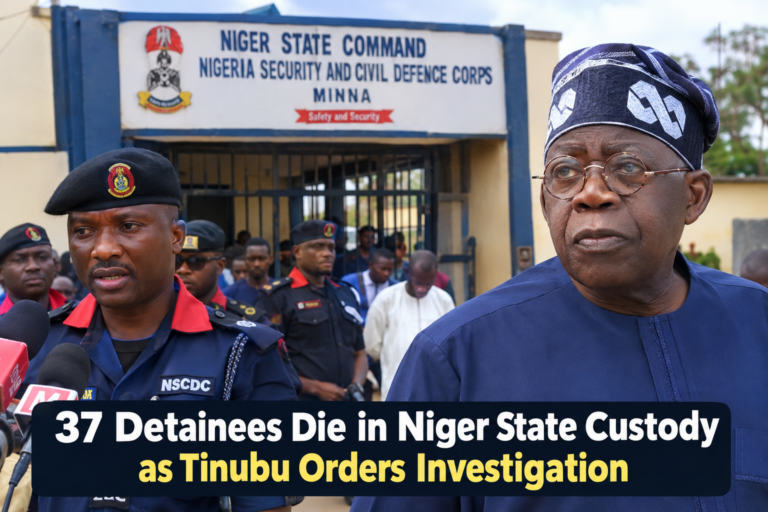
37 Detainees Die in Niger State Custody as Tinubu Orders Investigation
Nigeria is facing fresh scrutiny over conditions in detention facilities after 37 people arrested during an anti-illegal-mining operation died while in the custody of the Nigeria Security and Civil Defence Corps (NSCDC) in Minna, Niger State. The victims were among dozens of people arrested during operations targeting suspected illegal mining activities in parts of the…
Nigeria Pushes for Bigger Role in Global AI Services
Nigeria is seeking to move beyond traditional outsourcing and position itself as a provider of higher-value artificial intelligence and technology-enabled services to the global market. The Director-General of the National Information Technology Development Agency, Kashifu Inuwa Abdullahi, highlighted the opportunity during discussions linked to the 81st United Nations General Assembly. According to him, Nigeria’s growing…