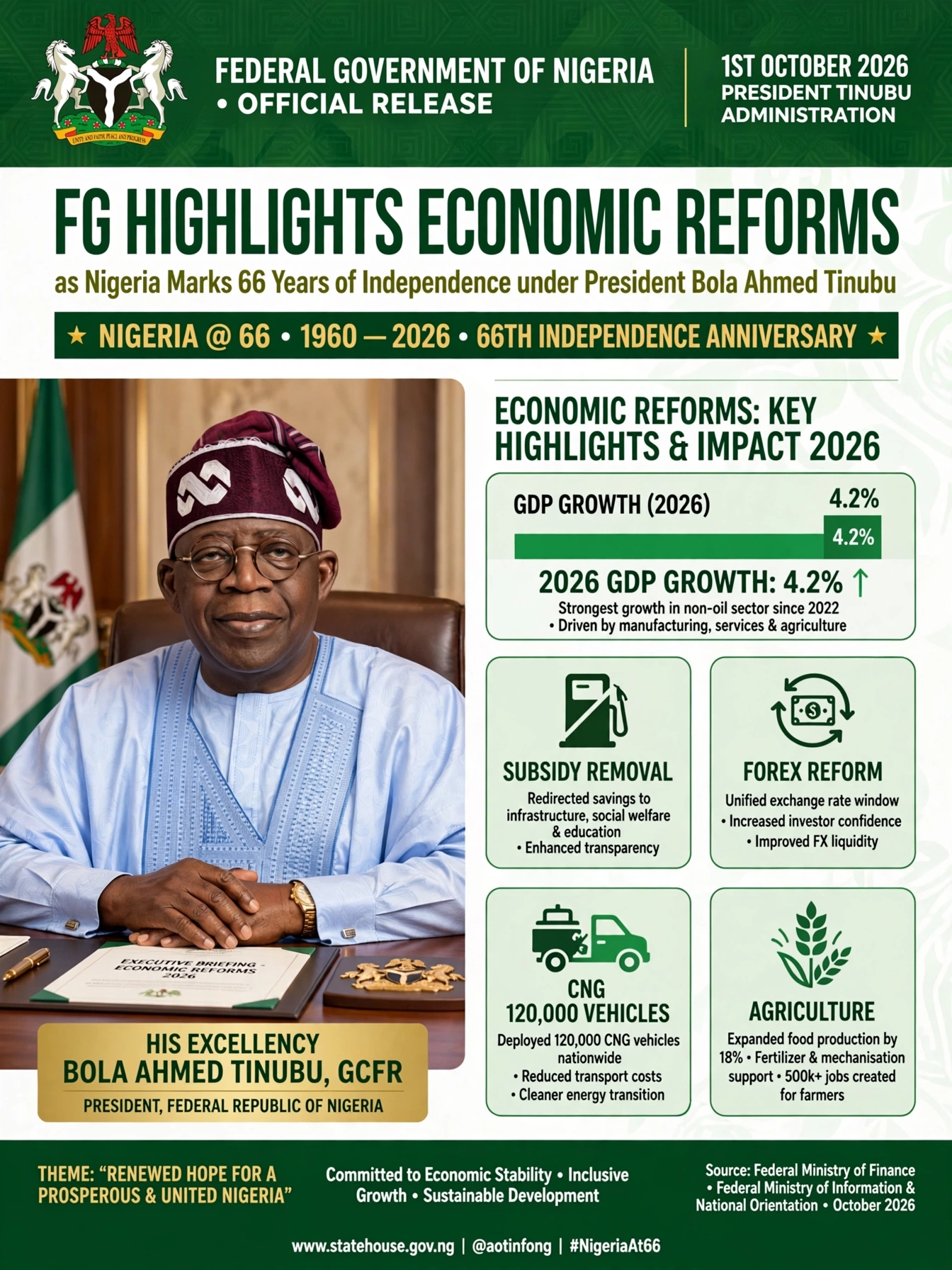
The Federal Government has highlighted economic reforms introduced under President Bola Ahmed Tinubu as Nigeria marks its 66th Independence Anniversary. Secretary to the Government of the Federation, George Akume, made the remarks on Wednesday during the 66th Independence Anniversary Public Lecture in Abuja. Akume said the administration’s reforms since 2023 were designed to address longstanding economic and fiscal challenges. Among the major measures he highlighted were the removal of the petrol subsidy, foreign exchange reforms and changes to the country’s fiscal system. According to Akume, the reforms have begun to produce measurable economic results. He cited World Bank data indicating that Nigeria’s real GDP grew by 4.2 per cent in the first half of 2026, compared with 3.9 per cent during the corresponding period of the previous year. He also pointed to infrastructure investment, domestic refining capacity, agriculture, energy and other sectors as areas where the government says progress has been recorded. The SGF said more than 120,000 vehicles had been converted to Compressed Natural Gas, supported by more than 400 conversion centres and 90 fuelling stations nationwide. He also highlighted government programmes targeting education, youth skills, healthcare, agriculture and social protection. On agriculture, Akume said the government was supporting mechanisation, irrigation, improved seeds, fertiliser distribution, storage and local processing. He also disclosed that the World Bank had approved $500 million in credit for the Nigeria Sustainable Agricultural Value-Chains for Growth project. The government has nevertheless acknowledged that economic challenges remain and that growth must translate into better living conditions for ordinary Nigerians. Akume himself said the task ahead was to ensure that economic growth resulted in jobs and higher incomes. The Federal Government has therefore framed the next phase of its economic programme around consolidating reforms and expanding opportunities. As Nigeria marks 66 years of independence, the discussion over the country’s economic direction remains closely linked to questions about inflation, household purchasing power, employment, food security, energy costs and access to opportunities. The government says the reforms are laying the foundation for long-term growth, while the coming years will determine how effectively those economic changes translate into tangible improvements for Nigerians.
Similar Posts
Sickle Cell Foundation Calls for Home-Grown Solutions to Nigeria’s Sickle Cell Crisis
The Sickle Cell Foundation Nigeria has called for stronger Nigerian leadership in developing and implementing home-grown solutions to the country’s sickle cell burden. The foundation made the call as concerns continue over the challenges faced by people living with sickle cell disorder, including access to appropriate healthcare, diagnosis, treatment, counselling and long-term support. The organisation’s…
How the iPhone Evolved From a Simple Touchscreen Phone to a Global Icon
When Apple introduced the first iPhone in 2007, it was difficult to predict just how much the device would change the mobile phone industry.At the time, smartphones were already around, but Apple took a different approach. Instead of relying on a physical keyboard or stylus, the company put a touchscreen at the centre of the…
EPISCOPAL PRIEST REV. FLOURISH KLINK’S CLAIM THAT “JESUS TRANSITIONED” SPARKS FRESH ONLINE DEBATE
A sermon delivered by Episcopal priest Rev. Flourish Klink at New York City’s Cathedral of St. John the Divine has resurfaced online, drawing widespread attention and debate over Klink’s theological claims about God, gender and Jesus Christ. Klink delivered the sermon on March 21, 2026, during the Cathedral’s “Celebration of Trans Joy and Resilience,” a…
Police Issue Nationwide Security Alert Over Planned Attacks on Schools, Churches and NYSC Camps
The Nigeria Police Force has placed its formations across the country on heightened alert following intelligence indicating possible coordinated terrorist attacks on schools, places of worship, NYSC orientation camps and other vulnerable locations. The security warning comes as schools prepare for the commencement of the 2026/2027 academic session, raising fresh concerns about the safety of…
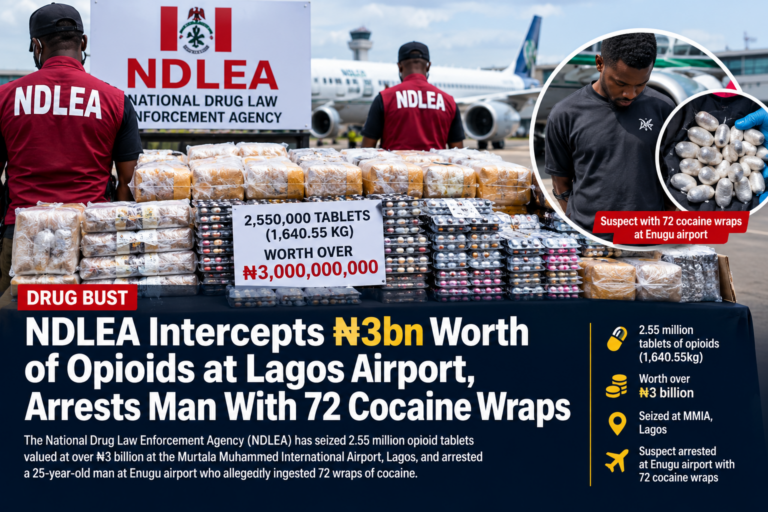
NDLEA Intercepts ₦3bn Worth of Opioids at Lagos Airport, Arrests Man With 72 Cocaine Wraps
The National Drug Law Enforcement Agency (NDLEA) has announced the interception of 2.55 million tablets of opioids valued at more than ₦3 billion at the Murtala Muhammed International Airport in Lagos. The agency said the drugs, weighing 1,640.55 kilogrammes, were seized on September 22 during the examination of three consignments at the airport’s import shed….
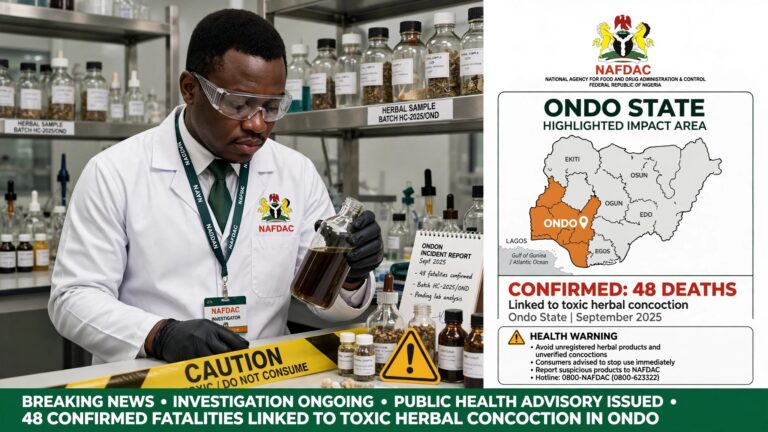
NAFDAC Confirms 48 Deaths Linked to Toxic Herbal Concoction in Ondo
The National Agency for Food and Drug Administration and Control has confirmed that 48 people have died following the consumption of a toxic herbal concoction in Ondo State. The agency also disclosed that 182 cases of illness have been recorded in connection with the incident, prompting further investigation into the substance responsible for the outbreak….