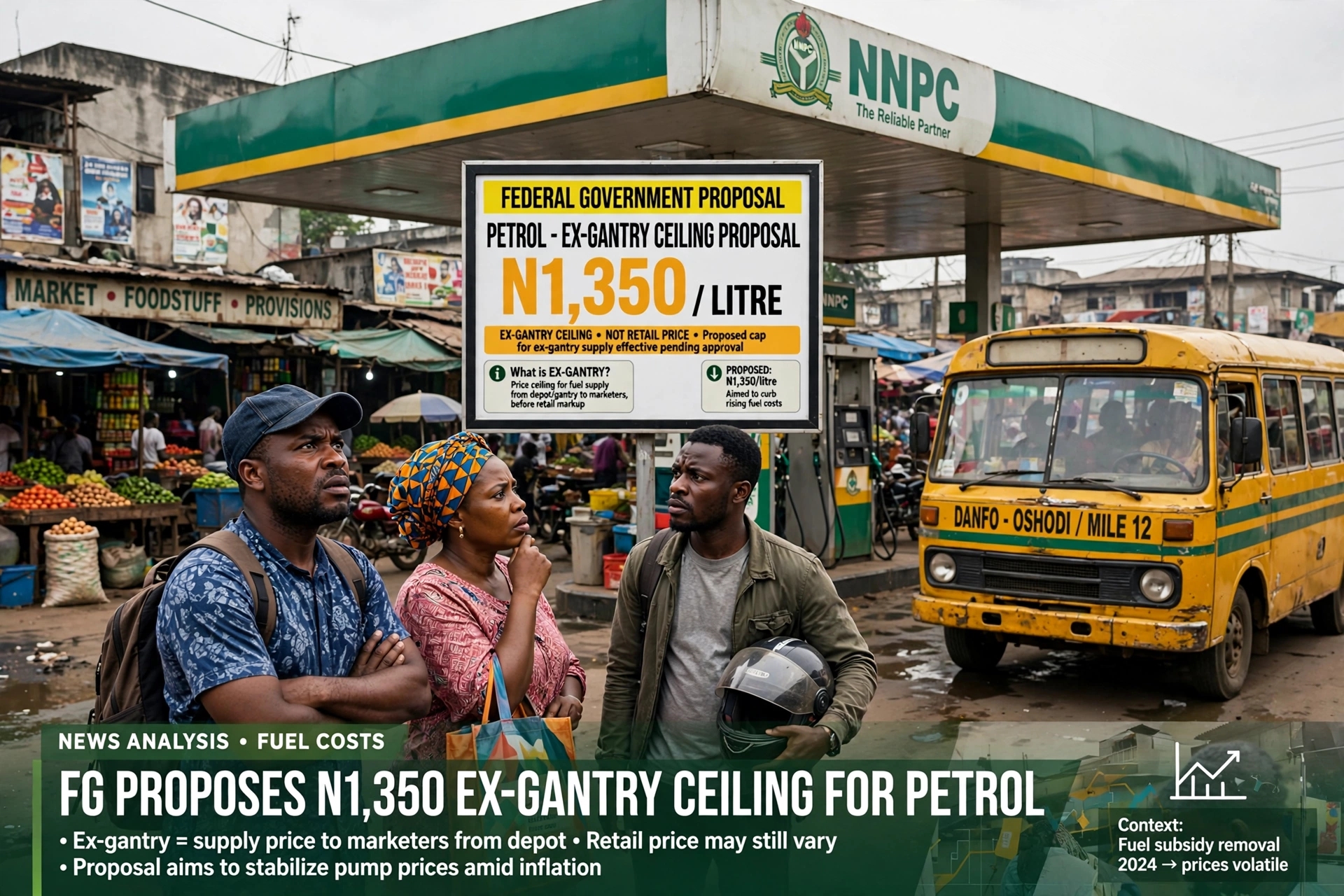
The Federal Government has proposed negotiating a ceiling of ₦1,350 per litre on petrol’s ex-gantry price as part of efforts to reduce fluctuations in domestic fuel prices. The proposal was disclosed by the Minister of Finance and Coordinating Minister of the Economy, Taiwo Oyedele, during a press conference in Abuja on Thursday. According to reports published on Friday, October 9, the proposed arrangement is intended to provide greater stability in petrol pricing amid changes in international crude oil prices and foreign exchange rates. The announcement comes as Nigerians continue to grapple with the effects of expensive transportation, rising food prices and other living expenses. The proposed ceiling is part of a broader effort to moderate price fluctuations and reduce the uncertainty facing consumers and businesses. Petrol prices have a significant influence on Nigeria’s economy because many households and businesses depend on road transportation, generators and fuel-powered equipment. When fuel prices increase, transport operators often adjust fares, while businesses may raise the prices of goods and services to cover additional operating costs. The resulting increases can place further pressure on households whose incomes have not risen at the same pace. However, the proposed ₦1,350 figure relates to the ex-gantry price. It should not be interpreted as a confirmed nationwide retail price at filling stations. Actual pump prices may differ depending on distribution expenses, location, transportation costs and other market conditions. The proposal has also renewed public discussion about the Federal Government’s approach to petrol pricing following the removal of the longstanding fuel subsidy. The government has maintained that its proposed interventions should not be confused with a return to the former subsidy arrangement. A separate reported measure involves a temporary discount on petrol sold at Nigerian National Petroleum Company Limited filling stations. The government says the arrangement is intended to provide temporary relief rather than restore the previous subsidy system. Although the proposal has attracted attention, its practical effect will depend on the outcome of negotiations and the final implementation arrangements. Consumers will be watching closely to determine whether the measures lead to meaningful reductions in transportation costs and prices of essential goods. For now, the proposed ceiling represents an effort to address fuel-price volatility, but it does not guarantee that every filling station will sell petrol at the same price.
Similar Posts
Obasanjo Calls for Greater Benefits for Oil-Producing States
Former President Olusegun Obasanjo has reportedly called for increased derivation benefits for Nigeria’s oil-producing states, bringing renewed attention to the country’s longstanding debate over resource ownership and revenue distribution. The issue is particularly important to communities in the Niger Delta, where oil production generates substantial economic activity but environmental damage, infrastructure challenges and development concerns…
Nigeria’s Public Debt Rises to ₦166.79 Trillion as Debt Stock Climbs by ₦7.44tn in Three Months
Nigeria’s total public debt has risen to ₦166.79 trillion as of June 30, 2026, according to the latest report from the Debt Management Office (DMO). The new figure represents an increase of ₦7.44 trillion, or 4.7 per cent, from the ₦159.35 trillion recorded at the end of the first quarter of 2026. The DMO’s figures…
About 17,000 Missing-Person Cases Remain Under Active Tracing in Nigeria — ICRC
About 17,000 missing-person cases remain under active tracing in Nigeria, according to the International Committee of the Red Cross. The humanitarian organisation said the cases involve people whose whereabouts remain unknown, with many cases connected to armed conflict, violence, displacement and other emergencies. The ICRC said it works with the Nigerian Red Cross Society to…
TINUBU DEFENDS ECONOMIC REFORMS AS OPPOSITION QUESTIONS IMPACT ON NIGERIANS
President Bola Tinubu’s economic policies have become a major focus of political debate as his administration prepares to seek another term in office amid persistent concerns about the cost of living and household finances. The president launched his re-election campaign in Kaduna on October 24, 2026, defending his administration’s direction as opposition figures continued to…
TINUBU LAUNCHES 2027 RE-ELECTION CAMPAIGN IN KADUNA, BLAMES OPPOSITION FOR HUNGER
President Bola Ahmed Tinubu has officially launched his re-election campaign ahead of Nigeria’s 2027 general election, using a rally in Kaduna State to defend his administration’s economic policies and criticise opposition politicians over the country’s economic challenges. The campaign flag-off took place on Saturday, October 24, 2026, at Ranchers Bees Stadium in Kaduna, where the…
Explosion Rocks Gas Outlet in Kubwa, Abuja, Sparks Panic Among Residents
An explosion and fire at a gas outlet around Liberty Junction in Kubwa, Abuja, caused panic among residents on Sunday morning. The incident occurred at a gas-refilling outlet in the area, with reports indicating that the blast shook nearby structures and prompted an emergency response. The Federal Fire Service said its FCT Command and other…