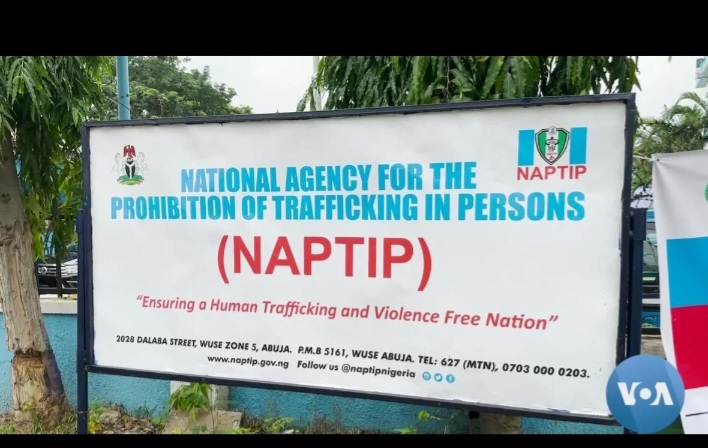
ABUJA — The Federal Government has received 105 Nigerians rescued during an operation targeting cybercrime syndicates in Ghana, as authorities begin assessing their circumstances and arranging support following their return. The National Agency for the Prohibition of Trafficking in Persons (NAPTIP) announced the development after a coordinated operation involving Nigerian and Ghanaian authorities. According to reports published on October 12 and 13, Ghanaian authorities rescued 119 Nigerians during the operation. Of that number, 105 had been repatriated to Nigeria, while the remaining 14 were still undergoing processing for their return. The operation was coordinated by Nigeria’s Office of the National Security Adviser following contact from Ghana’s Cyber Security Authority. NAPTIP led the Nigerian agencies involved in the operation, working alongside immigration, security and intelligence institutions. The participating organisations included the Nigeria Immigration Service, the Department of State Services, the National Intelligence Agency and the National Commission for Refugees, Migrants and Internally Displaced Persons. The Nigerian High Commission in Ghana and other partners also supported the process. NAPTIP Director-General Binta Adamu Bello received the returnees on behalf of the Federal Government and assured them that officials would assess their circumstances. The agency said the returnees would undergo profiling to establish their individual situations and determine what assistance they might require. This process is important because people found in cybercrime operations may have different levels of involvement. Some individuals may knowingly participate in criminal activities, while others may have been recruited under false pretences or subjected to coercion and exploitation. Authorities must therefore establish the circumstances of each individual rather than automatically assume that every person rescued was either a trafficking victim or a willing participant in criminal activity. NAPTIP said the screening process would help determine the appropriate support and reintegration measures. The operation has renewed attention on the risks facing Nigerians who travel abroad after receiving promises of lucrative employment. Criminal networks can use attractive job offers and misleading recruitment arrangements to draw people into situations they do not fully understand.In some cases involving international scam operations, victims have reported coercion, threats, restrictions on movement and pressure to participate in illegal activities.Prospective migrants are therefore encouraged to verify prospective employers, recruitment agencies, employment contracts and travel arrangements before leaving Nigeria. Promises of unusually high salaries without clear job descriptions or verifiable employers should be treated with caution. The operation demonstrates the importance of cooperation between countries in responding to criminal networks that operate across national borders. Effective cooperation can help authorities identify people at risk, disrupt criminal operations and arrange the safe return of affected individuals. However, identifying potential victims is only the first step. Screening, appropriate protection, investigations and reintegration support may also be necessary. The immediate priority is to establish the circumstances of the 105 returnees and determine what assistance they need. Authorities may also use information obtained during screening to support further investigations into the networks involved. NAPTIP has not publicly established that all 105 Nigerians were trafficking victims or that all were forced to participate in cybercrime. Their individual circumstances will need to be assessed. The operation nevertheless highlights the risks associated with deceptive overseas recruitment and the need for stronger international cooperation to protect Nigerians from exploitation.
Similar Posts
FG Highlights Economic Reforms as Nigeria Marks 66 Years of Independence
The Federal Government has highlighted economic reforms introduced under President Bola Ahmed Tinubu as Nigeria marks its 66th Independence Anniversary. Secretary to the Government of the Federation, George Akume, made the remarks on Wednesday during the 66th Independence Anniversary Public Lecture in Abuja. Akume said the administration’s reforms since 2023 were designed to address longstanding…
New Telecom Operator Enters Nigerian Market as Competition Grows
Nigeria’s telecommunications industry is welcoming a new operator following the issuance of a Unified Access Service Licence to Swift Telephone Network Limited. The licence became effective on October 1, 2026, giving the Nigerian-owned company regulatory approval to provide voice, data, fixed and mobile telecommunications services. The entry comes into a market dominated by a handful…
Edo APC Chairman’s ‘AK-47 Fire’ Remark Sparks Calls for Investigation
The Edo State Chairman of the All Progressives Congress, Jarrett Tenebe, has come under criticism following an alleged reference to “AK-47 fire” while speaking about the party’s political mobilisation ahead of the 2027 elections. Tenebe reportedly made the remark while addressing APC supporters in the state. He was speaking about the party’s target of securing…
Nigeria’s Human Rights Record Draws Attention as International Obligations Remain in Focus
Nigeria’s human rights obligations and its engagement with international institutions remain important subjects in discussions about governance, security and the protection of fundamental freedoms. Nigeria has been elected to the United Nations Human Rights Council for the 2027–2029 term after securing 172 votes out of 181 in an election held on Tuesday, 13 October 2026…
NIGERIA FACES ₦3.6 TRILLION LOSSES FROM TRANSPORT INEFFICIENCIES, EXPERT SAYS
Nigeria loses more than ₦3.6 trillion to inefficiencies and distortions in its transport and logistics sector, according to Dr Obiora Madu, Director-General of the Africa Centre for Supply Chain. Madu made the disclosure at the BusinessDay Mobility and Logistics Conference in Lagos, where industry stakeholders called for a more integrated transport system to reduce costs…
Olu Jacobs Dies at 84: Nollywood Loses One of Its Most Celebrated Actors
Nigeria’s entertainment industry has been thrown into mourning following the death of veteran actor and film executive, Oludotun Baiyewun Jacobs, popularly known as Olu Jacobs, at the age of 84. The actor died on Wednesday, September 16, 2026. His family announced the news through a statement shared by his son, Olusoji Jacobs, bringing an end…