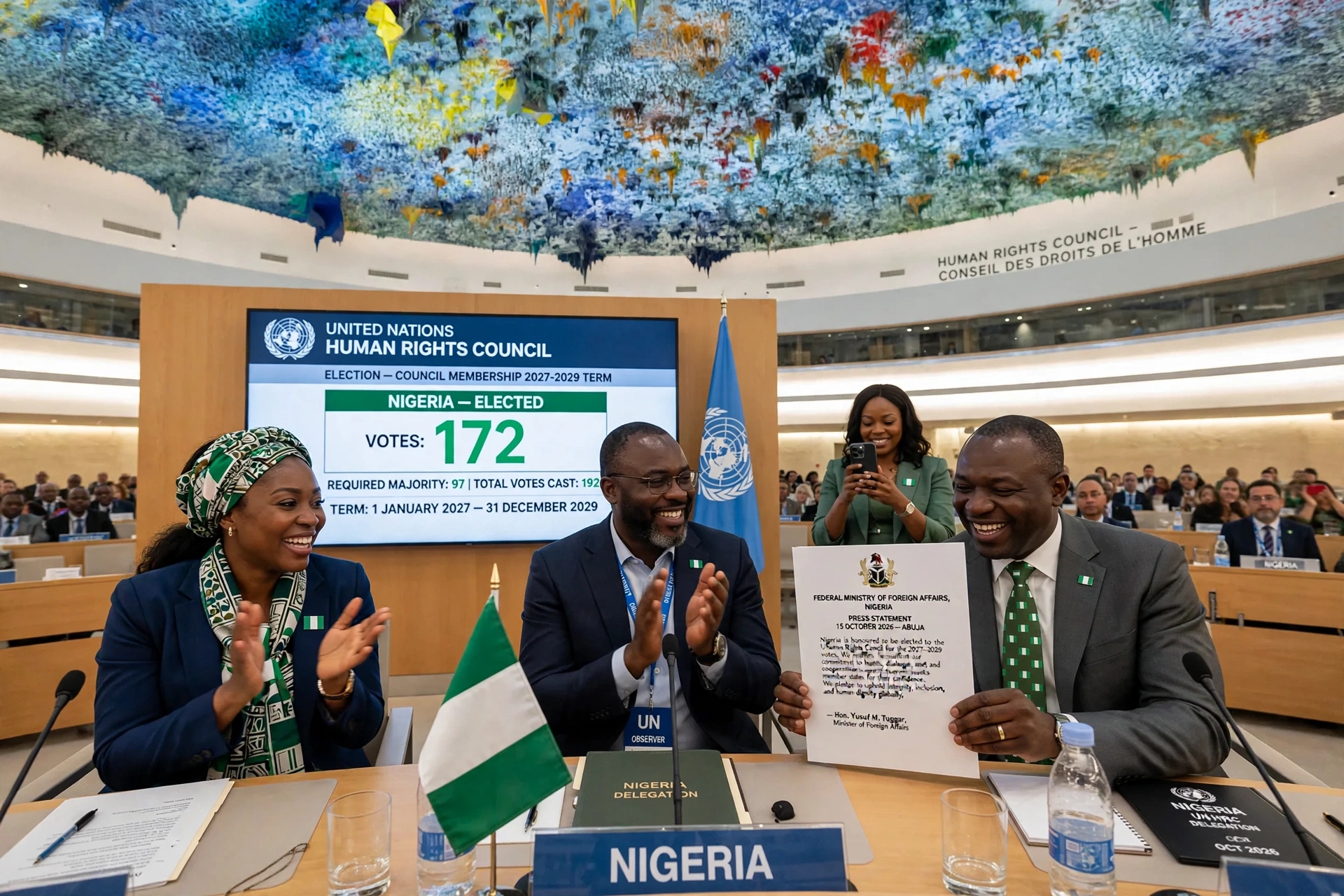
Nigeria has secured a seat on the United Nations Human Rights Council for the 2027–2029 term, earning 172 votes during an election at the UN General Assembly. The result, reported on Wednesday, October 14, represents a significant diplomatic development for the country as it prepares to take on another international responsibility in January 2027. According to the reported election results, Nigeria will serve a three-year term beginning on January 1, 2027, and ending on December 31, 2029. The Human Rights Council is the United Nations body responsible for promoting and protecting human rights around the world. The council provides a platform for countries to discuss human rights concerns, examine allegations of violations and make recommendations intended to improve protections. Its work includes reviewing the human rights records of UN member states through the Universal Periodic Review process. It also considers country-specific situations and thematic issues involving civil liberties, discrimination, humanitarian concerns and other human rights challenges. Membership gives elected countries an opportunity to participate directly in these discussions and contribute to international deliberations. However, membership does not automatically resolve domestic human rights problems or guarantee that a country’s policies will receive international approval. Nigeria’s election places it among the countries expected to participate in discussions concerning international human rights standards and their implementation. The country will have an opportunity to contribute to debates involving civil liberties, access to justice, protection of vulnerable groups and the responsibilities of governments towards their citizens. The development also places renewed attention on Nigeria’s own human rights record. Issues involving security operations, detention practices, access to justice, freedom of expression and the protection of vulnerable communities remain important subjects of domestic and international discussion. Nigeria’s performance during its term will therefore be assessed not only through its participation at the United Nations but also through the consistency of its actions with the principles it supports internationally. The council’s work is carried out through meetings, investigations, reviews, resolutions and engagement with member states and other stakeholders. Its recommendations can contribute to international pressure for improvements, although their implementation often depends on political cooperation and the willingness of governments to act. Nigeria’s new term offers an opportunity to contribute to international human rights discussions while demonstrating commitment to the protection of rights at home. The challenge will be to translate diplomatic participation into constructive engagement and measurable progress.
Similar Posts
FG Domestic Borrowing Surges 90% to ₦24.7tn in Eight Months as Businesses Face Credit Pressure
Nigeria’s Federal Government borrowed ₦24.7 trillion from domestic investors in the first eight months of 2026, representing a 90.5 per cent increase compared with the ₦12.98 trillion recorded during the corresponding period of 2025. The sharp increase in domestic borrowing has renewed attention on the government’s financing needs and the availability of credit for businesses…
INTERPOL AI Operation Identifies 126 Suspected Terrorist Fighters
The International Criminal Police Organization, INTERPOL, has identified 126 suspected foreign terrorist fighters through an artificial intelligence-powered counter-terrorism operation involving Nigeria and other international partners. The operation used artificial intelligence to analyse visual material linked to suspected jihadist networks and assist law enforcement agencies in identifying individuals believed to be connected to terrorist activities. INTERPOL…
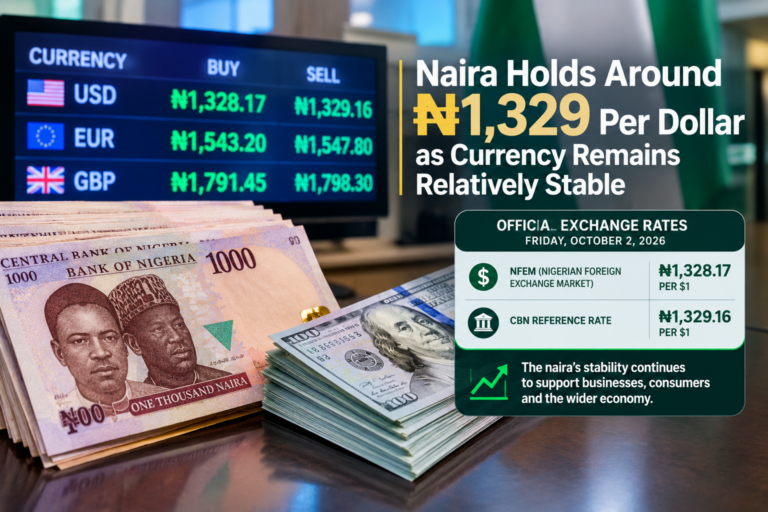
Naira Holds Around ₦1,329 Per Dollar as Currency Remains Relatively Stable
The Nigerian naira maintained relative stability against the United States dollar on Friday, October 2, 2026, with the currency trading around the ₦1,329-per-dollar level in the official foreign exchange market. Data from the Nigerian Foreign Exchange Market indicated a dollar rate of approximately ₦1,328.17, while the Central Bank of Nigeria reference rate stood around ₦1,329.16….
INEC Under Fire as Isa Pantami Challenges Exclusion From 2027 Gombe Governorship List
ABUJA — The Independent National Electoral Commission (INEC) is facing renewed scrutiny following the exclusion of former Minister of Communications and Digital Economy, Isa Ali Pantami, from its final list of governorship candidates for the 2027 general elections. The development has sparked fresh questions about the management of party primaries, the interpretation of electoral laws…
ONE DONOR, HUNDREDS OF CHILDREN: DUTCH SPERM DONOR CASE SPARKS FERTILITY DEBATEA
Dutch sperm donor has become the focus of an extraordinary legal case after his donations were linked to at least 550 children, raising fresh questions about donor limits and the way fertility donations are monitored.Jonathan Meijer was ordered by a court in The Hague in 2023 to stop donating sperm to new prospective parents after…