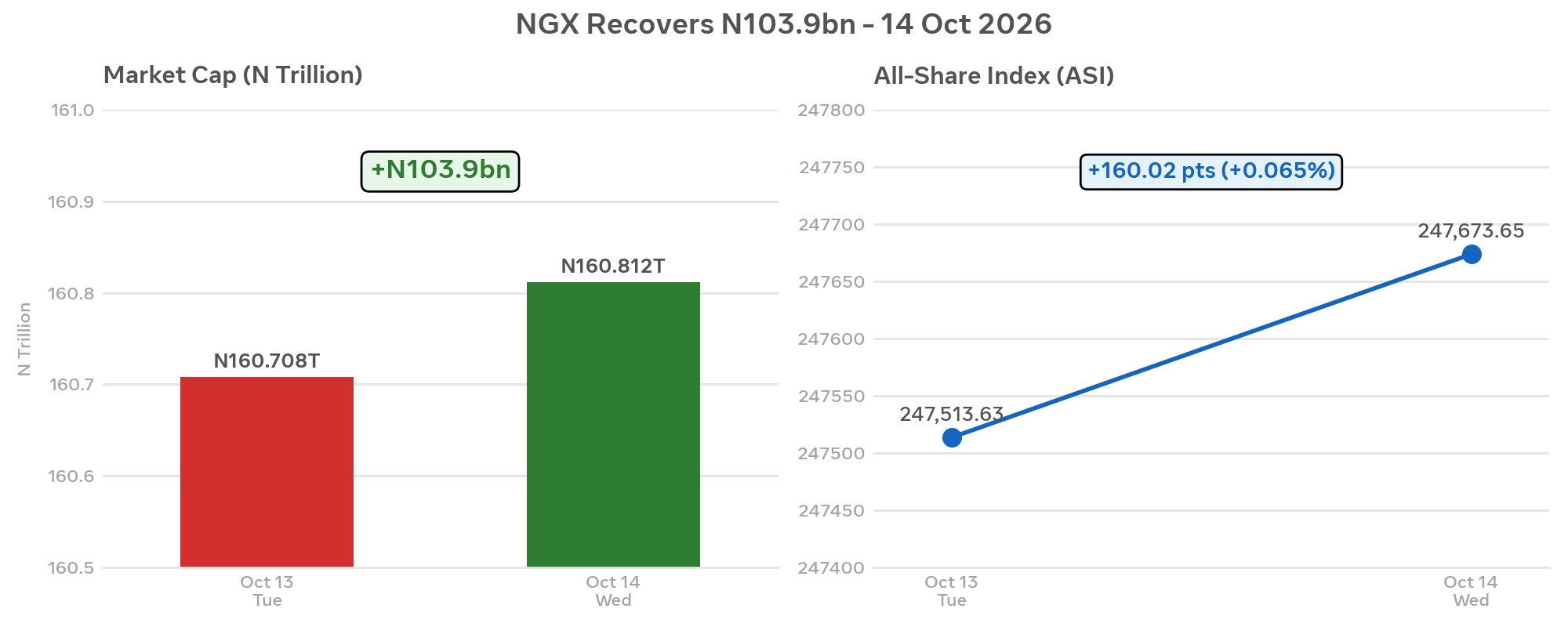
Nigeria’s stock market recovered ₦103.9 billion in market value on Wednesday, 14 October 2026, according to official trading data from the Nigerian Exchange published on Thursday, October 15, 2026. The Nigerian equities market returned to positive territory on Wednesday, October 14, 2026, as investor wealth expanded by N103.90 billion in a single trading session, lifting the total market capitalization of listed equities to N160.81 trillion. Official figures show overall equity market capitalization climbed from N160.708 trillion recorded on Tuesday, 14 October to settle at N160.812 trillion at the close of trading on Wednesday. The benchmark All-Share Index (ASI) appreciated by 160.02 points (0.065%), closing at 247,673.65 points, up from Tuesday’s closing value of 247,513.63 points.Market Summary – 14 October 2026:• All-Share Index (ASI): 247,673.65 points, up 0.065% from 247,513.63 points • Market cap: N160.81 trillion, up 0.065% from N160.71 trillion • Market value gained: N103.90 billion • Trading volume: 314.90 million shares across 30,922 deals Market capitalisation is the combined value of the shares of listed companies, calculated using their market prices and the number of outstanding shares. When share prices rise across the market, total market capitalisation generally increases. A recovery in market value may indicate improved share prices, renewed investor interest or stronger performance among companies listed on the Nigerian Exchange. The upward movement on 14 October was driven by broad-based appreciation across key sector indices, led by Oil & Gas, Banking, and Insurance. The NGX Oil/Gas Index surged from 6,000.20 to 6,034.68 points, boosted by Aradel Holdings Plc which added 1.67% to close at N1,400.00, while banking stocks lifted the Banking Index from 2,547.15 to 2,550.65 points, supported by Wema Bank, Access Holdings, GTCO and UBA. However, a single day’s increase does not necessarily establish that the market has entered a sustained upward trend. The day before the recovery, on Tuesday 13 October, the market had shed N144 billion as market capitalisation declined to N160.708 trillion from N160.852 trillion. Investors typically examine several indicators before drawing conclusions, including the All-Share Index, trading volume, market breadth and the performance of individual sectors. Nigeria’s investment environment has been shaped by changes in monetary policy, currency movements and efforts to stabilise the wider economy. Banks, manufacturers, consumer-goods businesses and oil-related firms may respond differently to changes in interest rates, production costs and demand.
Similar Posts
INEC Under Fire: Is Nigeria’s Electoral Referee Playing for APC?
Nigeria’s electoral referee is facing a question that could define the 2027 elections: can INEC convince millions of Nigerians that it is truly independent — or are growing allegations of political bias becoming impossible to ignore? The Independent National Electoral Commission (INEC) was created to protect the integrity of Nigeria’s elections. But as the country…
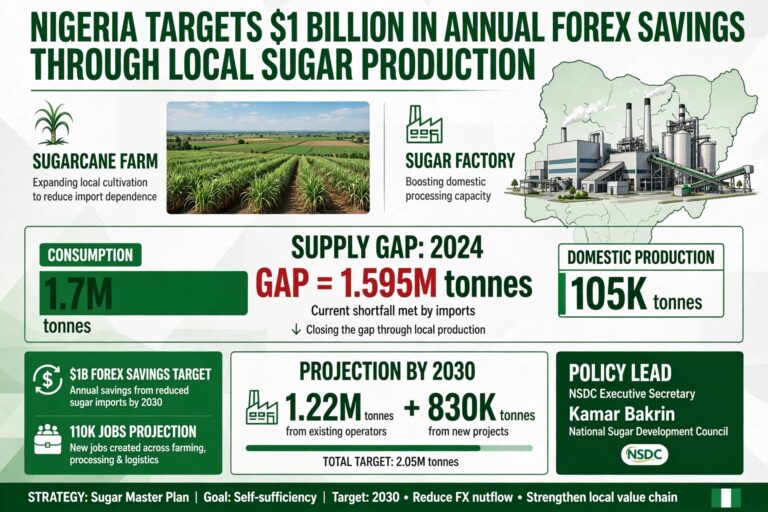
NIGERIA TARGETS $1 BILLION IN ANNUAL FOREX SAVINGS THROUGH LOCAL SUGAR PRODUCTION
Nigeria could save approximately $1 billion in foreign exchange annually and create 110,000 direct jobs if the country achieves self-sufficiency in sugar production, according to projections attributed to the National Sugar Development Council. The council’s Executive Secretary and Chief Executive, Kamar Bakrin, outlined the potential benefits as the government seeks to reduce dependence on imported…
Truck Crushes NYSC Member to Death in Ibadan, Several Others Injured
IBADAN — Tragedy struck Ibadan, the Oyo State capital, after an articulated truck reportedly rammed into several vehicles, killing a serving member of the National Youth Service Corps (NYSC) and leaving other people injured. The incident occurred on Monday around the Agodi Gardens area, behind the Oyo State Government Secretariat, according to a report published…
Osun on Alert as DSS Warns of Alleged Terror Plot Targeting Worship Centres
Osun State has been placed on heightened security alert following a warning from the Department of State Services (DSS) over an alleged plan by terrorists to attack places of worship and other crowded locations in the state. The warning has sparked increased security awareness among religious communities, with Christian and Muslim leaders urged to take…
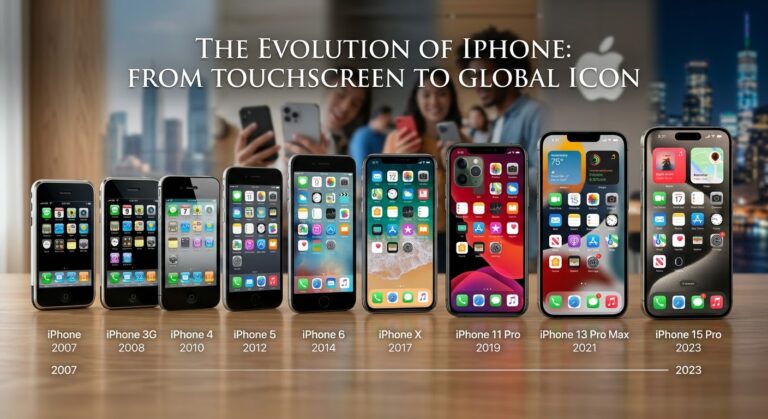
How the iPhone Evolved From a Simple Touchscreen Phone to a Global Icon
When Apple introduced the first iPhone in 2007, it was difficult to predict just how much the device would change the mobile phone industry.At the time, smartphones were already around, but Apple took a different approach. Instead of relying on a physical keyboard or stylus, the company put a touchscreen at the centre of the…