The Trade Union Congress of Nigeria (TUC) has rejected the Federal Government’s proposed ₦70,000 monthly transport allowance for public service workers, insisting that Nigerian workers need permanent salary improvements rather than temporary financial interventions. The disagreement follows the Federal Government’s announcement of a six-month transport allowance for workers beginning in November 2026, the intervention was reached during a conciliation meeting between government representatives and the leadership of the Nigeria Labour Congress (NLC) in Abuja on October 27. Under the agreement, the government approved a monthly transport allowance of ₦70,000 for six months. The intervention is intended to cushion the impact of rising transportation costs and the broader economic difficulties confronting Nigerian workers. However, the Trade Union Congress expressed dissatisfaction with the proposed intervention. In a statement issued on Wednesday, October 28, TUC President Festus Osifo and Secretary-General Nuhu Toro argued that the government should prioritise an immediate salary increase. The congress also called for the implementation of outstanding agreements affecting workers, including the agreement involving the Joint Health Sector Unions, the TUC maintained that temporary allowances would not adequately address the financial difficulties facing workers. The agreement between the Federal Government and the NLC also covered other outstanding welfare issues. These include the payment of outstanding peculiar allowance arrears dating back to May 1, 2026, in three equal monthly instalments beginning in November. The government also agreed to redeem 19 months of outstanding allowances owed to health workers within three months, beginning in December 2026. Both parties further agreed to establish a Minimum Wage Negotiation Committee to begin discussions immediately. However, they did not reach an agreement on the effective date for implementing a new national minimum wage. The disagreement between the two labour organisations raises broader questions about the most effective way to improve workers’ welfare, while the six-month transport intervention could provide temporary relief, it does not necessarily resolve the wider challenges associated with inflation, food prices, transportation costs and inadequate purchasing power. For workers whose salaries are already stretched by rising living expenses, the difference between temporary assistance and a sustainable improvement in income remains significant. The government is expected to commence the transport intervention in November 2026. Meanwhile, the disagreement highlights the need for continued engagement between government and organised labour to find lasting solutions to the economic difficulties facing Nigerian workers.
Similar Posts
Boko Haram Weakened But Not Defeated, Gombe Governor Warns
Gombe State Governor and Chairman of the Northern States Governors’ Forum, Inuwa Yahaya, has warned that Boko Haram has been weakened but has not been completely defeated. Yahaya made the statement during the 13th meeting of the North-East Governors’ Forum in Maiduguri, Borno State. According to the governor, attacks on communities continue despite years of…
NAPTIP Receives 105 Nigerians Rescued From Cybercrime Syndicates in Ghana
ABUJA — The Federal Government has received 105 Nigerians rescued during an operation targeting cybercrime syndicates in Ghana, as authorities begin assessing their circumstances and arranging support following their return. The National Agency for the Prohibition of Trafficking in Persons (NAPTIP) announced the development after a coordinated operation involving Nigerian and Ghanaian authorities. According to…
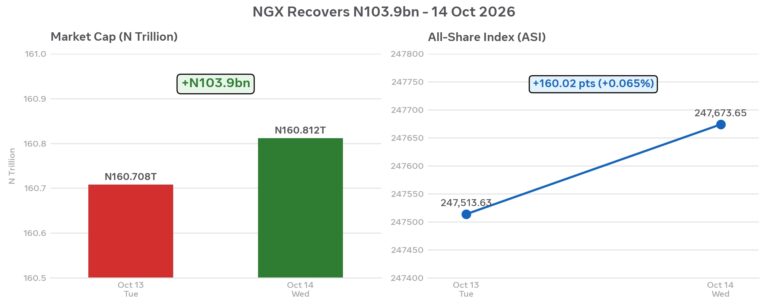
Nigeria Stock Market Recovers ₦103.9 Billion in Market Value
Nigeria’s stock market recovered ₦103.9 billion in market value on Wednesday, 14 October 2026, according to official trading data from the Nigerian Exchange published on Thursday, October 15, 2026. The Nigerian equities market returned to positive territory on Wednesday, October 14, 2026, as investor wealth expanded by N103.90 billion in a single trading session, lifting…
Meta Launches Enterprise AI Platform as Zuckerberg Announces Major Business Push
Meta is expanding its artificial intelligence ambitions beyond consumer-facing products with the launch of Meta Enterprise Platform, a new business-focused division designed to help companies use AI to grow, automate operations and transform how they work.Meta CEO Mark Zuckerberg announced the initiative, describing it as a new major pillar of the company’s business.The platform will…
US SECURITY BRIEFING RAISES FRESH QUESTIONS OVER TINUBU’S HEALTH AHEAD OF 2027 ELECTION
Fresh questions have emerged over the health of Nigerian President Bola Ahmed Tinubu following the circulation of a security briefing attributed to Mike Arnold, a former mayor of Blanco, Texas, which reportedly raised concerns about the President’s condition and the potential political consequences of a serious health crisis. According to reports, the document was submitted…
Lekki Port Traffic Congestion Worsens as Trucks Disrupt Cargo Movement
Traffic congestion around the Lekki Deep Seaport corridor in Lagos has worsened, with port stakeholders warning that the growing gridlock is beginning to disrupt cargo movement and port operations. The congestion has been linked to the movement of tankers and container trucks along the busy corridor, with stakeholders raising concerns about the enforcement of traffic…