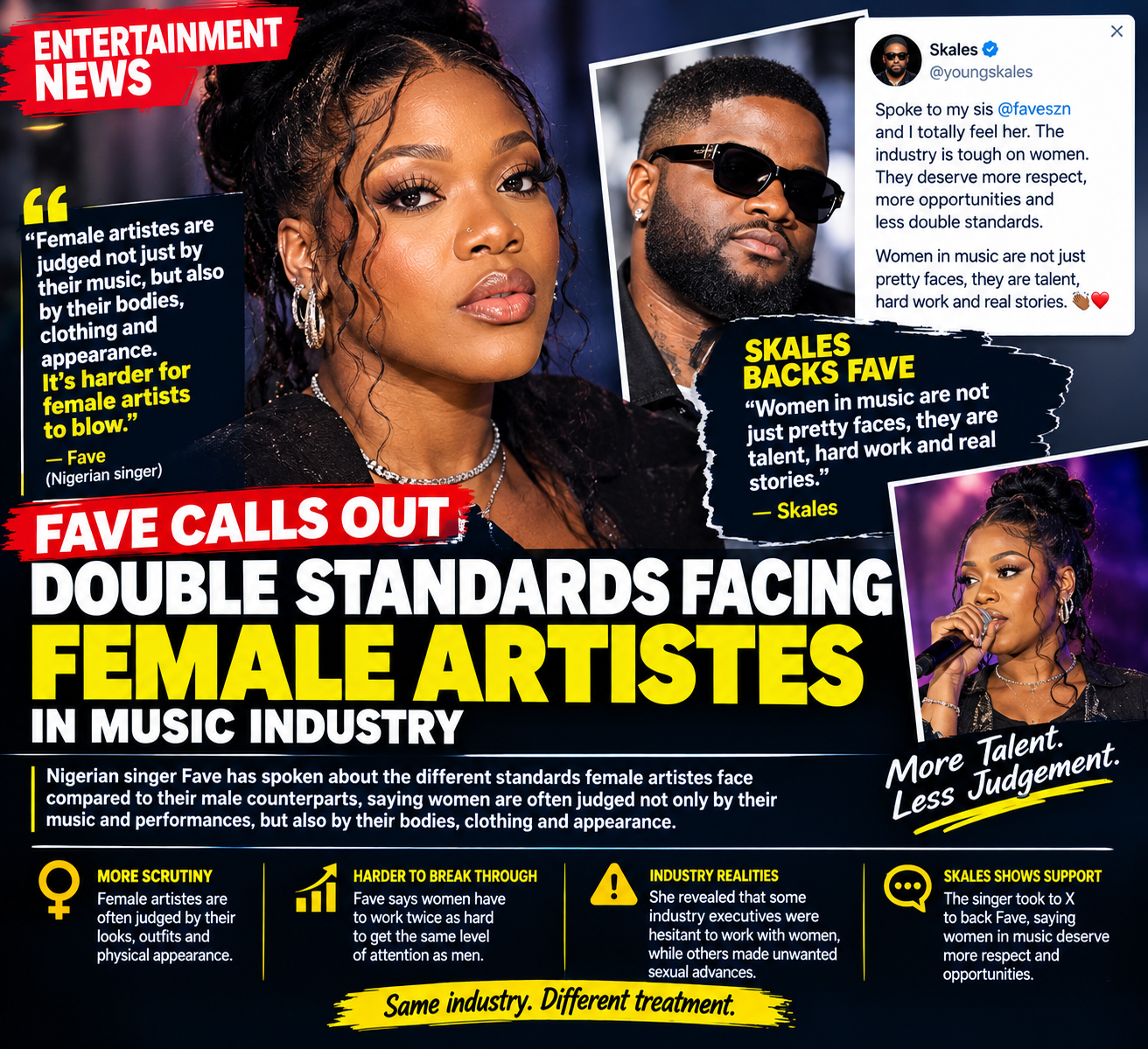
Nigerian singer Fave has sparked a fresh conversation about gender expectations in the music industry after speaking openly about the different standards she believes female artistes face compared with their male counterparts. The “Baby Riddim” singer made the comments while speaking on the Afropolitan Podcast, where she discussed the challenges women encounter while trying to build successful careers in music. According to Fave, female artistes are frequently judged not only by their music and performances but also by their bodies, clothing and physical appearance. She argued that conversations about female musicians can quickly shift away from their artistic work and focus instead on how they look or dress. Fave said she believes this creates an additional hurdle for women trying to establish themselves in an already competitive industry. “It’s harder for female artists to blow” Fave said female artistes often have to put in significantly more effort to receive the same level of attention given to male performers. She also pointed to the expectations placed on women during performances, arguing that female artistes are often expected to prove themselves repeatedly while men can receive attention without facing the same level of scrutiny. The singer further revealed that, early in her career, she encountered industry executives who were hesitant about working with female artistes because they considered women difficult to manage. She also spoke about unwanted sexual advances that women may encounter while trying to gain access to studios and influential industry figures. Fave’s comments have received support from fellow Nigerian singer Skales. Reacting on X, Skales acknowledged the difficulties female entertainers face and praised women working in the industry. His response added another voice to the ongoing discussion about gender expectations, opportunities and treatment within Nigeria’s music business. Fave’s remarks have renewed discussions about how female artistes are perceived in the Nigerian entertainment industry. While appearance and branding can be important parts of an artiste’s public image, Fave’s argument is that these factors should not overshadow musical ability and performance. Her comments have therefore brought renewed attention to the experiences of women trying to establish themselves in Afrobeats, from securing record deals and accessing industry opportunities to dealing with public scrutiny. As the Nigerian music industry continues to expand globally, the conversation over whether male and female artistes are judged by the same standards is likely to remain an important one.
Similar Posts
POPULAR MEDIA PERSONALITIES WEIGH IN AS REGINA DANIELS’ RETURN TO NED NWOKO’S HOME REIGNITES FRESH QUESTIONS
Oluebubethetalkingdrum and Okonkwo Odinakachukwu join the growing conversation surrounding the actress, her estranged husband and the latest twist in their highly publicised saga. The Regina Daniels and Ned Nwoko saga has taken another dramatic turn after the actress was recently spotted at the residence of her estranged husband, sparking fresh reactions across social media and…
JACKIE CHAN DEATH HOAX ROCKS THE INTERNET AS FALSE REPORTS OF ACTION LEGEND’S DEATH GO VIRAL
By XanderXO Entertainment A wave of false reports claiming that legendary actor and martial-arts star Jackie Chan has died has sent social media into a frenzy, prompting fans around the world to question the authenticity of the viral posts. The 72-year-old actor is alive, and reports circulating online that he died in 2026 are false….
PHYNА & NKECHI BLESSING CLASH ON CAMERA AS OCTOBER 1 BOXING SHOWDOWN LOOMS
The ongoing public clash between reality TV star Phyna and Nollywood actress Nkechi Blessing has taken another dramatic turn after a video showing both entertainers confronting each other surfaced online.The incident reportedly occurred at the studio of media personality Morayo Brown, where the two women came face-to-face amid their ongoing disagreement. In the viral footage,…
Bells’ time in the #BBNaija Show Ya Sef house has come to an end!
.Bells spent 56 days making sure her presence was felt in Biggie’s house. She found love with Yusuf, stood firmly by the people she cared about and navigated relationship gbas gbos, friendship friction and one garden clash that earned her a seat on Biggie’s Bench Warmer.Through it all, Bells was never one for background noise.Tonight,…
BBNaija: Nomy Disqualified From Season 11 After Repeated Defiance
Big Brother Naija Season 11 has taken another dramatic turn as housemate Whitney Chukwu, popularly known as Nomy, has been disqualified from the reality show.Nomy’s exit was announced on Monday, September 7, after Big Brother accused her of repeatedly defying his instructions while in the house.The latest incident happened after Nomy was assigned the “Benchwarmer”…
PETE EDOCHIE’S GREETING TO OONI OF IFE REIGNITES CULTURAL RESPECT DEBATE
A resurfaced encounter between veteran Nollywood actor Pete Edochie and the Ooni of Ife has reopened conversations about tradition, royal etiquette and the different ways respect is expressed across Nigeria. A resurfaced video showing veteran Nollywood actor Pete Edochie greeting the Ooni of Ife, Oba Adeyeye Enitan Ogunwusi, has once again sparked a heated conversation…