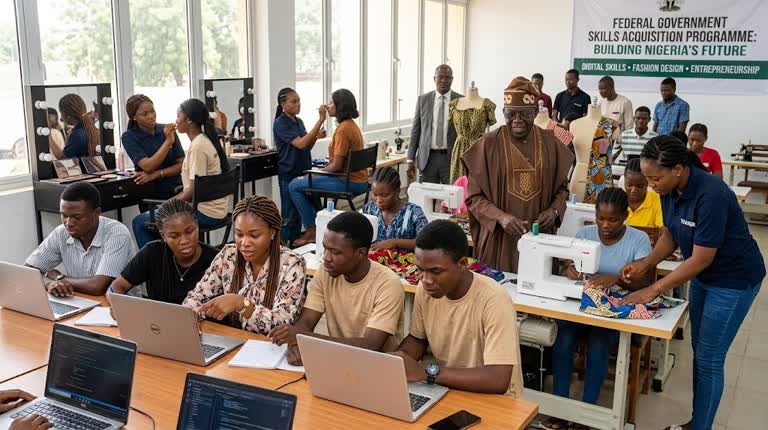
The Federal Government has launched a four-year poverty reduction initiative targeting five million Nigerians, with 700 beneficiaries in Oyo State receiving training in artificial intelligence (AI), graphics design, and vocational skills.
The programme is being implemented by the Office of the Senior Special Assistant to the President on Technical, Vocational and Entrepreneurship Education (OSSAP-TVEE). It aims to tackle unemployment, bridge skills gaps, and equip Nigerians with the skills and resources needed to establish businesses and achieve financial independence.
The Oyo State training programme ran from September 28 to October 9 and concluded with a graduation ceremony at the University of Ibadan. Beneficiaries received equipment and digital devices to support their professional development and entrepreneurial activities.
Government Emphasises Skills Development
Speaking at the graduation ceremony, the Senior Special Assistant to the President on Technical, Vocational and Entrepreneurship Education, Dr Abiola Arogundade, said President Bola Tinubu wants young Nigerians to have opportunities to become economically independent.
“Mr President believes that our young people do not simply need assistance. They need opportunity. They need skills. They need the tools to compete and build sustainable livelihoods. And that is what today represents,” she said.
According to the programme’s figures, 30 beneficiaries received training in AI and graphics design, 85 were trained in make-up artistry, and another 85 in fashion design. In addition, 500 beneficiaries received digital devices.
Arogundade encouraged the beneficiaries to use their newly acquired skills and equipment to build sustainable businesses and create opportunities for others.
“What you receive today is not the destination. It is the beginning. Take the skills you have learnt. Take the tools you have received, and build something with them,” she said.
Beneficiaries Encouraged to Create Jobs
Oyo APC governorship candidate, Senator Sharafadeen Alli, also urged the beneficiaries to take advantage of the programme to establish sustainable businesses and create employment opportunities.
One of the beneficiaries, Olaleye Idowu, said he hopes to become a professional AI prompt engineer within five years. He also expressed his ambition to train and employ others in the future.
The Olubadan of Ibadanland, Oba Rashidi Ladoja, described the initiative as a positive development, expressing hope that it would empower beneficiaries and contribute to poverty reduction.
Focus on Economic Empowerment
The initiative highlights the role of technical education, digital skills, and vocational training in addressing unemployment and supporting entrepreneurship.
By providing training, equipment, and digital devices, the programme seeks to help beneficiaries turn their knowledge into productive ventures and sustainable livelihoods.
Its broader target is to reach five million Nigerians over four years, although the overall impact will depend on effective implementation and the ability of beneficiaries to translate their training into lasting economic opportunities.