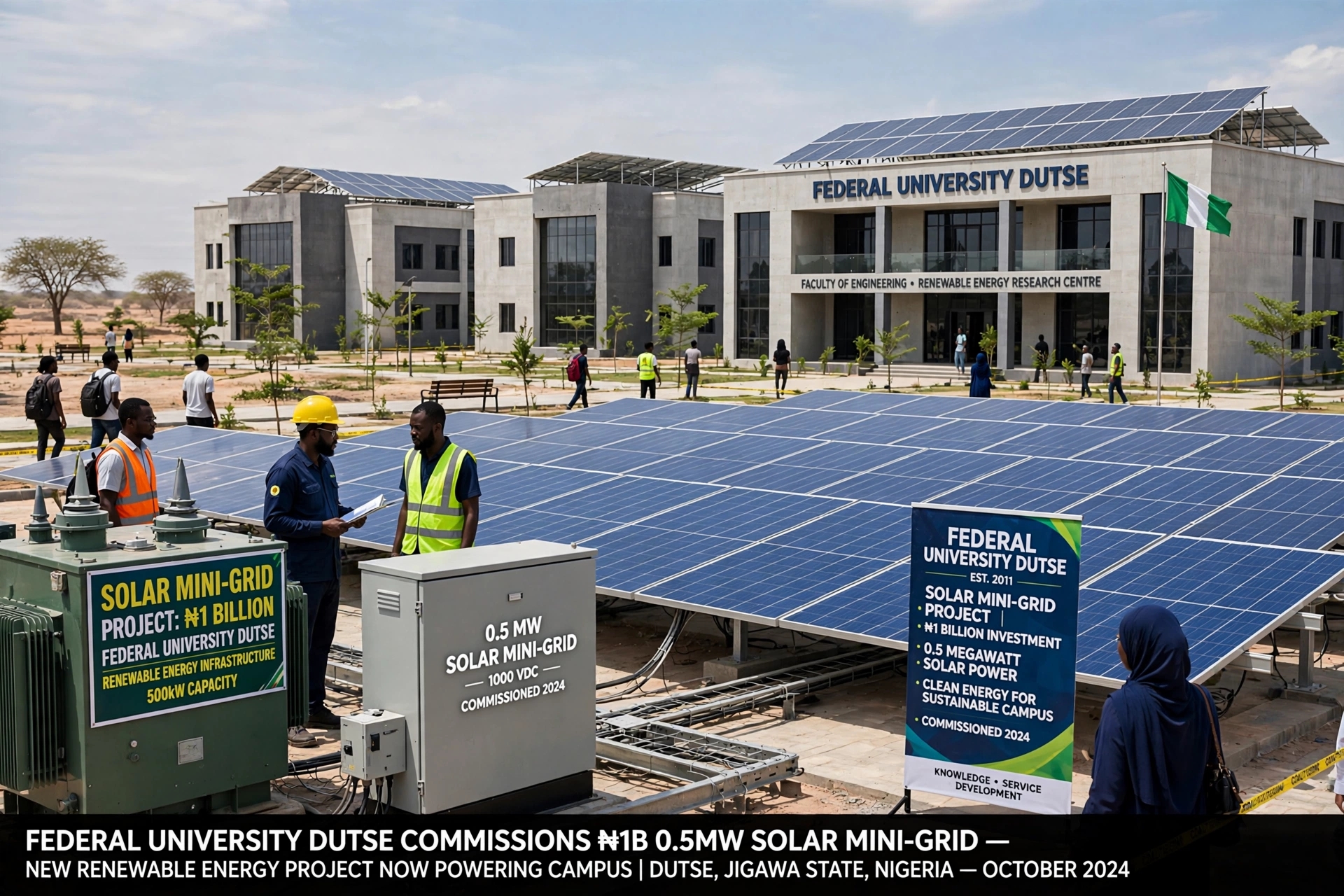
The Federal University Dutse (FUD) in Jigawa State has secured a ₦1 billion solar mini-grid project aimed at strengthening electricity supply on campus. The development was confirmed by the university in a statement issued on Wednesday, October 1, 2026, by the Acting Director of Public Affairs, Mr Abdullahi Yahaya Bello. According to the statement, the project was approved by the Energy Commission of Nigeria (ECN) under the Federal Government’s Renewed Hope Solarization Agenda for Alternative Energy. The project highlights growing efforts to improve power infrastructure at Nigerian universities, where unreliable electricity can disrupt academic activities, research and essential administrative services.Confirmed Award and Funding:- Amount: ₦1 billion awarded by ECN- Capacity: 0.5-megawatt (500-kilowatt) solar mini-grid for generation of power to improve electricity supply on campus- Status: Approved and awarded, expected to commence soon- Completion timeline: 3 months from commencement- Additional project: 100 solar-powered streetlights approved by ECN, with 50 already ready for installationThe statement noted that the mini-grid would provide additional electricity and improve power supply for teaching, learning, research and other activities on campus. Vice-Chancellor, Prof. Ahmad Mohammed Gumel, expressed appreciation to President Bola Ahmed Tinubu and the Director-General of ECN, Dr Mustapha Abdullahi, for the intervention. He described it as significant to the university’s infrastructure drive and disclosed that ECN is also willing to partner with the university on renewable energy research. Electricity is essential to the daily operations of modern universities. Laboratories require reliable power to operate equipment, while libraries, computer centres and lecture facilities depend on electricity to support learning and research. Students also rely on power to charge devices, access digital learning materials and complete assignments. When electricity supply is unreliable, institutions may face additional costs associated with generators, fuel and equipment maintenance. These expenses can divert resources that could otherwise support academic programmes and student services. Solar mini-grids can provide electricity by combining solar panels, power-conversion equipment and, where included in the design, battery storage. Depending on their capacity and configuration, such systems can reduce dependence on diesel generators and improve the reliability of electricity supply. They may also help institutions manage long-term energy costs, although the initial installation, maintenance and replacement of equipment require careful planning. The FUD project is part of broader federal efforts to solarize tertiary institutions, a programme that has already delivered over 100MW across 24 federal universities. While the award is confirmed, the actual benefits will depend on implementation. Students and staff will want to know:1. When installation will physically begin on campus2. Which buildings and hostels will be connected to the 500kW system3. How much electricity the system is expected to generate daily and its backup arrangement4. Arrangements for long-term maintenance and sustainabilityTransparent reporting on these details will help the university community assess the project’s likely impact. Investment in dependable electricity can improve the learning environment and support research activities. For universities seeking to expand digital learning, scientific research and technology-based programmes, reliable power is increasingly important. If successfully implemented within the stipulated three months, the reported solar project could contribute to improved campus operations at Federal University Dutse and serve as a model for renewable energy adoption in higher education. The next important step will be translating the approved ₦1 billion funding into an operational system that delivers measurable benefits to students and staff.
Similar Posts
EKSU Confers Honorary Doctorate on Banker Abayomi Adeyeri
The Senate of Ekiti State University (EKSU) has today, April 11, 2026, conferred an Honorary Doctor of Finance (Honoris Causa) on Mr. Abayomi Adeyeri. The ceremony, held at the university’s main campus, honored Adeyeri for his contributions to the banking sector and his role in national economic development. Adeyeri, a veteran banker who previously oversaw…
The Wrong Train: AEFUNAI SUG Director Of Welfare Ovu Obinna Peter Shares a Powerful Message About Knowing When to Walk Away
Sen. Ovu Obinna Peter, SUG Director of Welfare, shares a powerful message about knowing when to walk away from the wrong situations, embracing personal growth, and finding the courage to choose a better path.
Final Call for JAMB Direct Entry Registration as Portal Shuts Today
If you are planning to secure your university admission through Direct Entry (DE) for the 2026 session, your window of opportunity closes at midnight. Today, Saturday, April 25, 2026, marks the final deadline for the purchase of e-PINs and the completion of registration across the country. The Joint Admissions and Matriculation Board (JAMB) has maintained…
TETFund Releases 2026 Intervention Figures for 271 Tertiary Institutions
The Tertiary Education Trust Fund (TETFund) has officially announced the disbursement figures for its 2026 intervention cycle. Executive Secretary Arc. Sonny Echono confirmed that 271 federal and state-owned tertiary institutions will receive multi-billion naira allocations aimed at infrastructure, research, and technical development. Breakdown of 2026 Allocations The 2026 disbursement guidelines provide a specific flat-rate allocation…
Etagara Festival Begins in Ikwo: Students Urged to Stay Safe and Alert
The annual Etagara Masquerade Festival has commenced in Ikwo, with activities centered around Junction Axes and nearby areas. Students are being advised to exercise caution during the celebrations. Key safety guidance for students includes: Avoid approaching masquerades or blocking their paths. Move in groups if outside. Follow instructions from parents, teachers, and local authorities. Head…
JAMB Delists 23 CBT Centres and Warns 89 Others Ahead of 2026 UTME
The Joint Admissions and Matriculation Board (JAMB) has officially blacklisted 23 Computer-Based Test (CBT) centres across the federation following significant technical failures during the 2026 Mock-UTME held on March 28. In a move to safeguard the integrity of the upcoming main examination—scheduled to run from April 16 to April 25, 2026—the board also issued a…