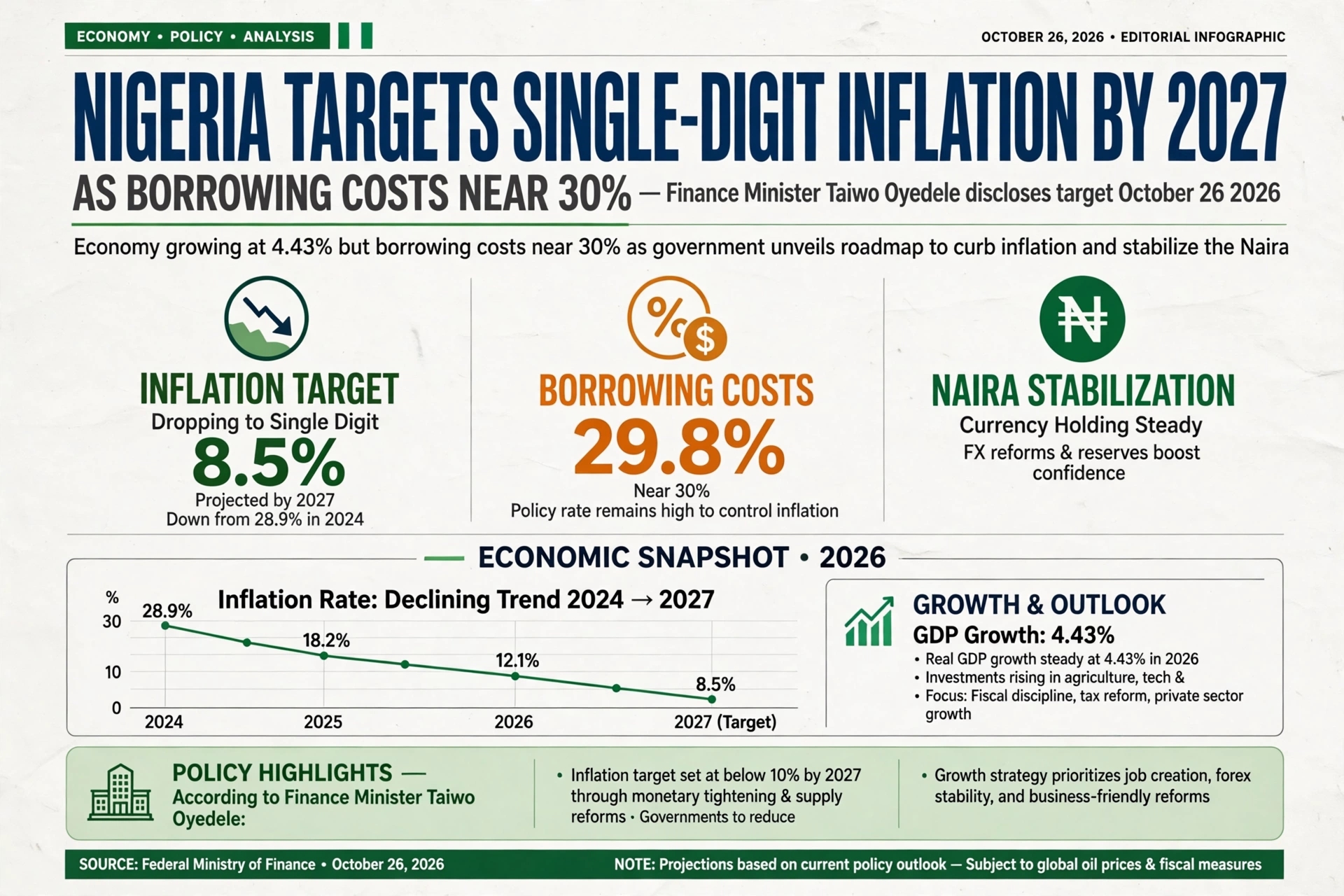
The Federal Government has set an ambitious target of reducing Nigeria’s inflation rate to single-digit levels before the end of 2027, a move officials believe could pave the way for lower borrowing costs and stronger economic growth. Finance Minister Taiwo Oyedele disclosed the target on Monday, October 26, 2026, highlighting the relationship between inflation, interest rates, business investment and the broader performance of the Nigerian economy. Oyedele noted that Nigeria’s economy was growing at approximately 4.43%, while borrowing costs for businesses remained close to 30%. He argued that bringing inflation under control could create the conditions necessary for interest rates to fall substantially, allowing businesses to access more affordable financing. High borrowing costs have remained a significant challenge for Nigerian businesses, particularly manufacturers, small enterprises and companies seeking to expand their operations. When interest rates are high, businesses may find it difficult to obtain loans for purchasing equipment, increasing production or employing additional workers, consumers can also experience the effects through expensive credit, higher business costs and increased prices for goods and services, the government’s inflation target is therefore intended to support broader economic objectives, including investment, job creation and improved purchasing power. However, reducing inflation to single-digit levels would require a substantial improvement in price stability. Achieving the target will depend on several factors, including food prices, energy costs, transportation expenses, exchange-rate stability and the effectiveness of monetary and fiscal policies, food and transport costs are particularly important because they influence the everyday expenses of millions of Nigerian households, the government will also need to balance efforts to encourage economic growth with measures designed to control inflation. Although the announcement provides a clear policy ambition, it does not guarantee that inflation will reach single-digit levels by the deadline, for ordinary Nigerians, the real test will be whether the government’s economic policies translate into more affordable food, lower business costs, increased employment and improved living standards. The coming months will provide further evidence of whether the country is moving towards the stated target.
Similar Posts
NIGERIA’S MOBILE SUBSCRIPTIONS RISE ABOVE 195 MILLION
Nigeria’s telecommunications sector has recorded further growth, with active mobile subscriptions rising to about 195 million in July 2026. The increase highlights the growing importance of mobile communication and internet services to Nigerians.Mobile phones have become an essential part of daily life, with Nigerians increasingly relying on them for banking, business, education, entertainment, communication and…
FG Enrols 16,000 Nigerians in Free Digital Training Academy
The Federal Government has enrolled 16,000 Nigerians into the first cohort of its newly established Digital Training Academy (DTA), a free programme designed to equip young Nigerians with digital skills needed in today’s changing job market. The development comes as Nigeria continues to face growing demand for technology and digital skills, with young people increasingly…
Nigerian Airlines Threaten Nationwide Shutdown Over Future Union Disruptions
Domestic airlines operating under the Airline Operators of Nigeria have warned that they could shut down their operations nationwide if aviation unions again disrupt the operations of any member airline. The warning follows the disruption of airline activities during an industrial action at airports in Lagos and Abuja on August 11. The Airline Operators of…
11 Injured as Petrol Tanker Explodes in Edo State After Residents Scoop Fuel
A petrol tanker explosion in Oluku, Edo State, has left 11 people with varying degrees of burns after residents reportedly gathered to scoop fuel from a fallen tanker. The incident has renewed concerns about the dangers of scooping fuel from accident scenes. At least 11 people have sustained varying degrees of burns following a petrol…
NIGERIA CALLS FOR GREATER AFRICAN ECONOMIC INDEPENDENCE, URGES INVESTMENT IN INFRASTRUCTURE
Nigeria’s delegation at the Berlin Global Dialogue says African countries must strengthen domestic resources, process raw materials locally and build strategic partnerships that support development. Nigeria has called for greater African economic independence, stronger domestic resource mobilisation and strategic investment in infrastructure as part of efforts to accelerate sustainable development across the continent. The position…
Anambra vs Ebonyi Online Banter: The ‘Pack and Go’ Debate Takes an Unexpected Turn
The online banter between Anambra and Ebonyi has taken a humorous turn, raising questions about the people who live, work, study, and do business across state lines. Here’s why the debate is attracting attention.