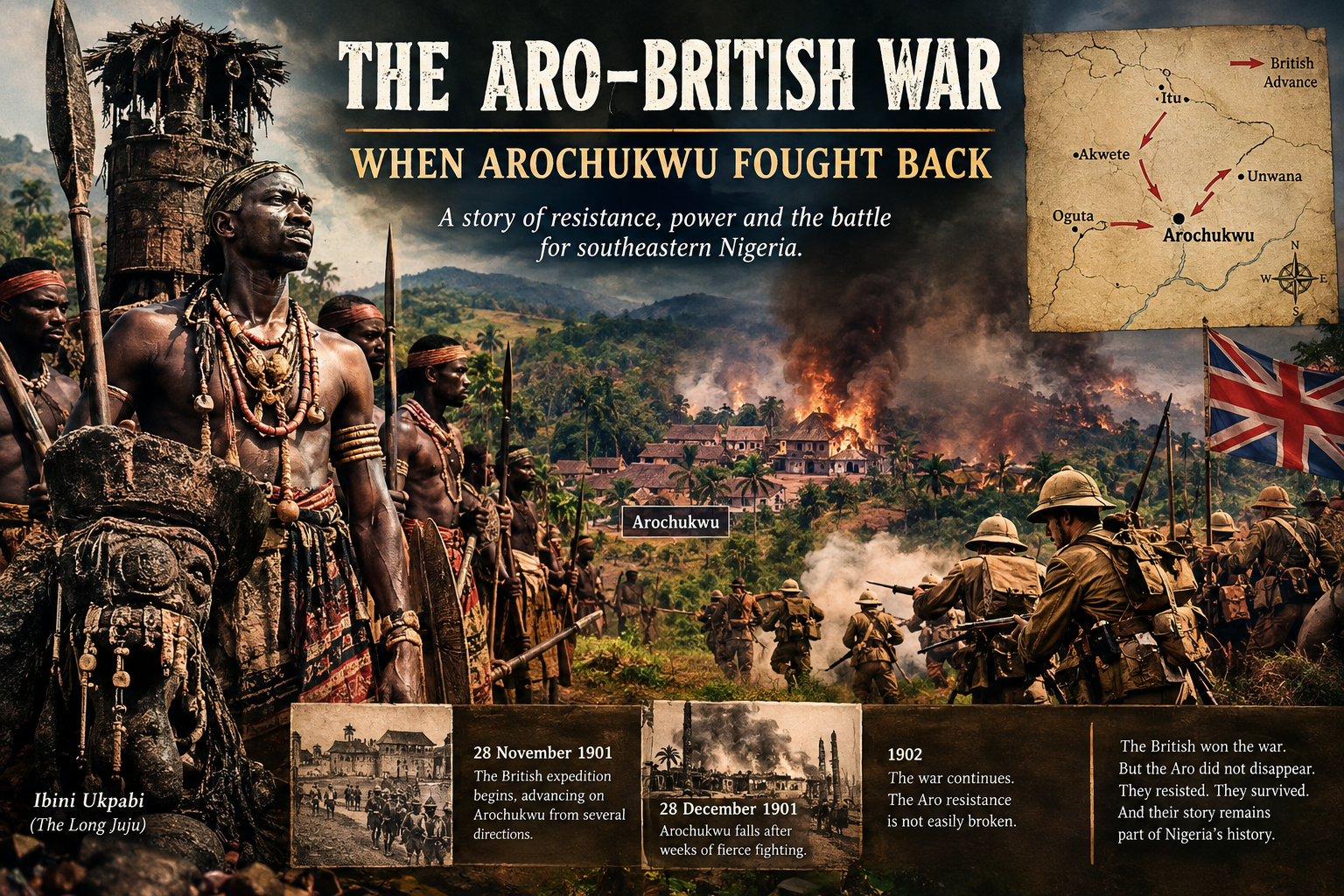
century ago, Arochukwu stood at the centre of one of the most influential political, commercial and religious networks in southeastern Nigeria. Then, in 1901, the British Empire marched into Aro territory.The conflict that followed became known as the Anglo- Aro War, or the Aro Expedition of 1901–1902.It was not simply a battle between two armies.It was a confrontation Led by keg figures like okoro toti against an expanding European colonial power . Arochukwu was an established African network whose influence stretched across large parts of southeastern Nigeria.And when the fighting ended, the political world that had made Arochukwu powerful had been fundamentally altered.BEFORE THE WAR: AROCHUKWU WAS ALREADY Powerful to understand the war, it is important to understand what Arochukwu represented.The Aro Confederacy was not simply a single town or conventional kingdom. Arochukwu was its major centre, while Aro communities, traders and political networks existed across a much wider territory.The Aro became influential through commerce, migration, alliances and the religious authority associated with Ibini Ukpabi, popularly known as the Long Juju.Their commercial network connected communities across southeastern Nigeria and reached into neighbouring regions. This gave Aro merchants considerable influence over regional trade.But Aro history also contains a darker chapter.Historical scholarship documents Aro involvement in the slave trade, including the capture and movement of enslaved people. British officials subsequently presented the suppression of the slave trade as one of the principal reasons for military action against the Aro.However, historians have also argued that the conflict cannot be explained by the slave trade alone.British expansion into the interior threatened existing Aro commercial influence, while Christian missionary activity and colonial administration challenged institutions through which the Aro exercised authority.The war therefore emerged from a mixture of political, economic, religious and colonial interests.BRITAIN WANTED THE INTERIOR By the end of the nineteenth century, British influence was moving deeper into what is now southeastern Nigeria.The Aro resisted this expansion.For Britain, the existence of a powerful independent network in the interior presented an obstacle to the consolidation of colonial authority.For the Aro, British expansion threatened an established political and economic order.Negotiations did not resolve the growing tension.By 1899, British authorities had already begun planning a military operation against the Aro.The situation eventually moved from diplomatic confrontation to open conflict.THE WAR Begins in November 1901, Britain launched its major military expedition.Lieutenant-Colonel Arthur Forbes Montanaro commanded the operation. British forces advanced toward Arochukwu from several directions, with columns operating from places including Oguta, Akwete, Unwana and Itu.The expedition involved more than 1,500 fighting troops alongside thousands of carriers, supported by modern weapons including artillery and machine guns.The Aro and their allies resisted.But the military balance was heavily unequal.British forces possessed modern firearms, artillery and machine guns, while the Aro and their allies did not have comparable military technology.The fighting nevertheless was not an effortless British occupation. Aro resistance was described as strong, and fighting continued beyond the capture of Arochukwu.THE FALL OF AROCHUKWU After weeks of fighting, British forces reached Arochukwu.On 28 December 1901, Arochukwu fell after fierce fighting in and around the town.The fall of Arochukwu was more than the capture of a settlement.It struck at the centre of Aro political and religious authority.The British also targeted the institution surrounding Ibini Ukpabi, the Long Juju, which had become one of the most important symbols of Aro authority.Accounts of exactly what happened to the shrine differ. Some historical accounts describe the British as destroying or blowing up the shrine, while other sources note that the sacred site associated with Ibini Ukpabi still exists at Arochukwu today.What is less disputed is that the British campaign deliberately targeted the institution and its authority as part of the effort to dismantle the existing Aro system.THE WAR DID NOT END WITH AROCHUKWU The capture of Arochukwu did not immediately end resistance.British forces continued military operations against Aro resistance and their allies into 1902.The conflict eventually reached its final stages around March 1902, after further fighting in areas including Bende.The defeat destroyed the political power of the Aro Confederacy as it had existed before the war. But Aro resistance did not simply disappear overnight.Aro involvement in later resistance to British rule continued in different parts of southeastern Nigeria.WHAT DID THE BRITISH REALLY WANT?This remains one of the most important questions surrounding the war.British authorities described the operation using terms such as “punitive expedition” and presented the campaign partly as an effort to suppress the slave trade and practices associated with Aro influence.Those reasons were not invented out of thin air: historical research documents the involvement of some Aro networks in slave trading.But historian Adiele Afigbo argued that the official explanation did not tell the entire story. His study places the expedition within the broader process by which Britain was establishing effective colonial control over southeastern Nigeria.Other historical material likewise emphasizes the importance of breaking Aro commercial influence and opening the interior to British-controlled trade and administration.So the war should not be reduced to a simple story of Britain versus slavery.It was also part of the larger process of British colonial expansion.WHAT WAS LOST? For the Aro, the consequences were enormous.The political system that had allowed Arochukwu to exercise regional influence was broken.The authority associated with Ibini Ukpabi was attacked.British colonial administration increasingly replaced existing systems of political authority.Trade patterns changed.Christian missionaries gained greater opportunity to operate.And the Aro world was incorporated into a colonial political system controlled by Britain.Yet the story should not end by portraying the Aro simply as people who disappeared after defeat.Aro communities and descendants continued to exist across Nigeria and beyond, while Aro identity, migration and cultural influence survived the colonial conquest.THE LEGACY OF THE ARO–BRITISH WAR The Aro–British War lasted only a relatively short time, but its consequences reached far beyond the battlefield.The defeat of the Aro removed one of the major obstacles to Britain’s consolidation of power in southeastern Nigeria.It also demonstrated something that would repeatedly occur during the colonial conquest of Africa:an established African political order could be transformed when confronted by a European empire possessing superior military technology and an expanding colonial state.Arochukwu did not simply lose a war.It lost the political independence that had allowed its network of influence to operate on its own terms.And that is why the events of 1901–1902 remain an important part of Nigerian history.The question is not merely who won the war?Britain won the military campaign.The deeper historical question is:What happened to the political, economic and cultural order that existed before the British arrived and what did colonial rule replace it with?More than a century later, that question remains part of the history of Arochukwu, the Aro people and southeastern Nigeria.
Similar Posts
The Day Aba Market Ground to a Halt as Women Smashed British Banks and Burned Colonial Courtrooms to Ash
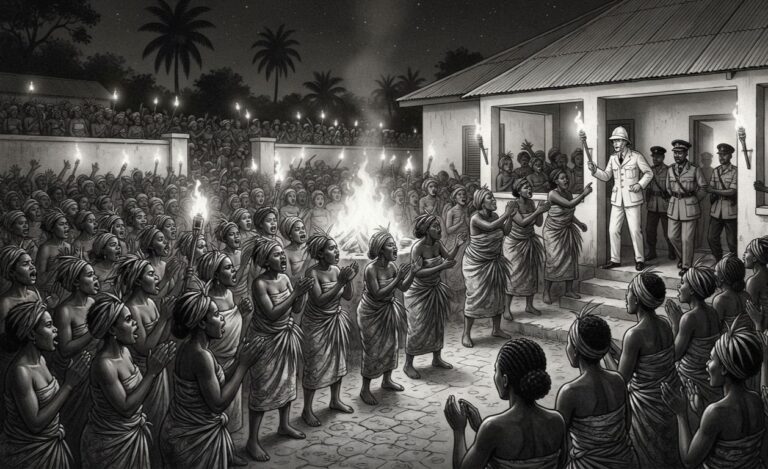
CHAPTER THREE – Aba Women Riot The victory at Oloko was a declaration of freedom that spread across six thousand square miles. By December 1929, over 25,000 women had joined the uprising. They were no longer just protesting a tax; they were systematically dismantling the entire infrastructure of colonial oppression.In the city of Aba, the…
The Night 10,000 Men Fought Themselves
The air outside Karansebes was freezing, and the Austrian army was exhausted. It was 1788, they were at war with the Ottoman Empire, and everyone’s nerves were shredded. A small troop of hussars (cavalrymen) rode ahead to scout for the enemy. They didn’t find any Ottoman soldiers, but they did find a group of locals…
Mozart’s Midnight Madness
It was October 28, 1787, in Prague, and Wolfgang Amadeus Mozart was in deep trouble. The grand premiere of his highly anticipated new opera, Don Giovanni, was scheduled for the very next evening. The theater was sold out, the actors were rehearsing, and the orchestra was ready. There was just one massive problem: Mozart hadn’t…
The Legend of the “Ghost Lecturer” Who Disappeared for an Entire Semester
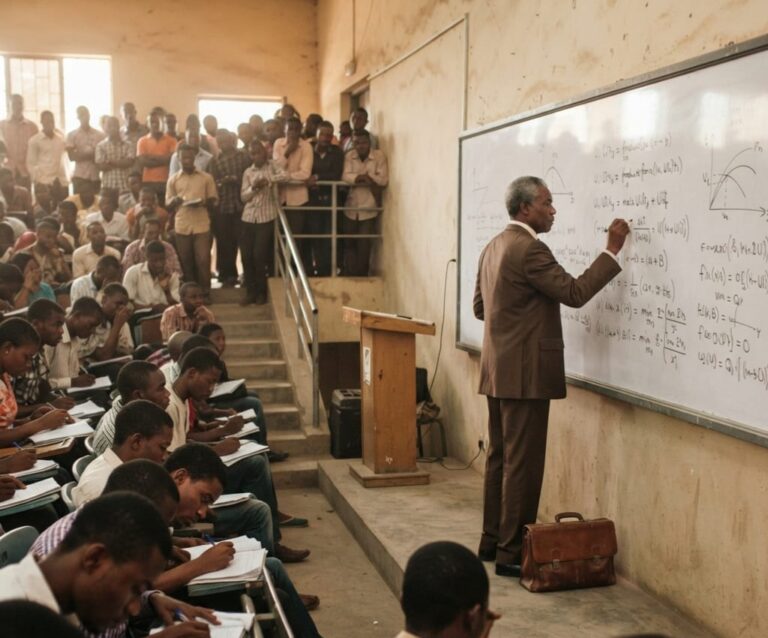
If you’ve ever gone to a 7:00 AM lecture in a hall packed like a BRT bus, stood for two hours because all the plastic chairs were taken, and wondered if the lecturer was ever going to show up—this story is for you. Except, this didn’t happen to just one class. It happened to an…
How 10,000 Furious Women Gathered to “Sit on Chief Okugo” and Strip Him of His Royal Cap
CHAPTER TWO – Aba Women Riot Within hours, the market networks transformed from places of commerce into an underground military machine. Women wrapped palm fronds—the Omu—around their heads and waists. In southeastern Nigeria, the palm leaf was a sacred emblem of crisis, an unmistakable call to war. If a man saw a woman wearing the…
The Day the Hot Plate Caused a Midnight Stampede Down the Female Hostel Stairs
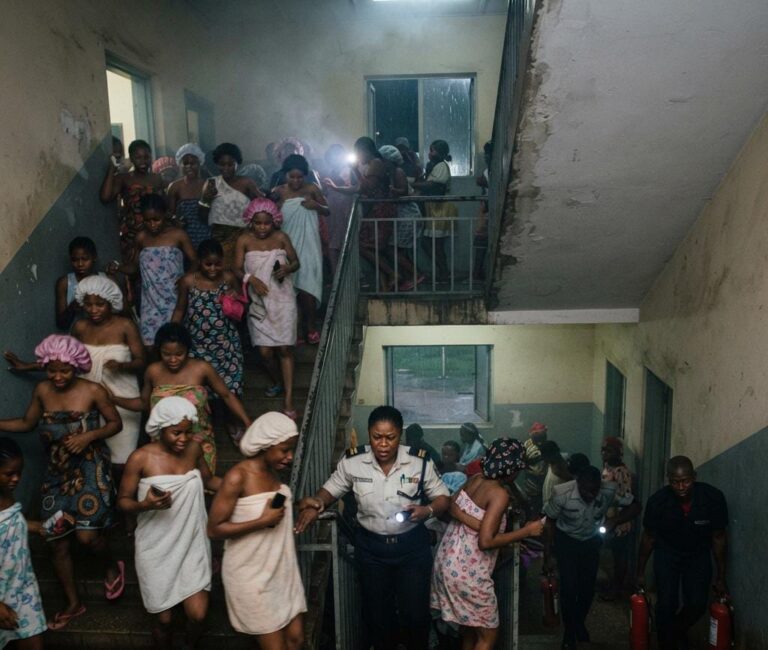
It was a rainy Tuesday night, the perfect weather for cooking a sneaky, highly illegal pot of beans using an electric hot plate. In Room 105 of the female hostel, the rules against heavy electrical appliances didn’t matter when hunger was staring you in the face. Funmi had the pot bubbling beautifully on top of…