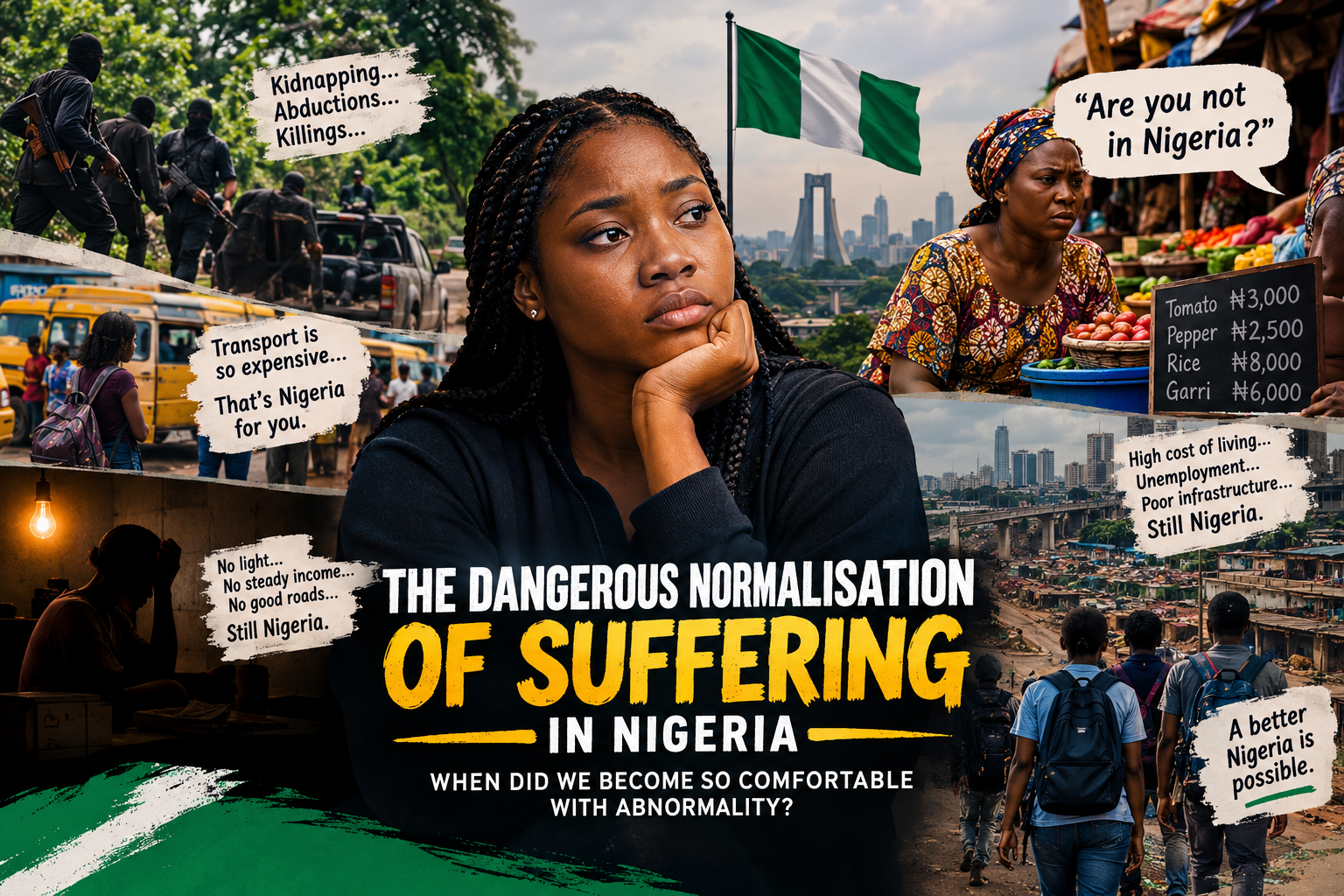
There is something deeply troubling about a country where suffering has become so familiar that people no longer find it unusual. A country where kidnapping has become a recurring headline, where families constantly worry about the safety of their loved ones, and where travelling from one location to another sometimes comes with the fear of not reaching one’s destination. A country where you cannot even complain about the price of goods in the market without someone reminding you, “Are you not in Nigeria?” Think about that statement for a moment. You walk into a market, ask for the price of an ordinary household item, express surprise at how expensive it has become, and someone responds with those familiar words: “Are you not in Nigeria?”
You complain about the cost of transportation, electricity, food or basic necessities, and the response is almost predictable.
“That’s Nigeria for you.”
But when did being Nigerian become an acceptable explanation for everything that makes life unnecessarily difficult?
When did we begin treating hardship as a national identity rather than a problem that deserves attention?Perhaps one of the most disturbing examples of this normalisation is the frequency with which Nigerians encounter reports of kidnapping, abductions, killings and other security challenges, another community is attacked. Another family is thrown into uncertainty. Another person disappears. Another ransom demand makes the headlines, people express outrage, share their fears and offer prayers. Yet, as time passes, another disturbing report arrives, and the cycle continues. Of course, Nigerians have not necessarily stopped caring. Many are simply exhausted by the repetition of tragedies and the uncertainty surrounding their safety, but no society should reach a point where the news of another kidnapping barely interrupts its daily routine. The fear of being abducted should not be part of the ordinary calculation Nigerians make before travelling, attending school, visiting relatives or conducting business. Security is not a luxury. It is a fundamental responsibility of the state. The phrase “Are you not in Nigeria?” deserves a conversation of its own. It is increasingly used to dismiss complaints that should ordinarily be taken seriously. A customer questions an unreasonable price, and the response is that everything is expensive in Nigeria, a worker complains that their salary can barely cover basic expenses, and someone reminds them that the economy is difficult, a student complains about the financial pressure of education, and the response is that everyone is struggling, a citizen questions poor infrastructure, and the conversation quickly becomes an argument about how Nigerians should learn to manage. The problem is not that people are unaware of the country’s economic difficulties, the problem is that awareness of those difficulties is gradually being used to silence legitimate complaints.
Understanding that a country is experiencing economic challenges does not mean citizens should surrender their right to question unreasonable conditions, being Nigerian should not mean accepting everything without explanation. One of the greatest dangers of prolonged hardship is how it changes people’s expectations. People begin to celebrate things that should ordinarily be basic responsibilities, a few hours of electricity become something to appreciate excessively, a functioning public facility becomes a remarkable achievement. Receiving a salary on time becomes an occasion for celebration. There is nothing wrong with appreciating good things. The problem begins when the absence of basic services becomes so familiar that their provision feels extraordinary. A country should not measure progress by how successfully its citizens have adapted to deprivation, it should measure progress by how effectively it has reduced the conditions that make survival unnecessarily difficult. Nigerian young people are watching, experiencing and responding to these realities. Many graduates leave universities with ambitions but encounter limited employment opportunities. Others spend years trying to establish businesses in an environment where infrastructure costs, financial pressure and uncertainty make progress difficult. For some, migration has become an attractive alternative. For others, the dream of independence is postponed by the daily struggle to afford basic necessities, we cannot continue to tell young people to work hard, acquire skills and remain patient without also asking whether the society is creating enough opportunities for their efforts to produce meaningful results. Resilience is important, but resilience alone cannot build a functioning society.
This conversation is not an argument that government is responsible for every difficulty in society. Citizens, businesses and institutions all have roles to play, we must discourage corruption, dishonesty, exploitation and the everyday practices that undermine collective progress. However, citizens must also be able to demand accountability from those entrusted with public responsibilities.
Political loyalty should never become more important than public welfare. Criticism should not automatically be interpreted as hatred for the country, loving Nigeria should include wanting better for Nigeria. A citizen who questions poor conditions is not necessarily unpatriotic. Sometimes, questioning those conditions is an expression of genuine concern for the country’s future.
Perhaps the most uncomfortable question is not why Nigeria has so many challenges, but why so many unacceptable conditions have become familiar parts of everyday life. When did insecurity become something people simply pray about and move on from? When did economic hardship become an excuse for every unreasonable demand? When did asking questions become complaining? And when did the simple desire to live comfortably become an expectation people are told is unrealistic?
We must be careful not to confuse endurance with progress, silence with patience or acceptance with patriotism. Nigeria deserves citizens who demand better, institutions that deliver better and leadership that understands that the ordinary Nigerian’s desire for a decent life is not an unreasonable demand. A COUNTRY SHOULD NOT REQUIRE ITS PEOPLE TO LOWER THEIR EXPECTATIONS JUST TO MAKE THEIR REALITY EASIER TO ACCEPT. And perhaps it is time we stopped answering every legitimate complaint with “Are you not in Nigeria?” The more important question should be: Why should being in Nigeria mean that people must accept what they would never consider acceptable elsewhere?
Similar Posts
Zenfind Technology, Outright Growth and StudyCrew: Three Young Companies Building Solutions to Everyday Challenges
Zenfind Technology: Simplifying Accommodation and Local Discovery Zenfind Technology is a technology company focused on identifying everyday problems and developing practical digital solutions. Its first project, Zenifind, aims to simplify accommodation searches, hotel discovery, and access to local services. The platform is designed to connect landlords and tenants directly, addressing housing-search challenges faced by many…
Nigeria’s Heroes Deserve More Than a National Anthem
Every October 1, Nigeria remembers her heroes. We hear their names, we see their portraits, we repeat the familiar stories of independence, sacrifice and patriotism. Then the speeches end, the flags come down. And, too often, the lessons disappear with them. But Nigeria’s heroes deserve more than a few paragraphs in an Independence Day speech,…
NIGERIAN MARRIAGE LISTS: IS IT TIME FOR FAMILIES TO REDUCE THE COST OF TRADITION?
Marriage is supposed to be the beginning of a new chapter in the lives of two people. It represents love, commitment, responsibility and the willingness to build a future together. In Nigeria, however, before many couples can begin that journey, they must first navigate a traditional marriage process that can be financially demanding. Across different…
Muse Spark vs ChatGPT: Which AI is Better for Writers in 2026?
As a writer who has already published 2 stories, I’m always testing new tools. I used AI for ideas and finding the right words, but not to write the whole thing.In April 2026 Meta dropped Muse Spark, and everyone started asking: “Is this better than ChatGPT?”I tested both. One gave me ideas fast. The other…
RWANDA’S DARKEST CHAPTER: WHEN WORDS HELP PREPARE THE GROUND FOR GENOCIDE
Genocide does not begin only when people are killed. Long before mass violence reaches its most horrific stage, societies may experience the spread of dehumanising language, organised propaganda, political manipulation and the gradual normalisation of hatred. The 1994 genocide against the Tutsi in Rwanda remains one of the clearest and most painful demonstrations of this…
What the Girl Child Goes Through — And Why Nigeria Can No Longer Look Away
Before she becomes a woman, she is already at war. A war she did not start, for a body she did not choose, in a world that was not designed for her. Let us follow the life of a typical Nigerian girl child not the privileged one on Instagram, but the one in your street,…