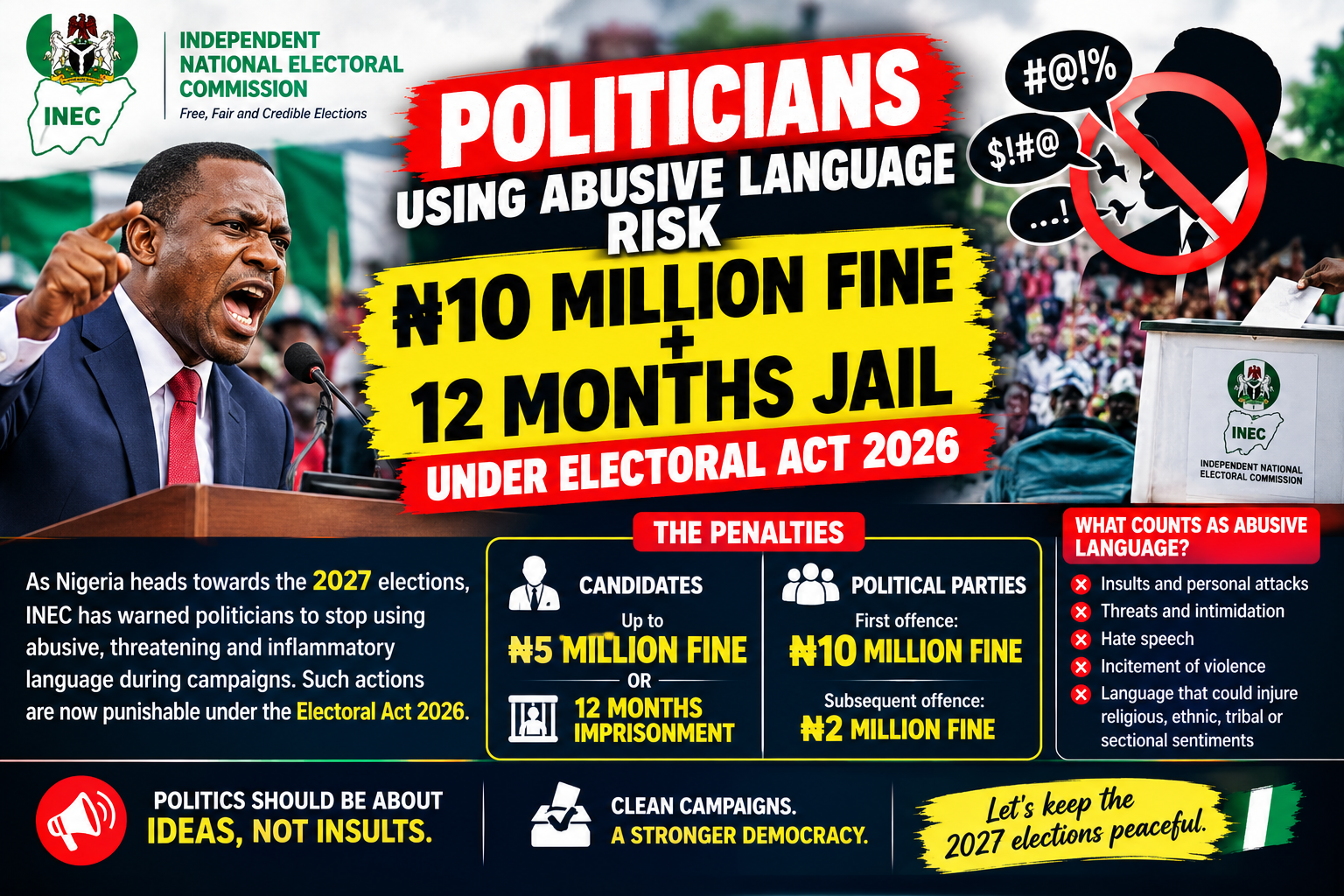
As Nigeria moves closer to the 2027 elections, the Independent National Electoral Commission (INEC) has warned politicians that abusive, threatening and inflammatory campaign language could come with serious legal consequences. The warning comes at a time when political rhetoric is already becoming increasingly heated, with politicians and supporters trading insults, threats and provocative statements across rallies and social media. INEC says political campaigns are expected to focus on policies, ideas and issues—not language capable of provoking violence, intimidating voters or inflaming ethnic, religious or sectional tensions. According to INEC, Section 96 of the Electoral Act 2026 prohibits campaign language that could injure religious, ethnic, tribal or sectional sentiments or provoke violent reactions. The Commission has also warned that threats against voters, political opponents or dissenting residents can cross the line from ordinary political criticism into electoral intimidation. Under the penalty cited by INEC, a candidate convicted of the offence could face a fine of up to ₦5 million or 12 months’ imprisonment, while a political party could face a ₦10 million fine for a first offence and ₦2 million for subsequent offences. For years, Nigerian political campaigns have frequently been accompanied by insults, personal attacks, threats and inflammatory speeches. But with the 2027 elections approaching, INEC is signalling that politicians may no longer be able to dismiss every provocative statement as ordinary campaign rhetoric. The Commission has stressed that criticism of an opponent or disagreement over government policies is not automatically an offence. The concern arises when political language becomes threatening, coercive, hateful or capable of provoking violence. The warning comes as political activity intensifies across the country ahead of the 2027 general elections. INEC has called on political parties, security agencies, the media, traditional rulers and religious leaders to help prevent inflammatory rhetoric from escalating into violence. The message is clear: political competition should be about winning voters, not frightening them.
Similar Posts
Popular Creators Peller and Jarvis Permanently Relocate to Canada
Peller and his wife, Jarvis, have reportedly relocated to Canada as the young couple continues to pursue their personal and career goals.
Nigeria Launches New Digital Postcode System for Buildings Nationwide
Nigeria is set to introduce a new National Digital Alphanumeric Postcode System, giving addressable buildings across the country unique digital codes. The system officially launches on October 1, 2026, as part of efforts to modernise Nigeria’s addressing infrastructure and make it easier to identify and locate buildings. According to the official National Digital Postcode platform…
Nigeria’s External Earnings Rise to $20.08bn as Oil and Gas Exports Increase
Nigeria’s external earnings climbed to $20.08 billion in the second quarter of 2026, representing a significant increase from the $15.56 billion recorded in the first quarter, according to provisional balance of payments figures released by the Central Bank of Nigeria. The latest figures indicate stronger export performance during the three-month period, with crude oil, natural…
Meta Launches Enterprise AI Platform as Zuckerberg Announces Major Business Push
Meta is expanding its artificial intelligence ambitions beyond consumer-facing products with the launch of Meta Enterprise Platform, a new business-focused division designed to help companies use AI to grow, automate operations and transform how they work.Meta CEO Mark Zuckerberg announced the initiative, describing it as a new major pillar of the company’s business.The platform will…
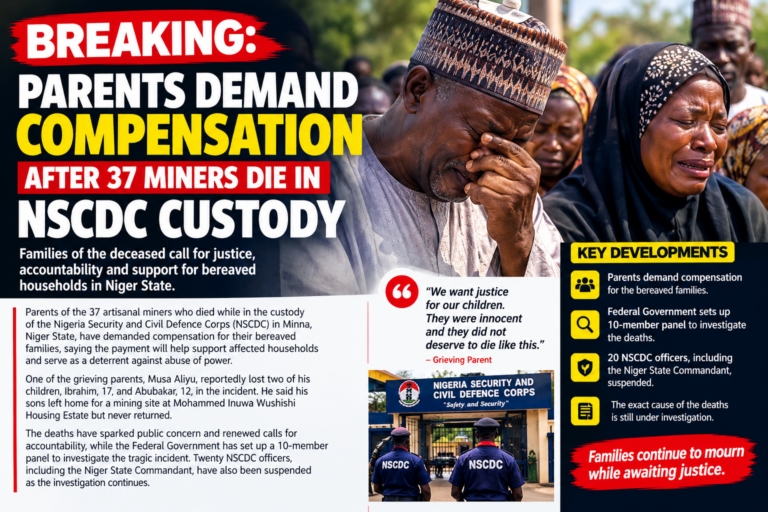
Parents Demand Compensation After 37 Miners Die in NSCDC Custody
Parents of artisanal miners who died while in the custody of the Nigeria Security and Civil Defence Corps in Minna, Niger State, have demanded compensation for the bereaved families. The parents are also calling for accountability over the deaths, which occurred after the miners were arrested and detained by the NSCDC. They said compensation would…
FG Domestic Borrowing Surges 90% to ₦24.7tn in Eight Months as Businesses Face Credit Pressure
Nigeria’s Federal Government borrowed ₦24.7 trillion from domestic investors in the first eight months of 2026, representing a 90.5 per cent increase compared with the ₦12.98 trillion recorded during the corresponding period of 2025. The sharp increase in domestic borrowing has renewed attention on the government’s financing needs and the availability of credit for businesses…