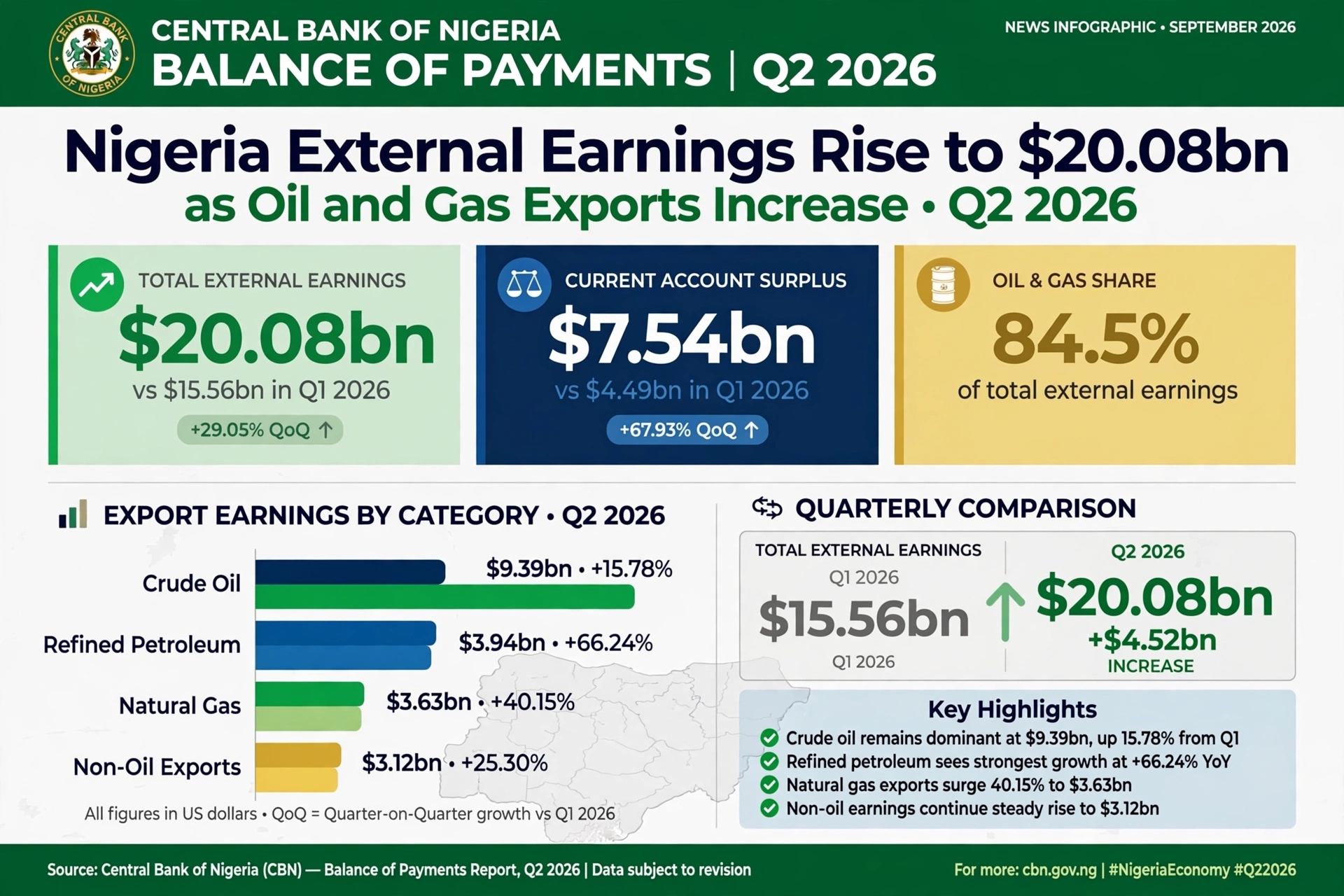
Nigeria’s external earnings climbed to $20.08 billion in the second quarter of 2026, representing a significant increase from the $15.56 billion recorded in the first quarter, according to provisional balance of payments figures released by the Central Bank of Nigeria. The latest figures indicate stronger export performance during the three-month period, with crude oil, natural gas, refined petroleum products and non-oil exports all contributing to the increase. Crude oil export earnings rose by 15.78 per cent to $9.39 billion, while natural gas exports increased by 40.15 per cent to $3.63 billion. The country also recorded a notable increase in refined petroleum product exports, which climbed by 66.24 per cent to $3.94 billion during the quarter. Non-oil exports also increased by 25.30 per cent to $3.12 billion. The stronger export performance helped Nigeria record a larger current account surplus. The surplus rose to $7.54 billion in the second quarter, compared with $4.49 billion in the first quarter and $5.17 billion in the corresponding period of 2025. The increase represents a substantial improvement in Nigeria’s external position and reflects the stronger contribution of merchandise exports during the period. Another factor supporting the goods account was a decline in crude oil imports. According to the reported figures, crude oil imports dropped from $1.39 billion in the first quarter to about $580 million in the second quarter. The performance of refined petroleum exports has also drawn attention because of Nigeria’s growing domestic refining capacity. The increase suggests that Nigeria is not only earning from crude oil exports but is also expanding its role in the export of refined petroleum products. Non-oil exports also recorded growth during the quarter, rising to $3.12 billion. The development is significant because Nigeria has repeatedly sought to increase earnings from sectors outside crude oil. However, the latest figures do not mean that all areas of Nigeria’s external accounts improved at the same pace. The services account recorded a larger net outflow during the quarter, while investment-related payments also remained part of the country’s external transactions. Nevertheless, the overall current account position strengthened considerably. The latest data comes at a time when Nigeria continues to focus on improving foreign exchange earnings, increasing oil production, protecting petroleum infrastructure and expanding non-oil exports. Higher export earnings can provide additional foreign exchange inflows and potentially strengthen the country’s external position, although the broader impact will depend on oil prices, production levels, import demand and developments in other components of the balance of payments. For policymakers, the figures provide fresh evidence of stronger export activity in the second quarter. For businesses and investors, attention will now turn to whether the improvement can be sustained in subsequent quarters and whether Nigeria can continue expanding refined petroleum and non-oil exports alongside crude oil and natural gas. The second-quarter figures therefore put renewed focus on Nigeria’s ability to convert its natural resources, refining capacity and growing non-oil sectors into more stable external earnings.
Similar Posts
Nigeria’s Smartphone Ownership Rises to 75% as Digital Usage Expands
Smartphone ownership in Nigeria has risen to 75 per cent, reflecting the growing role of mobile devices in communication, business and access to digital services. The figure was contained in the Nigeria Smartphone Study, a nationwide analysis of smartphone ownership and digital application usage conducted by KPMG in partnership with Orange Group Nigeria. According to…
Olu Jacobs Dies at 84: Nollywood Loses One of Its Most Celebrated Actors
Nigeria’s entertainment industry has been thrown into mourning following the death of veteran actor and film executive, Oludotun Baiyewun Jacobs, popularly known as Olu Jacobs, at the age of 84. The actor died on Wednesday, September 16, 2026. His family announced the news through a statement shared by his son, Olusoji Jacobs, bringing an end…
Ohafia Community Drama: Woman Reportedly Banished Over Alleged Affair With Two Brothers
A social-media report has sparked widespread reactions after a woman was reportedly banished from her community in Ohafia, Abia State, following allegations of sexual relations with two brothers. A woman identified only in circulating social-media posts has reportedly been expelled from Amuma, Ohafia, Abia State, after she was allegedly caught having sexual relations with two…
Tinubu Returns to Nigeria After Four-Week Working Vacation in Europe
President Bola Ahmed Tinubu has returned to Nigeria after spending about four weeks in Europe on what the Presidency described as a working vacation. The President arrived at the Presidential Wing of the Murtala Muhammed International Airport in Lagos on Tuesday evening, September 29. He departed Nigeria on August 30 and spent time in London…
‘I Started Casting Out Demons at 17’ — Edo Governor Okpebholo Links Teenage Experience to Fight Against Insecurity
Edo State Governor, Monday Okpebholo, has attracted widespread attention after recalling his early involvement in Christian ministry, saying he began “casting out demons” when he was about 17 or 18 years old. The governor made the statement while speaking during a church service at The VOTAGE Church, also known as Voice of This Age, at…
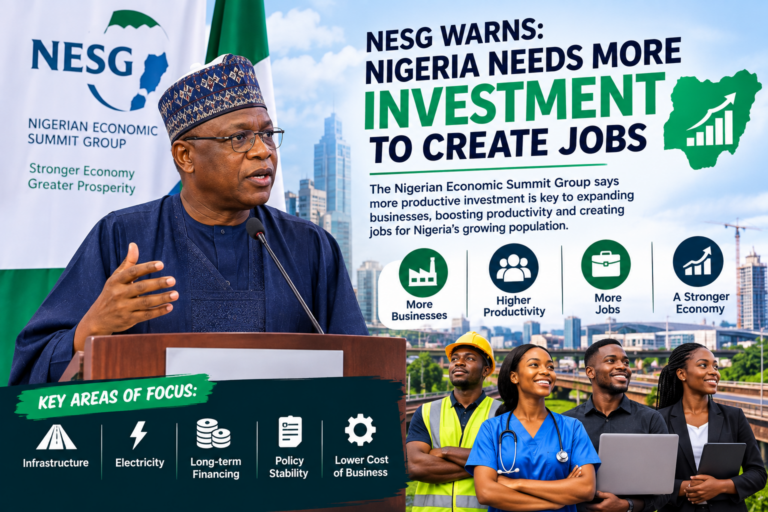
NIGERIA NEEDS MORE INVESTMENT TO CREATE JOBS, NESG WARNS
Nigeria needs significantly more productive investment if the country is to create enough jobs for its rapidly growing population, the Nigerian Economic Summit Group has warned. The organisation said investment remains critical to expanding businesses, increasing productivity and generating employment opportunities.The warning comes as millions of Nigerians continue to search for employment opportunities while businesses…