By XanderXO Entertainment | October 13, 2026
Fresh accusations of airstrikes in Yemen, missile attacks targeting Saudi Arabia and major disruptions to regional aviation are intensifying concerns about a widening security crisis in the Middle East.
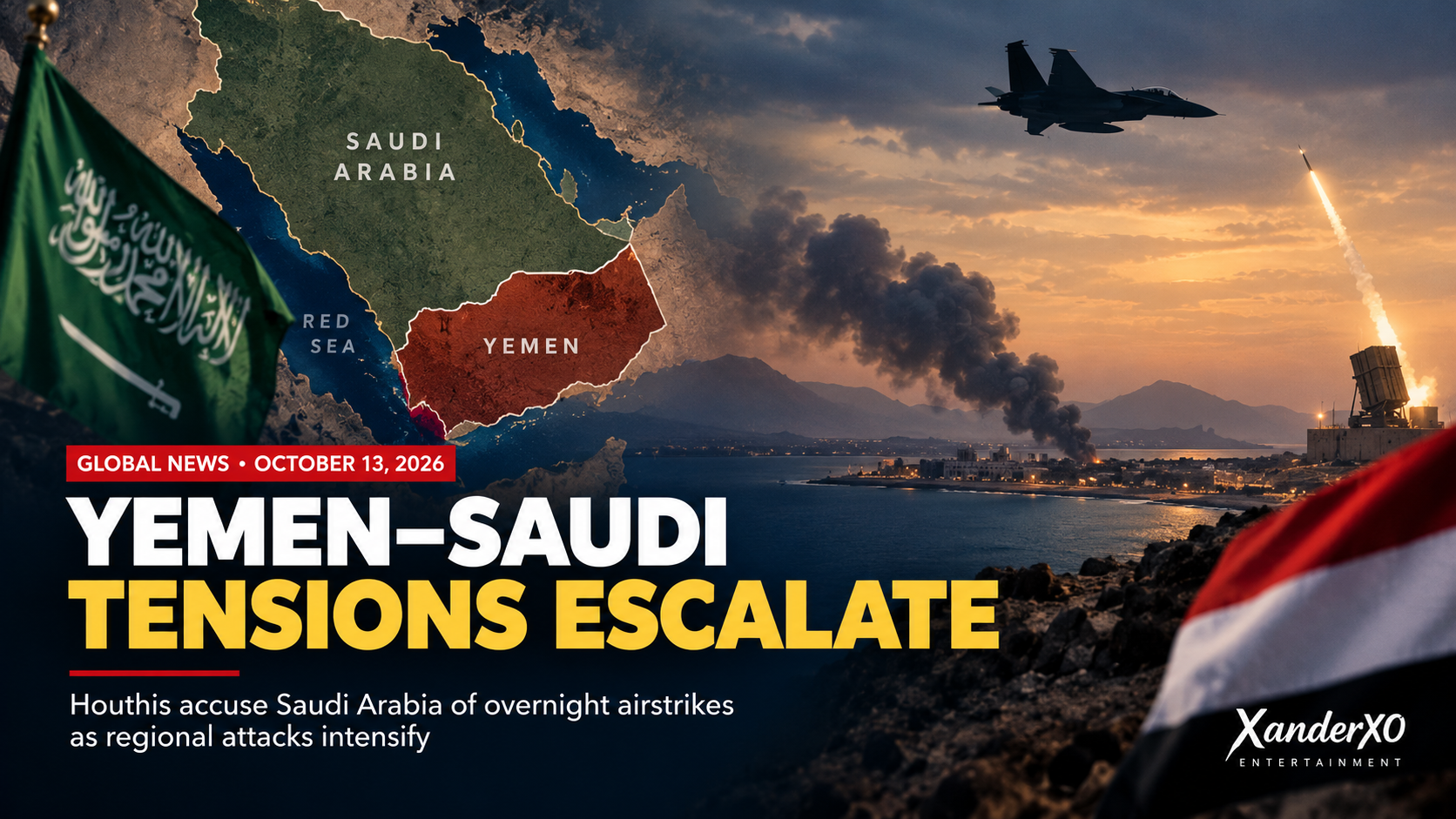
On Tuesday, October 13, Yemen’s Houthi rebels accused Saudi Arabia of launching overnight airstrikes against locations under their control, including Kamaran Island, areas near the Red Sea port city of Hodeida and Jawf province along the Saudi border.
The accusations came amid an intensifying exchange of attacks involving the Iran-aligned Houthi movement and Saudi Arabia, raising renewed questions about the security of civilian infrastructure, regional stability and critical international transport routes.
Saudi Arabia had not immediately responded to the latest allegations, according to the Associated Press. The reported airstrikes should therefore be understood as allegations rather than independently established facts.
HOUTHI-SAUDI HOSTILITIES ENTER A DANGEROUS PHASE
The latest developments follow a series of reported Houthi missile and drone attacks against Saudi targets.
According to Reuters, Saudi authorities suspended operations at King Khalid International Airport in Riyadh following repeated attacks, with the closure announced to continue until October 17, subject to further developments.
The disruption followed deadly projectile strikes at the airport’s passenger terminal. Reports published over the weekend described casualties, including deaths and hundreds of injuries in one of the attacks.
The Houthis have claimed responsibility for attacks involving missiles and drones, while Saudi Arabia has reported intercepting incoming threats.
The developments represent a serious challenge for Saudi security authorities and have heightened concerns about the vulnerability of civilian infrastructure during armed conflict.
Although Saudi Arabia has faced Houthi attacks before, the reported disruption to its capital’s principal airport underscores the potential consequences when hostilities affect facilities used by ordinary travellers and international businesses.
INTERNATIONAL AIRLINES FACE GROWING DISRUPTIONS
The crisis is also affecting international aviation.
Airlines have suspended or adjusted services to Saudi destinations amid security concerns, while aviation authorities have issued warnings about operating in affected airspace.
Reuters reported that several international carriers, including Lufthansa, Air France-KLM, Etihad Airways and Qatar Airways, had cancelled or suspended certain services involving Riyadh or other Saudi destinations.
These disruptions can have consequences far beyond the immediate conflict zone.
Riyadh is an important destination for business travel, government engagement and international events. Prolonged airport closures and airspace restrictions can complicate travel arrangements, increase operating costs and force airlines to reroute aircraft.
Passengers may face cancellations, delays and longer journeys, while businesses may encounter difficulties transporting personnel and coordinating international meetings.
The situation also raises a wider question about the protection of civilian aviation during regional conflicts.
International aviation depends on predictable access to airspace and reliable security information. When missile and drone attacks threaten major airports, the consequences can extend to airlines, travellers and commercial connections across multiple countries.
WHY THE RED SEA MATTERS TO THE WORLD
The geography of the conflict gives it significance beyond the borders of Yemen and Saudi Arabia.
Yemen lies beside the Red Sea and near the Bab el-Mandeb Strait, a strategic maritime passage connecting the Red Sea with the Gulf of Aden and the wider Indian Ocean.
The route forms part of an important shipping corridor used by commercial vessels travelling between Europe and Asia.
Any escalation that threatens maritime security could force shipping companies to reconsider routes, increase insurance costs and extend delivery times.
Longer journeys can raise fuel expenses and disrupt supply chains, potentially affecting the prices of goods far from the Middle East.
Energy markets are also vulnerable to regional instability. If attacks threaten critical infrastructure or shipping routes, oil prices and transportation costs could face additional upward pressure.
The precise economic consequences will depend on the duration and geographical reach of the hostilities, as well as whether commercial shipping remains able to operate safely.
DIPLOMATIC PRESSURE GROWS AS REGIONAL POWERS RESPOND
The latest escalation is prompting renewed calls for regional coordination and diplomatic engagement.
The Associated Press reported that Qatar’s emir called for stronger Gulf security coordination, while Egypt’s foreign minister condemned Houthi attacks during discussions with his Iranian counterpart and urged diplomatic solutions.
Such engagement reflects the wider regional implications of the crisis.
Saudi Arabia’s security concerns intersect with broader tensions involving Iran, the United States and other regional actors. The Houthi movement has received support from Iran, although the extent of Iranian involvement in individual operations remains a separate question from the group’s own claims and actions.
An escalation involving additional regional powers could make de-escalation more difficult and increase the risk of further attacks against military, economic or civilian targets.
At the same time, diplomatic channels remain important because the consequences of prolonged instability could extend across borders and affect countries with different political and economic interests.
CIVILIANS REMAIN AT THE CENTRE OF THE CRISIS
Behind the military developments are the risks faced by civilians.
Missile attacks, airstrikes and threats to transport infrastructure can place residents, airport workers, passengers and other non-combatants in danger.
Yemen has endured years of conflict and humanitarian hardship. Renewed fighting risks deepening the difficulties confronting communities already affected by insecurity and damaged infrastructure.
In Saudi Arabia, attacks on civilian facilities and disruptions to essential transport services create additional safety concerns for residents and travellers.
International humanitarian law requires parties to armed conflict to distinguish between civilians and combatants and to take precautions to protect civilian populations.
The protection of civilian life must remain central to any response to the escalating hostilities.
WHAT HAPPENS NEXT?
The immediate outlook will depend on whether the exchange of attacks continues, whether Saudi Arabia responds to the latest allegations of airstrikes and whether regional diplomatic efforts can prevent further escalation.
The security situation also has implications for airlines, shipping operators, energy markets and international businesses monitoring developments across the Middle East.
For now, the latest reports point to a crisis with consequences extending beyond the battlefield.
The central concern is no longer limited to the security of the two countries. It also involves the safety of civilians, the stability of regional transport networks and the possibility that further escalation could create wider international economic and security repercussions.
As developments continue, independent verification of military claims and careful monitoring of civilian impacts will be essential to understanding the true scale of the crisis.
Sources: Associated Press reporting published October 13, 2026, and Reuters reporting published October 12, 2026.
#XanderXO #Yemen #SaudiArabia #MiddleEast #BreakingNews #InternationalRelations #Geopolitics #GlobalSecurity #RedSea #WorldNews #InternationalNews