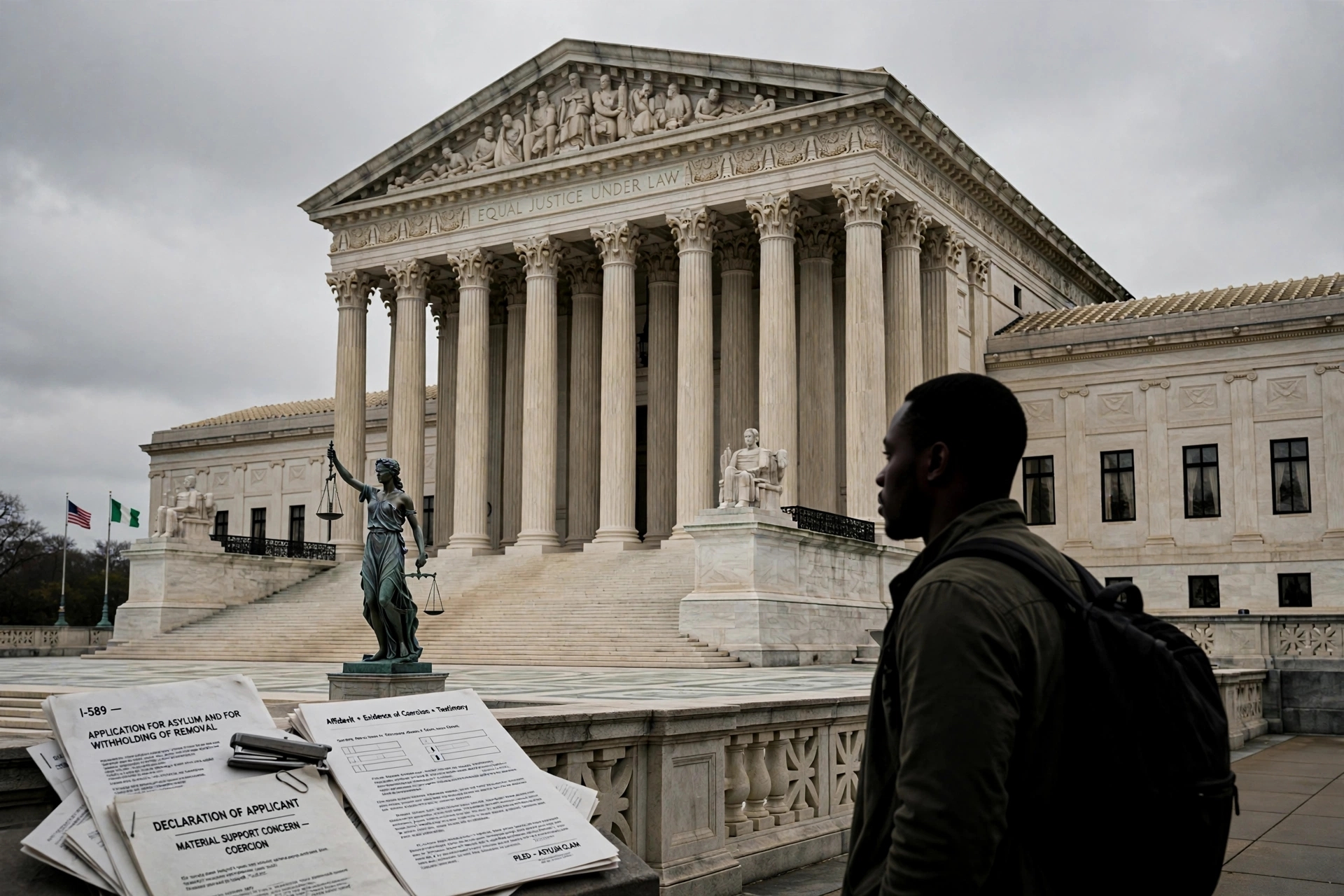
The United States Supreme Court has reportedly agreed to hear an asylum dispute involving Nigerian citizen Izuchukwu Ozurumba, whose case raises questions about how US immigration law treats people who claim they were forced to assist an armed group. The dispute concerns the interpretation of legal provisions that can prevent asylum from being granted to applicants considered to have provided material support to a terrorist organisation. According to the report, Ozurumba maintained that he was compelled to cook for members of an armed separatist group. His case has focused attention on the distinction between voluntary assistance and actions allegedly performed under coercion. The Supreme Court’s decision to hear the dispute could have implications for how similar claims are evaluated under US immigration law. US immigration law contains provisions that can make applicants ineligible for asylum if they are considered to have provided material support to a terrorist organisation. The application of those provisions can become complicated when an applicant argues that the assistance was not voluntary. In cases involving armed groups, people may claim that they were threatened, detained or otherwise forced to perform tasks they would not have chosen to undertake. The legal question is whether, and under what circumstances, alleged coercion affects the application of the relevant statutory restrictions. The answer depends on the governing law, the evidence presented and the legal arguments considered by the courts. The case highlights the difficulties that can arise when immigration proceedings involve people who say they were victims of violence but whose actions may fall within a statutory exclusion. A person who claims to have been forced to provide food, transport or other assistance to an armed organisation may argue that the conduct should not be treated in the same way as deliberate support. Immigration authorities, meanwhile, must apply the legal requirements governing eligibility for protection. The outcome may therefore depend on how the law defines material support and whether the relevant provisions allow an exception or other consideration where coercion is alleged. The details of Ozurumba’s individual case must be distinguished from the broader legal questions before the court. The Supreme Court’s review could provide guidance on the interpretation of the applicable immigration provisions and the treatment of coercion claims. Depending on the questions presented, the court may clarify the legal standards that lower courts and immigration authorities must apply in similar cases. However, agreeing to hear a case does not mean the court has already ruled in favour of either side. The final decision will depend on the arguments presented and the court’s interpretation of the relevant law. It is also important not to assume that the outcome will automatically determine every asylum application involving a person who claims to have been forced to assist an armed group. Individual cases may differ in their facts, evidence and procedural history. The case could attract attention among Nigerians seeking protection in the United States, particularly those whose claims involve threats, violence or alleged coercion by armed organisations. Nevertheless, an applicant’s eligibility for asylum depends on the specific legal requirements and the facts of the individual case. People pursuing immigration protection should obtain advice from qualified legal professionals familiar with US asylum law rather than assuming that another applicant’s experience determines their own prospects. They should also preserve relevant evidence and provide accurate information throughout their proceedings. Beyond the immediate dispute, the case raises a difficult question: how should the law distinguish between a person who voluntarily supports an armed organisation and someone who claims to have acted under threat? The issue involves both the interpretation of statutory restrictions and the circumstances in which a person acted. A legal system must apply the law consistently while examining the evidence and arguments relevant to the case before it. The Supreme Court’s eventual ruling could help define how those considerations interact under the applicable immigration framework. Attention will now focus on the court proceedings, the arguments advanced by the parties and the eventual judgment. Until the court issues its decision, the precise legal implications remain uncertain. For Nigerian asylum seekers and immigration observers, the case is significant because it could clarify how US law treats claims of forced assistance to armed groups. Its ultimate impact will depend on the Supreme Court’s reasoning and the scope of its ruling.
Similar Posts
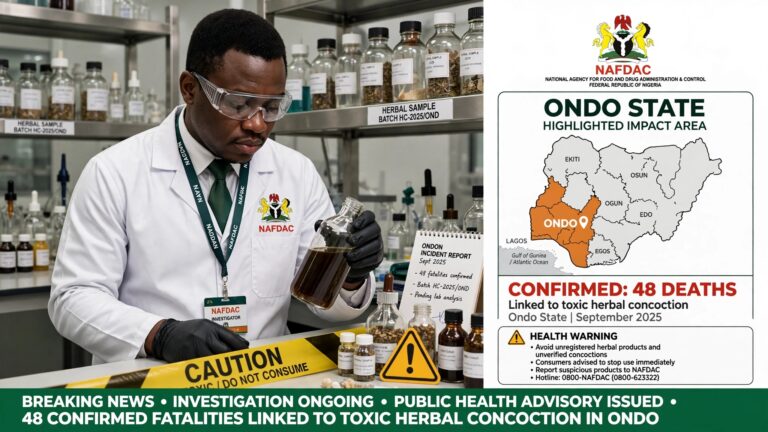
NAFDAC Confirms 48 Deaths Linked to Toxic Herbal Concoction in Ondo
The National Agency for Food and Drug Administration and Control has confirmed that 48 people have died following the consumption of a toxic herbal concoction in Ondo State. The agency also disclosed that 182 cases of illness have been recorded in connection with the incident, prompting further investigation into the substance responsible for the outbreak….
Nigeria Wins $3.38bn Mambilla Arbitration Battle as Major Legal Hurdle Is Cleared
Nigeria has won a major international arbitration battle connected to the long-delayed Mambilla Hydroelectric Power Project in Taraba State, avoiding potential financial exposure of more than $3.38 billion. An arbitration tribunal operating under the International Chamber of Commerce (ICC) in Paris ruled in Nigeria’s favour and rejected claims brought by Sunrise Power and Transmission Company…
Atiku- Tinubu Legal Battle: Court Fixes November 20 for Ruling on Fresh Application
The Federal High Court in Abuja has fixed November 20, 2026, to rule on an application by former Vice President Atiku Abubakar and the African Democratic Congress (ADC) seeking to amend their suit challenging President Bola Tinubu’s eligibility for the 2027 presidential election. The matter came up on Tuesday, October 13, 2026, before Justice Inyang…
UNDP AND CISCO PARTNER TO EXPAND DIGITAL SKILLS AND EMPLOYMENT OPPORTUNITIES FOR NIGERIAN YOUTHS
The United Nations Development Programme (UNDP) and Cisco have formalised a partnership aimed at strengthening digital skills development and employment opportunities for young Nigerians through the Nigeria Jubilee Fellows Programme. The partnership was announced in a UNDP Nigeria press release published on October 15, following the signing of a memorandum of understanding involving the two…
LAGOS GOVT RAISES ALARM OVER PALM OIL ADULTERATED WITH CANCER-LINKED DYES
The Lagos State Government has raised concerns over increasingly sophisticated adulteration of palm oil in markets across the state, urging residents to be more vigilant about the products they purchase.The warning was issued through the Lagos State Consumer Protection Agency (LASCOPA) following a technical presentation at the 2026 Lagos State Food Safety Conference and Exhibition….
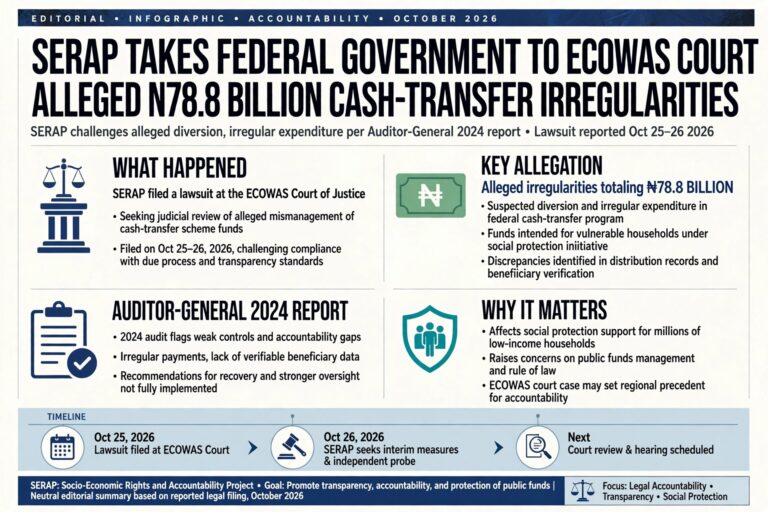
SERAP TAKES FEDERAL GOVERNMENT TO ECOWAS COURT OVER ALLEGED ₦78.8 Billion CASH-TRANSFER IRREGULARITIES
The Socio-Economic Rights and Accountability Project has taken the Federal Government to the ECOWAS Community Court of Justice over alleged financial irregularities involving more than ₦78.8 billion allocated to cash-transfer and social-protection programmes. The lawsuit, reported by Nigerian news outlets on October 25 and 26, 2026, concerns funds intended to support vulnerable households through government…