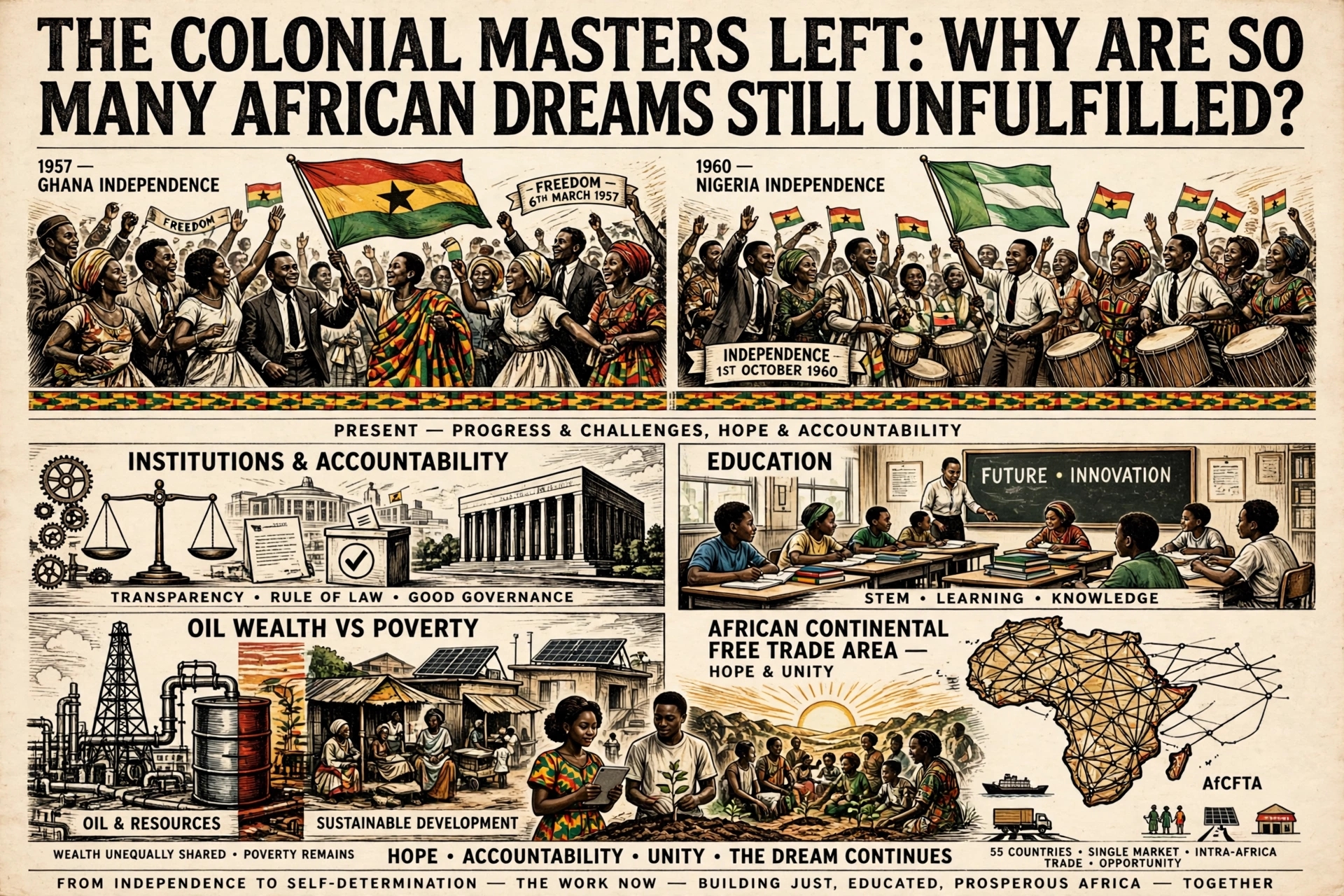
When African countries began gaining independence in the mid-twentieth century, the moment carried enormous expectations. Political freedom promised the opportunity to determine national priorities, build institutions, expand education and use domestic resources for the benefit of citizens. Yet decades after the end of formal colonial rule, many African countries continue to struggle with poverty, unemployment, weak institutions, insecurity and economic dependence. This raises a difficult question: why have so many of the promises of independence remained unfulfilled? Colonial rule was not a uniform experience across Africa, but it frequently involved political domination, economic extraction, racial discrimination and the restructuring of local economies to serve external interests. Colonial administrations established boundaries, imposed systems of government and shaped patterns of production and trade. In many territories, infrastructure was designed substantially around the movement of raw materials and the needs of colonial administration rather than balanced development across all communities. Access to political power and formal education was also highly unequal. In some places, colonial authorities relied on existing local institutions; in others, they transformed or replaced them. The resulting political and social structures varied widely, but they influenced the challenges faced by many newly independent governments. The wave of African independence accelerated during the 1950s and 1960s. Ghana became independent in 1957, while Nigeria gained independence in 1960. Other countries followed through different political struggles and transitions. Independence represented a historic achievement. African peoples had the right to govern themselves and pursue development according to their own priorities. However, political independence did not erase inherited economic weaknesses, eliminate external dependence or automatically produce accountable leadership. In the decades that followed, some African countries experienced military coups, civil wars, authoritarian governments, economic crises and conflicts over natural resources. Corruption and poor public administration weakened development in many places, while external debt, unfavourable trade conditions and global economic shocks created additional pressures, it would be historically inaccurate to blame every contemporary African problem on colonialism. Decisions made by post-independence governments matter. So do global markets, international financial systems, conflict, climate pressures and differences among individual countries. The more useful question is how African states can understand their history without allowing historical explanations to become excuses for present-day failure, political independence must be followed by institutional independence: the capacity to make and implement policies that serve the public interest rather than narrow political or commercial interests, economic independence does not require a country to isolate itself from the world. It requires the capacity to produce competitively, create decent jobs, develop industries, improve agricultural productivity and negotiate international relationships from a position of informed strength. African countries also need reliable education systems, accessible healthcare, effective courts and transparent management of public resources. Natural wealth becomes a genuine national asset only when institutions convert it into broad public benefit. Nigeria provides a particularly important example. The country’s oil resources have generated substantial revenue over many decades, yet economic diversification, infrastructure development and improvements in living standards remain central challenges, the answer cannot be reduced to blaming either foreign powers or domestic leaders alone. Responsible analysis must examine the interaction between historical structures, present policies and the decisions of institutions. African governments should also strengthen regional cooperation. The African Continental Free Trade Area offers a framework for expanding trade among African countries, although its benefits depend on infrastructure, regulatory coordination and practical implementation. Citzens, meanwhile, must demand accountability. Independence was achieved through collective struggle, but the task of nation-building requires continued public participation and scrutiny of those who exercise power. The achievements of African countries should not be ignored. Across the continent, communities have built businesses, expanded education, produced scientific and cultural innovations, and developed institutions despite significant challenges, the purpose of this editorial is not to portray Africa as a continent without progress. It is to insist that the promise of independence deserves a more serious commitment to development, the colonial era is part of Africa’s history, but it must not become a permanent explanation for every failure. True independence is strengthened when nations learn from the past, hold their own leaders accountable and build economies and institutions capable of serving their people.
Similar Posts
APARTHEID ENDED, BUT THE FIGHT FOR EQUALITY CONTINUES
A country may change its constitution, elect a new government and officially abandon a system of oppression without immediately eliminating the inequalities that system created. South Africa’s history provides a powerful reminder that political freedom is a necessary beginning, not the final destination of justice. For decades, apartheid institutionalised racial segregation and discrimination in South…
Honeywell Deploys Industrial AI Platform at Dangote Refinery to Improve Productivity
Honeywell Technologies has launched its Forge Plant Cognition artificial intelligence platform at the Dangote Petroleum Refinery in Lekki, Nigeria, in a move aimed at improving industrial efficiency and strengthening the refinery’s operational performance. Announced on October 26, 2026, the platform combines Honeywell’s industrial expertise with artificial intelligence capabilities from NVIDIA and computing infrastructure from Dell…
TECHNOLOGY AND AI: PROGRESS WITHOUT HUMANITY IS A DANGEROUS ILLUSION
Artificial intelligence is advancing at extraordinary speed, but society must confront an uncomfortable truth: technological progress does not automatically translate into human progress. We are living in an age where machines can write, analyse, create images, imitate voices and perform tasks once considered exclusively human. Artificial intelligence is transforming industries, reshaping economies and challenging our…
THE PRESSURE TO LOOK SUCCESSFUL IS DESTROYING A GENERATION
We are living in a generation where looking successful sometimes matters more than actually becoming successful. People are struggling financially but presenting luxurious lifestyles online. Some borrow money to celebrate birthdays, rent expensive outfits to create an impression, travel to places they cannot comfortably afford and purchase things they do not need simply to convince…
Nigeria’s Heroes Deserve More Than a National Anthem
Every October 1, Nigeria remembers her heroes. We hear their names, we see their portraits, we repeat the familiar stories of independence, sacrifice and patriotism. Then the speeches end, the flags come down. And, too often, the lessons disappear with them. But Nigeria’s heroes deserve more than a few paragraphs in an Independence Day speech,…
7 Things Every 100-Level Student Should Know Before Their First Semester
100 Level Students, Freshers, University Life, Student Tips, Academic Success, First Semester, Study Tips, Undergraduate Students, Education, AE-FUNAI