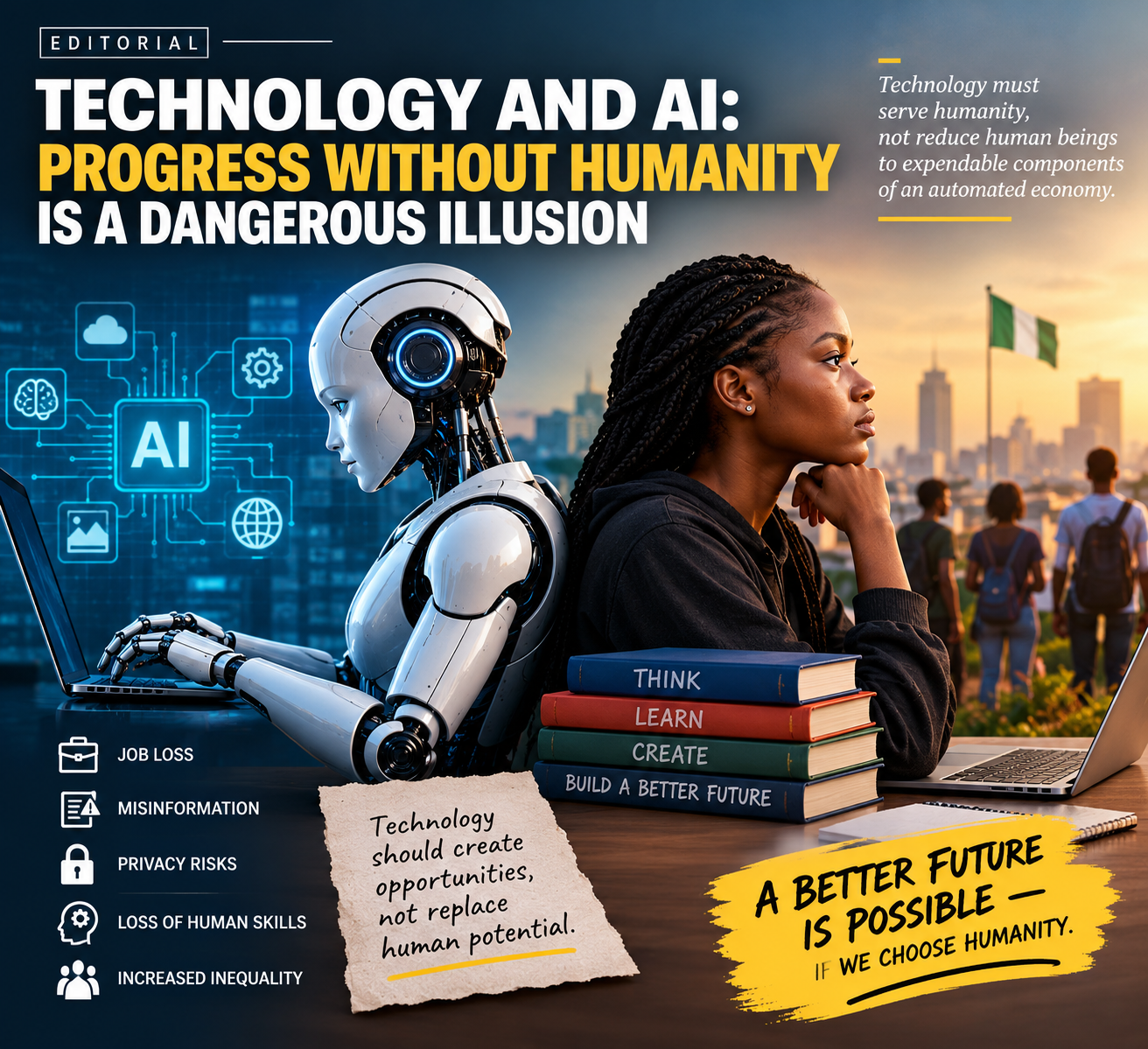
Artificial intelligence is advancing at extraordinary speed, but society must confront an uncomfortable truth: technological progress does not automatically translate into human progress. We are living in an age where machines can write, analyse, create images, imitate voices and perform tasks once considered exclusively human. Artificial intelligence is transforming industries, reshaping economies and challenging our understanding of intelligence itself. Yet, amid the excitement, one fundamental question remains unanswered: Who truly benefits from this revolution? The prevailing narrative celebrates efficiency, speed and automation. Businesses are encouraged to do more with fewer workers, students are tempted to outsource their thinking, and governments are racing to embrace technologies they do not always fully understand. In this rush to modernise, human consequences are too often treated as secondary considerations. This editorial takes a firm position: technology must serve humanity, not reduce human beings to expendable components of an automated economy. There is nothing inherently wrong with machines performing tasks faster or more accurately than people. AI can improve medical diagnosis, expand educational opportunities, strengthen research and help solve complex problems. Rejecting these possibilities would be foolish. But embracing innovation without questioning its social costs is equally irresponsible, when a company replaces workers with AI, efficiency may improve, but what happens to the displaced employees? When students submit AI-generated assignments without learning, what becomes of education? When convincing but false information spreads through AI-generated content, who accepts responsibility for the damage? These are not arguments against technology. They are arguments against technological irresponsibility. The danger is that society may begin measuring progress exclusively in terms of profit, productivity and computational power while neglecting employment, dignity, independent thought and social welfare. A machine may perform a task more cheaply, but the economic savings mean little to a society that leaves millions without meaningful opportunities. Our educational institutions must also confront an uncomfortable reality. If students can obtain instant answers to almost any question, memorisation alone becomes increasingly inadequate. Education must cultivate judgement, creativity, curiosity and the ability to distinguish truth from fabrication. AI should strengthen these abilities, not become a substitute for them. For Nigeria, the stakes are particularly high. We cannot afford to become a nation of technology consumers while other countries develop the systems, own the intellectual property and capture the greatest economic rewards. Embracing AI without investing in digital infrastructure, technical education, local research and workforce development risks widening existing inequalities. Our young population must be equipped to build technology, not merely use it. Government, industry and educational institutions must therefore move beyond ceremonial declarations about innovation. They must establish sensible safeguards, promote digital literacy, protect personal data, support workers through economic transitions and ensure that the benefits of AI are not concentrated in the hands of a privileged few, the central issue is not whether artificial intelligence will change the world. It already is. The real issue is whether society will shape that change deliberately or allow commercial interests and technological momentum to shape it for us. We must reject the dangerous assumption that whatever technology makes possible is automatically worth doing. Human welfare, fairness and accountability must remain the standards against which innovation is judged. Artificial intelligence may become more powerful, more sophisticated and more deeply embedded in everyday life. But intelligence without responsibility is a liability, and innovation without humanity is an empty achievement. The ultimate measure of technological progress is not how much human labour we can eliminate, how quickly machines can produce results or how much profit automation can generate, it is whether technology makes life more dignified, expands opportunity and enables more people to live meaningful lives. We must not build a future in which machines become increasingly valuable while human beings become increasingly disposable. Technology must advance, but humanity must not be sacrificed at the altar of progress.
Similar Posts
AFTER GRADUATION, THEN WHAT? NIGERIA’S SILENT WAR ON YOUNG JOB SEEKERS
The graduation gown comes off, the photographs are taken, congratulations pour in, and then reality arrives: “What next?” For many Nigerian graduates, finding a job can be harder than earning the degree itself. Applications are sent, interviews are attended, yet many employers still demand years of experience for entry level positions. It becomes a frustrating…
CROWN THE DEVIL
CROWN THE DEVIL We Know Who He Is. We Still Give Him the Crown. XanderXO — THE MOST DANGEROUS CROWN IS NOT ALWAYS FORCED UPON US There is something uncomfortable about power. We complain about it when it hurts us. We criticize it when it fails us. We curse it when the price becomes unbearable….
FROM SUG TO ABUJA: ARE WE TRAINING THE LEADERS OR PROBLEMS OF TOMORROW?
Chime Chukwuagoziem J. LL.B (Hons). (chukwuagoziem2003@gmail.com , +2349130791717) Every country eventually produces the politics it has taught its citizens to practice. The Nigerian question, therefore, may not begin in the chambers of the National Assembly, the Executive Council or the corridors of power in Abuja. It may begin much closer to home, in our lecture…
Zenfind Technology, Outright Growth and StudyCrew: Three Young Companies Building Solutions to Everyday Challenges
Zenfind Technology: Simplifying Accommodation and Local Discovery Zenfind Technology is a technology company focused on identifying everyday problems and developing practical digital solutions. Its first project, Zenifind, aims to simplify accommodation searches, hotel discovery, and access to local services. The platform is designed to connect landlords and tenants directly, addressing housing-search challenges faced by many…
Chinese Warehouses and Stores in Africa: A Blessing or a Threat to Local Businesses?
Walk into many major African cities today and there is a good chance you will come across shops, warehouses or businesses selling products imported from China. From electronics and phone accessories to clothes, household items, building materials and spare parts, Chinese products have become a familiar part of everyday life for many African consumers.For customers,…
WHEN CHANGE BECOMES A BURDEN: THE NEED FOR STUDENT-CENTRED ADMINISTRATION IN OUR UNIVERSITIES
Can an administration truly progress when the people it is supposed to serve are struggling to adjust to its administrative decisions and reforms?They say change is the only constant thing in life. This is absolutely true, as no reasonable progress is achieved without making adjustments and allowing room for change. Humans desire progress and development…