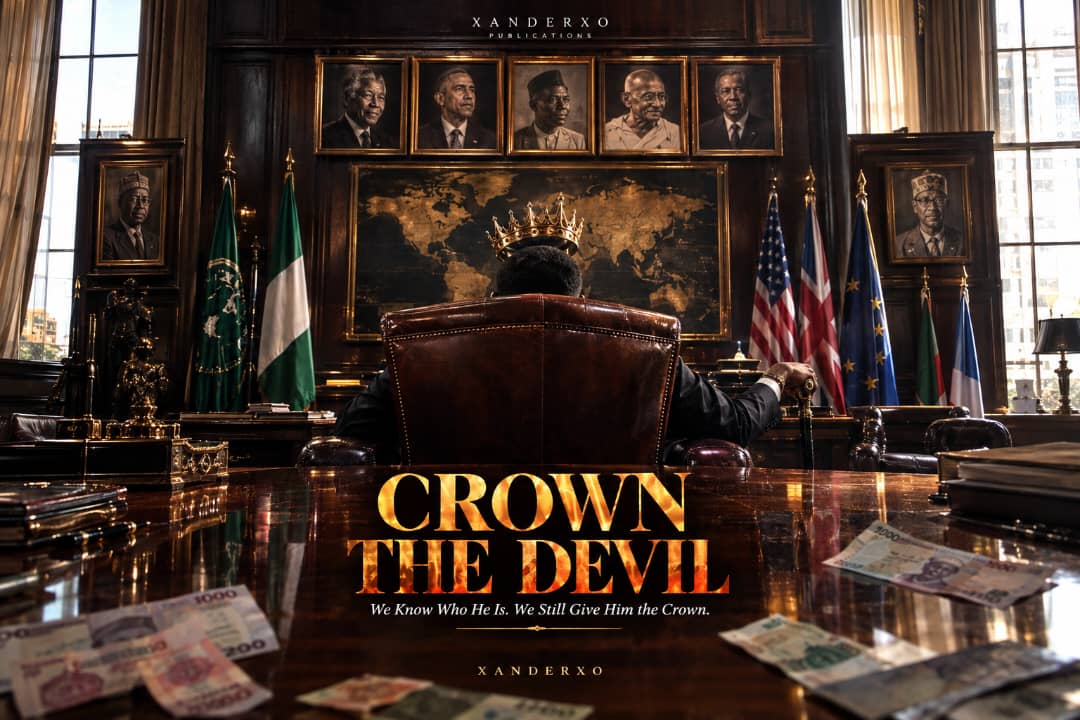
CROWN THE DEVIL
We Know Who He Is. We Still Give Him the Crown.
XanderXO
—
THE MOST DANGEROUS CROWN IS NOT ALWAYS FORCED UPON US
There is something uncomfortable about power.
We complain about it when it hurts us.
We criticize it when it fails us.
We curse it when the price becomes unbearable.
Yet sometimes, when the moment comes to decide who receives the crown, the same society that complained about the consequences helps place the crown on the very head it once questioned.
And that is where the real problem begins.
Because leadership is not merely about the person sitting in the chair.
It is about everything that happens after the chair is occupied.
A leader does not enter power alone. He brings ideas, relationships, interests, habits, alliances and consequences with him.
And sometimes, he leaves behind something even more difficult to remove than himself: a system that has learned how to survive him.
That is the meaning behind Crown the Devil.
The devil, in this article, is not a supernatural being.
It is a metaphor.
It represents leadership that is knowingly destructive, leadership that thrives on corruption, manipulation, patronage or impunity — and the uncomfortable reality that societies can sometimes participate in elevating such leadership.
The question, therefore, is not simply:
Who is the devil?
The harder question is:
Who handed him the crown?
—
WHEN DISAPPOINTMENT BECOMES APATHY
Political apathy rarely arrives overnight.
It grows.
First, people become disappointed.
Then they become frustrated.
Then they stop believing.
Eventually, they stop participating.
The sentence changes from:
«“We need better leadership.”»
to:
«“Nothing will ever change.”»
That sentence may sound harmless.
It is not.
When enough people begin believing that their participation does not matter, absence itself becomes political.
Nigeria’s electoral history illustrates the scale of the problem. According to the Independent National Electoral Commission, presidential-election turnout fell from 53.7% in 2011 to 43.6% in 2015, 34.7% in 2019 and 26.7% in 2023. INEC identified voter apathy and declining public trust as serious concerns for the country’s democracy.
Those figures are more than percentages.
Behind every percentage is a citizen.
A person who registered.
A person who could have voted.
A person who may have once believed.
And a person who, for one reason or another, eventually decided that participating was no longer worth it.
That is the dangerous stage of political disappointment.
When citizens stop expecting better, bad leadership no longer has to fight as hard for their attention.
—
THE PRICE OF “JUST TAKE THIS”
Politics can become especially dangerous when desperation meets temptation.
A bag of rice.
A little money.
A promise.
A favour.
A job.
A personal connection.
A small gift today.
And sometimes, something as simple as:
«“Don’t worry. I will remember you when I get there.”»
The problem is that public office is not a private transaction.
A citizen may receive something today, but public policy affects that citizen tomorrow — and everyone around them.
The road that is not built does not ask who voted for whom.
The hospital that lacks equipment does not ask who collected money during a campaign.
The school that receives inadequate resources does not ask who promised what.
Public decisions eventually become private consequences.
That is why the question of political choice cannot be reduced to what someone receives before an election.
The bigger question is what an entire society receives after the election.
—
YOU CANNOT BUY A FUTURE WITH A TEMPORARY GIFT
This is where the metaphor of the crown becomes important.
A crown is not simply decoration.
It is authority.
It is permission to make decisions.
It is access to institutions.
It is the power to influence what happens to millions of people.
So when society places that crown on someone’s head, it is not merely saying:
“We like you.”
It is effectively saying:
“We are giving you authority.”
And authority magnifies character.
If a leader enters power with integrity, institutions can be strengthened.
If a leader enters power with a commitment to public service, citizens may benefit.
But where leadership is characterized by corruption or abuse of public resources, the damage can extend beyond one individual.
People adapt to systems.
Institutions adapt.
Political networks adapt.
And those who learn how to benefit from a broken system may have an incentive to preserve it.
That is how a person can leave office while the habits associated with that period continue.
The person leaves. The pattern remains.
—
THE SEAT CAN OUTLIVE THE PERSON
This is one of the least discussed parts of political power.
We often focus on the individual.
Who is the president?
Who is the governor?
Who is the minister?
Who is the legislator?
But institutions are larger than individuals.
A powerful office can survive several occupants.
And every occupant leaves something behind.
A standard.
A precedent.
An appointment.
A relationship.
A political culture.
A network.
A method.
A lesson about what can be tolerated.
That is why corruption should not only be understood as the misconduct of individuals.
It can also become a question of institutional culture.
If misconduct repeatedly goes unpunished, people learn.
If loyalty is consistently rewarded over competence, people learn.
If public resources can be abused without meaningful consequences, people learn.
If citizens repeatedly believe that nothing will happen regardless of who governs, they learn too.
Eventually, the abnormal begins to look normal.
And perhaps that is one of the most dangerous things that can happen to a society:
when people stop being shocked by what should shock them.
—
AFRICA IS ASKING FOR A SEAT AT THE TABLE
The debate does not stop at national politics.
It reaches the international system.
In September 2026, as the United Nations General Assembly opened its 81st session, the question of Security Council reform again placed Africa’s representation under scrutiny.
The President of the General Assembly stated that Africa, despite being the largest regional grouping by number of UN member states and a major contributor to UN peacekeeping, remains underrepresented on the Security Council. He said, “Africa needs to be at the table, not on the menu.”
The African Union has maintained a long-standing position that Africa should have at least two permanent seats and five non-permanent seats on a reformed Security Council, with the permanent seats carrying the same privileges as existing permanent members, including the veto if it remains part of the Council.
This debate exposes a larger question about power:
Who gets to decide?
A continent can be discussed.
A continent can be represented.
A continent can be affected.
But representation becomes fundamentally different when those affected also have meaningful participation in the decisions being made.
As the African Union Commission Chairperson put it in May 2026, Africa is “not asking for a favour” but seeking what the AU describes as the correction of a historical injustice.
The argument is therefore not simply about occupying chairs.
It is about having a voice where decisions with global consequences are made.
—
BUT HERE IS THE QUESTION AFRICA MUST ALSO ASK ITSELF
It is easy to look outward.
It is harder to look inward.
We can ask why Africa does not have permanent representation on the Security Council.
We can ask why global institutions have been slow to change.
We can ask why African interests are sometimes represented by others.
All of those questions matter.
But another question matters just as much:
What are we doing with the power we already possess?
Because political power does not begin at the United Nations.
It begins much closer to home.
It begins in communities.
It begins in elections.
It begins in institutions.
It begins with citizens.
It begins with the understanding that public office is not personal property.
And it begins with refusing to treat political leadership as a marketplace where temporary benefits can be exchanged for long-term consequences.
—
THE DEVIL DOES NOT ALWAYS ARRIVE LOOKING LIKE A DEVIL
This may be the most uncomfortable truth of all.
Bad leadership does not always announce itself.
Sometimes it arrives with beautiful speeches.
Sometimes with music.
Sometimes with handshakes.
Sometimes with promises.
Sometimes with the language of hope.
Sometimes with a familiar face.
And sometimes, it arrives through someone who genuinely appears to represent change.
That is why citizens cannot afford to judge leadership only by slogans.
They must examine records.
They must examine policies.
They must examine institutions.
They must examine how power has been used.
They must ask difficult questions.
Because political responsibility does not end when the campaign ends.
The crown has consequences.
—
WHAT HAPPENS AFTER THE CROWN?
This is where political conversations often become too shallow.
We spend months discussing who should occupy the office.
Then, after the election, the conversation changes.
We complain.
We argue.
We defend.
We attack.
We blame.
And eventually, another election arrives.
Then the cycle begins again.
But democracy is more than election day.
It is what happens between elections.
It is accountability.
It is civic participation.
It is institutions.
It is the freedom to question those in power.
It is the responsibility of citizens.
It is the willingness to pay attention even when politics becomes boring.
Because politics may be boring on television.
But its consequences are never boring when they arrive at your doorstep.
—
BEFORE YOU CROWN ANYONE
A society must understand something simple:
A leader is not doing citizens a favour by governing.
Public office is a responsibility.
The road is public.
The school is public.
The hospital is public.
The money being spent is public.
The institution is public.
And ultimately, the consequences are public.
This is why the crown must be treated with seriousness.
Not because every politician is a devil.
Not because every political decision is corrupt.
And certainly not because citizens always have perfect choices.
But because power deserves scrutiny.
Leadership deserves accountability.
And citizens deserve to understand the consequences of the choices made in their name.
—
THE CROWN IS NEVER JUST A CROWN
Perhaps the greatest lesson is this:
We should stop asking only who deserves the crown.
We should also ask:
What will happen after we give it to them?
Who surrounds them?
What institutions will they strengthen?
What standards will they establish?
What behavior will they reward?
What will they tolerate?
What will they leave behind?
Because history rarely remembers only who occupied the chair.
It remembers what happened while they were sitting in it.
And when the crown eventually passes to another head, the new leader inherits more than an office.
They inherit the system.
The culture.
The expectations.
The precedents.
The people.
The possibilities.
Sometimes, they even inherit the damage.
So before we crown anyone, perhaps the question should never simply be:
“What can this person give us?”
Perhaps it should be:
“What are we giving this person the power to do?”
Because a crown can be removed.
A leader can leave.
An election can end.
But the consequences of giving someone power can live far beyond the moment the crown touches their head.
Choose the crown carefully.
Because the crown does not merely reveal the person who wears it.
Sometimes, it reveals the society that placed it there.
—
XanderXO