
Chime Chukwuagoziem J. LL.B (Hons).
(chukwuagoziem2003@gmail.com , +2349130791717)
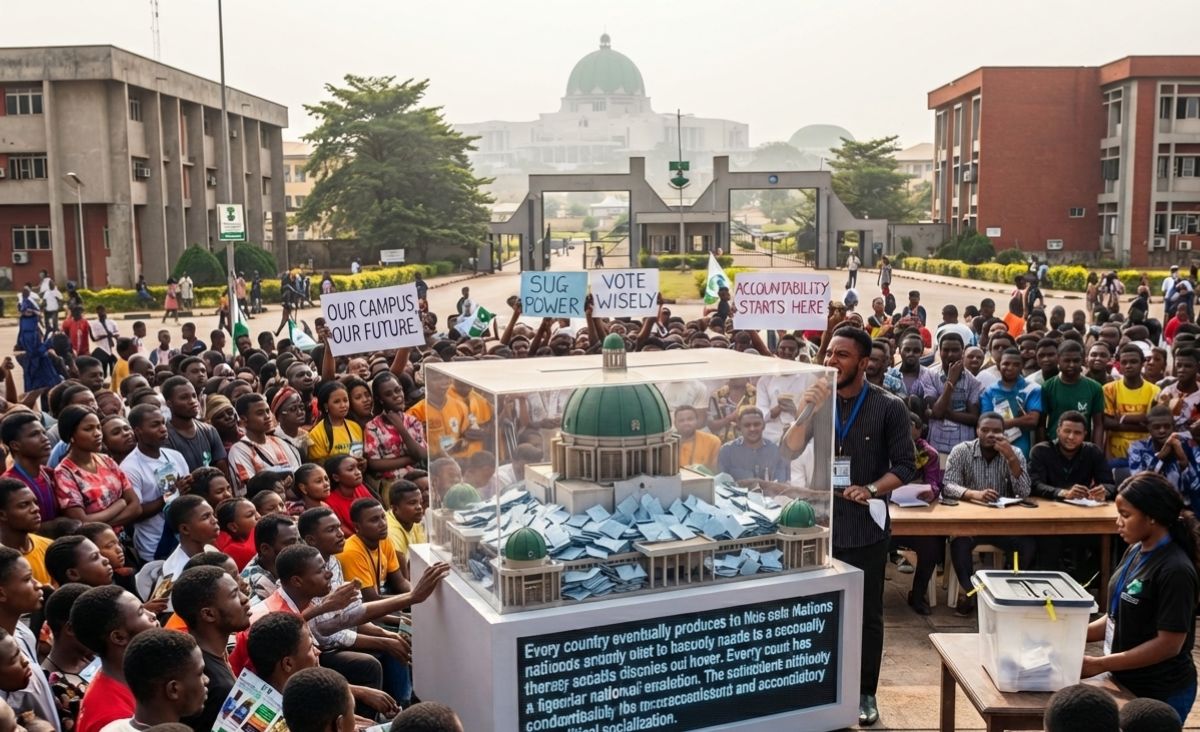
Every country eventually produces the politics it has taught its citizens to practice. The Nigerian question, therefore, may not begin in the chambers of the National Assembly, the Executive Council or the corridors of power in Abuja. It may begin much closer to home, in our lecture halls, faculty associations and Student Union Governments, where the first lessons of political power are often administered.
The university campus is Nigeria in miniature. It has its elections, its manifestos, its factions, its opposition, its alliances, its political merchants and, occasionally, its own species of patronage. Here, young citizens encounter power before they encounter the state in its full majesty. And therein lies the jurisprudential significance of student politics: political character is not ordinarily manufactured at the point of assuming national office; it is cultivated long before the office arrivesHistory offers little comfort to societies that imagine otherwise.
The ancients understood that institutions are only as virtuous as the habits of the people who inhabit them. Aristotle’s enduring inquiry into the constitution was, at its core, an inquiry into the relationship between political institutions and human character. The republic does not exist independently of its citizens; it is, in some measure, a reflection of them.
Our campuses provide an early laboratory for that reflection.
We condemn Abuja for political patronage while celebrating the campus godfather who determines who gets the ticket. We denounce electoral inducement at national elections, yet sometimes measure student candidates by what they can distribute before voting day. We demand accountability from public officials while excusing the financial opacity of those who govern our student unions because “he is our person”. This is more than irony. It is political socialization.
A society teaches its political ethics not merely through constitutions and statutes, but through the conduct it rewards and the misconduct it excuses. If competence is consistently subordinated to connection, if accountability is treated as hostility, if political office becomes an instrument of personal visibility, and if loyalty to patrons triumphs over fidelity to constituents, then the consequences cannot be confined to the campus. The student politician eventually graduates.
The SUG president may become a lawyer. The faculty representative may become a civil servant. The student activist may become a legislator. The young campaign strategist may one day sit in the very chambers from which today’s government is criticized. What then, are we sending into those chambers? This is not an indictment of student leadership. Indeed, student politics remains one of the few available theatres in which young Nigerians can learn the practical disciplines of representation, negotiation, constitutionalism and public accountability. But the electorate must also be placed in the dock.
When students elect on the basis of popularity rather than competence, ethnicity rather than capacity, friendship rather than principle, or inducement rather than policy, they participate in constructing the political culture they later condemn.
Democracy does not confer innocence upon the voter. The ballot is not merely a mechanism for selecting an individual; it is a declaration of the political values the electorate is prepared to reward.
The tragedy is that we speak too comfortably of “tomorrow’s leaders”. Tomorrow’s leaders are not waiting somewhere in the future. They are already here. They are contesting elections, exercising authority, drafting constitutions, mobilizing students and learning consciously or otherwise the grammar of power. The campus should therefore be more than a rehearsal for political office. It should be a school of republican virtue: where power is understood as a fiduciary responsibility, representation as a public trust, and office as a temporary stewardship rather than a personal entitlement. Abuja does not necessarily corrupt the politician. Sometimes, it merely enlarges the consequences of what the campus had already taught him. And so, the question before Nigerian students is simply not who will win the next SUG election. It is far more consequential. From SUG to Abuja, are our campuses producing citizens capable of governing a republic or merely politicians capable of capturing power?
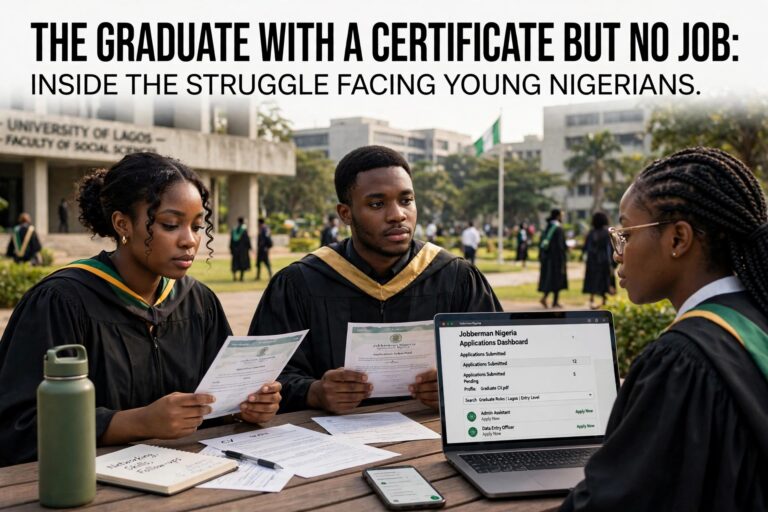





Just like a lecturer or a tutor corrects his/her student(s) in a class test, before the exams proper. I think there should be a way of depicting such scenarios amongst Students’ Leaders (whom we see as future politicians). We do see the University as a learning ground, but sometimes fail or neglect to correct misconducts before he/she leaves the four-walls of the University.
Circular Political influence can also be seen as a factor which promotes corruption, unaccountability, and other Political misappropriations amongst Students’ Leaders