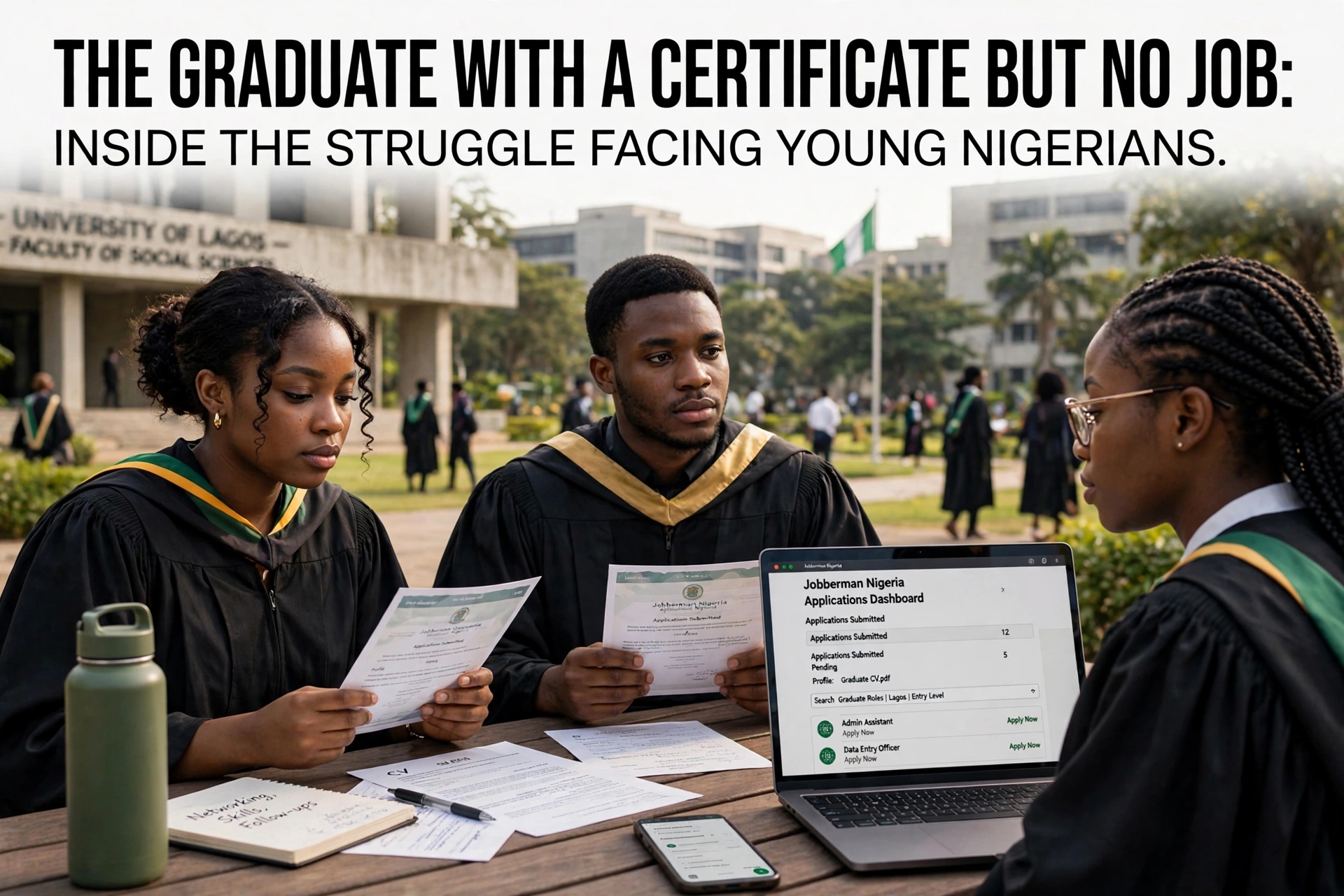
Graduation is often presented as the beginning of a brighter chapter. After years of lectures, examinations, assignments, financial sacrifices, and personal challenges, obtaining a university degree is expected to bring a sense of achievement and open the door to new opportunities. For many Nigerian graduates, however, the period after graduation can introduce a different kind of uncertainty. The certificate has been obtained. The academic journey has ended. Family members may be expecting good news, friends may be announcing new jobs, and society may be asking the familiar question: What comes next? For graduates who have yet to secure employment, answering that question can be difficult, the search for work may involve preparing numerous applications, attending interviews, learning new skills, contacting potential employers, and waiting for responses that sometimes never arrive. While every graduate’s experience is different, the challenges associated with the transition from university to employment deserve greater attention. In many Nigerian families, university education represents more than academic achievement. Parents and guardians may view a degree as an investment that will eventually help their children become financially independent and contribute to household responsibilities, for graduates themselves, completing university can create expectations of personal progress. Some hope to secure employment quickly, support their families, save money, or pursue further education. Others may want to establish businesses, enter professional careers, or obtain opportunities that were previously unavailable to them. These ambitions are not unreasonable. However, difficulties arise when the time required to achieve them becomes longer than expected. Agraduate who anticipated finding work within a few months may begin to feel discouraged when applications produce few results, the experience can become more complicated when family members, friends, or acquaintances repeatedly ask about employment. Questions that appear harmless to others may remind an unemployed graduate of a situation they are already trying to resolve. Searching for a job is itself a demanding process. Applicants must identify suitable vacancies, prepare application documents, meet qualification requirements, and sometimes travel for interviews, some positions require professional certifications, technical skills, previous work experience, or access to reliable internet and digital devices. For graduates who are already facing financial difficulties, these requirements can create additional obstacles, internet data, transportation, document preparation, and professional training may all require money. The difficulty is particularly frustrating when an applicant meets the stated qualifications but receives no feedback. However, the reasons for unsuccessful applications vary. Some vacancies attract large numbers of candidates, while others require specific experience or skills. Recruitment processes may also be affected by organisational budgets and changing business needs without evidence about a particular employer or recruitment exercise, it would be inaccurate to assume that every unsuccessful application results from unfair treatment. What remains clear is that job searching can demand considerable time, patience, resources, and emotional energy. For graduates who remain financially dependent on their parents, guardians, partners, or other relatives, unemployment can affect their sense of independence. An adult who previously hoped to contribute to household expenses may find themselves asking for money to cover transportation, feeding, internet access, or professional development, this situation can be uncomfortable, especially when the people providing support are also managing financial responsibilities. Some graduates may feel guilty about asking for assistance. Others may become anxious about how long their families can continue supporting them. Financial dependence does not mean that a graduate lacks ambition or the ability to contribute to society. It may simply reflect the difficulty of moving from education into paid work. Nevertheless, prolonged uncertainty can affect confidence and relationships, particularly when financial expectations are not openly discussed. Families can help by maintaining realistic conversations about expenses, employment plans, and available support. Graduates can also benefit from setting practical goals and communicating honestly about their progress. Social media has changed how young people experience the transition into adulthood. A graduate searching for employment can easily encounter posts announcing new jobs, professional achievements, international scholarships, business successes, and further educational opportunities, these achievements may be genuine and worth celebrating. However, constant exposure to other people’s progress can create the impression that everyone else is moving forward while one’s own life remains on hold. This comparison can become particularly difficult when the graduate does not have the financial resources to pursue similar opportunities, it is important to remember that social media presents selected moments rather than a complete picture of a person’s life. Someone announcing a new job may also have faced months of unsuccessful applications. Another person studying abroad may have received a scholarship or financial assistance unavailable to others. Recognising these differences does not eliminate the frustration of unemployment, but it can help graduates avoid measuring their entire worth against the visible achievements of others. When employment proves difficult to obtain, some graduates consider returning to school or pursuing professional certifications. Further education can be valuable when it provides knowledge or qualifications required for a specific career. However, additional education should be approached strategically. Before enrolling in another programme, graduates should investigate the requirements of their intended profession and determine whether a new qualification is likely to improve their prospects, they should also consider the cost of tuition, available funding, the time required, and whether practical experience might be equally important. Obtaining another certificate without understanding the needs of the intended labour market may not resolve the original problem. Career decisions are more effective when they are based on reliable information rather than the assumption that collecting more qualifications will automatically lead to employment. While searching for formal employment, some graduates explore other ways to develop their skills and earn income. Depending on their abilities and circumstances, these options may include freelance writing, digital services, tutoring, research assistance, customer support, small businesses, internships, or remote work, such opportunities can help graduates gain experience, develop professional relationships, and build a portfolio. However, they should not be presented as effortless solutions, freelancing requires the ability to find clients, deliver quality work, manage payments, and compete in a market where income may be inconsistent, remote jobs can attract substantial competition, and fraudulent advertisements may target applicants who are desperate for work. Graduates should therefore verify employers and clients, avoid suspicious upfront recruitment fees, and protect their personal and financial information. Where possible, they should prioritise opportunities that offer genuine learning, transparent terms, and realistic compensation, not every graduate will follow the same path, and temporary work should not be regarded as a measure of personal failure. Universities have an important role in helping students prepare for life after graduation. Career guidance should not be limited to the final weeks before students leave campus. Students benefit from early exposure to career options, practical projects, internships, professional networking, and information about the qualifications employers seek. Institutions can also strengthen relationships with businesses, government agencies, professional bodies, and other organisations that may offer internships or entry-level opportunities. Alumni networks can provide another source of support by connecting recent graduates with mentors who understand the realities of particular industries, career services should also help students identify transferable skills and explore opportunities beyond the occupations most commonly associated with their degrees. These measures cannot guarantee employment for every graduate, but they can help students make more informed career decisions and improve their transition into the labour market. Graduate unemployment cannot be addressed solely through individual motivation or university reforms, government policies that support productive industries, improve infrastructure, encourage responsible investment, and reduce barriers to business growth can contribute to a stronger employment environment. Reliable labour-market information is also important. Graduates need to understand where opportunities exist, which skills are in demand, and what qualifications different professions require, employers, meanwhile, can consider creating more structured entry-level positions, graduate trainee programmes, and internships that provide genuine experience. Where appropriate, recruitment processes should communicate requirements clearly and distinguish between skills that are essential from the beginning and those that can be developed through training. A system that expects every inexperienced applicant to possess extensive professional experience risks making the transition into work unnecessarily difficult. Addressing these issues requires cooperation among government, educational institutions, employers, and graduates themselves. While waiting for broader improvements, graduates can take practical steps to organise their search for work, they can begin by identifying the types of positions they are qualified to pursue and tailoring their CVs to relevant vacancies, they can also seek feedback on application documents, practise interview techniques, and develop skills that are directly relevant to their chosen career paths, keeping a record of applications, interview invitations, and follow-up dates can help make the process more organised. Graduates should also investigate legitimate professional networks, career fairs, alumni groups, and credible training opportunities, where suitable employment is unavailable, they may consider temporary work or carefully chosen projects that provide income and experience while they continue searching. These steps can improve preparedness, but they do not guarantee a job. A graduate’s employment outcome is influenced by personal decisions as well as economic conditions, employer requirements, and the number of available opportunities. It is therefore important to encourage personal initiative without suggesting that unemployment is always the individual’s fault. One of the most damaging assumptions surrounding unemployment is that a person’s value can be measured by their job title, income, or speed of professional advancement. Agraduate who has not secured employment may still possess valuable knowledge, abilities, ambitions, and potential, the absence of a job offer does not erase years of education or determine what someone can achieve in the future. At the same time, acknowledging the dignity of unemployed graduates should not mean ignoring the practical consequences of unemployment, people need income to meet their needs, support their families, and pursue their ambitions. They also need an environment in which their efforts have a reasonable chance of producing results. The objective should be to provide both encouragement and practical support. Graduates need opportunities, employers need capable workers, universities need effective career support, and policymakers need to address the economic conditions that shape the labour market. The transition from university to employment can be an uncertain period for Nigerian graduates, for some, opportunities arrive quickly. For others, the process involves prolonged applications, additional training, financial dependence, and difficult decisions about the future. These different experiences should be understood without reducing graduate unemployment to laziness, poor planning, or a lack of ambition. Graduates can take responsibility for improving their skills and pursuing opportunities, but institutions and employers must also recognise the importance of creating accessible pathways into productive work. Universities should prepare students for the realities of professional life. Employers should consider how to develop entry-level talent. Government should support policies that encourage sustainable economic activity and employment. Most importantly, graduates should not be defined solely by the time it takes them to find their first job. A degree is evidence of an educational achievement, not a guarantee of immediate success. And a delayed opportunity should not be mistaken for a wasted future, the challenge facing Nigeria is to ensure that the hopes invested in education have a stronger chance of becoming meaningful opportunities after graduation.
Similar Posts
The Future of Medical Education in the Light of Evolving Career Dynamics.
The roots of medical education in Nigeria can be dated back to 1930. Before the establishment of the MBBS programme, medical training was offered in Yaba Training College as a diploma course and it was run by the colonial masters- the British Colonial government. The graduates were awarded Licentiate of Medicine and Surgery (LMS) and…
BEYOND COMPLAINTS
HOW YOUNG NIGERIANS CAN HELP BUILD THE CHANGE THEY WANT TO SEE. Young people are often the most vocal about the challenges facing their country, ranging from unemployment and economic hardship to corruption, insecurity, and poor leadership.They complain and raise concerns to express their dissatisfaction and how they want things to be better.While these concerns…
BEFORE THE FIRST SHOT: THE OPPORTUNITIES NIGERIA LOST TO PREVENT WAR
Wars are often remembered through their most dramatic moments: the declaration of hostilities, the first gunshots, the advance of armies and the eventual surrender of one side. Yet the most important lessons of many conflicts lie in the days and months before the fighting begins, when peaceful alternatives still exist, the Nigerian Civil War offers…
THE HIDDEN COST OF UNIVERSITY EDUCATION IN NIGERIA: WHAT STUDENTS AND PARENTS PAY BEYOND TUITION FEES
For many Nigerian families, gaining university admission is a moment of joy and hope. However, beyond the excitement lies a financial reality: the cost of obtaining a degree extends far beyond tuition and acceptance fees, from accommodation and feeding to transportation, textbooks, internet data, and departmental expenses, university education places a significant financial burden on…
When a Community Says Thank You to the Land: Inside Amawbia’s 2026 New Yam Festival
There are celebrations where the food on the table is simply food, and then there are celebrations where food carries a story. For many Igbo communities, yam belongs to the second category, it can represent harvest, it can represent hard work, it can represent family. And during the New Yam Festival, it becomes part of…
THE DANGEROUS NORMALISATION OF SUFFERING IN NIGERIA: WHEN DID WE BECOME SO COMFORTABLE WITH ABNORMALITY?
There is something deeply troubling about a country where suffering has become so familiar that people no longer find it unusual. A country where kidnapping has become a recurring headline, where families constantly worry about the safety of their loved ones, and where travelling from one location to another sometimes comes with the fear of…