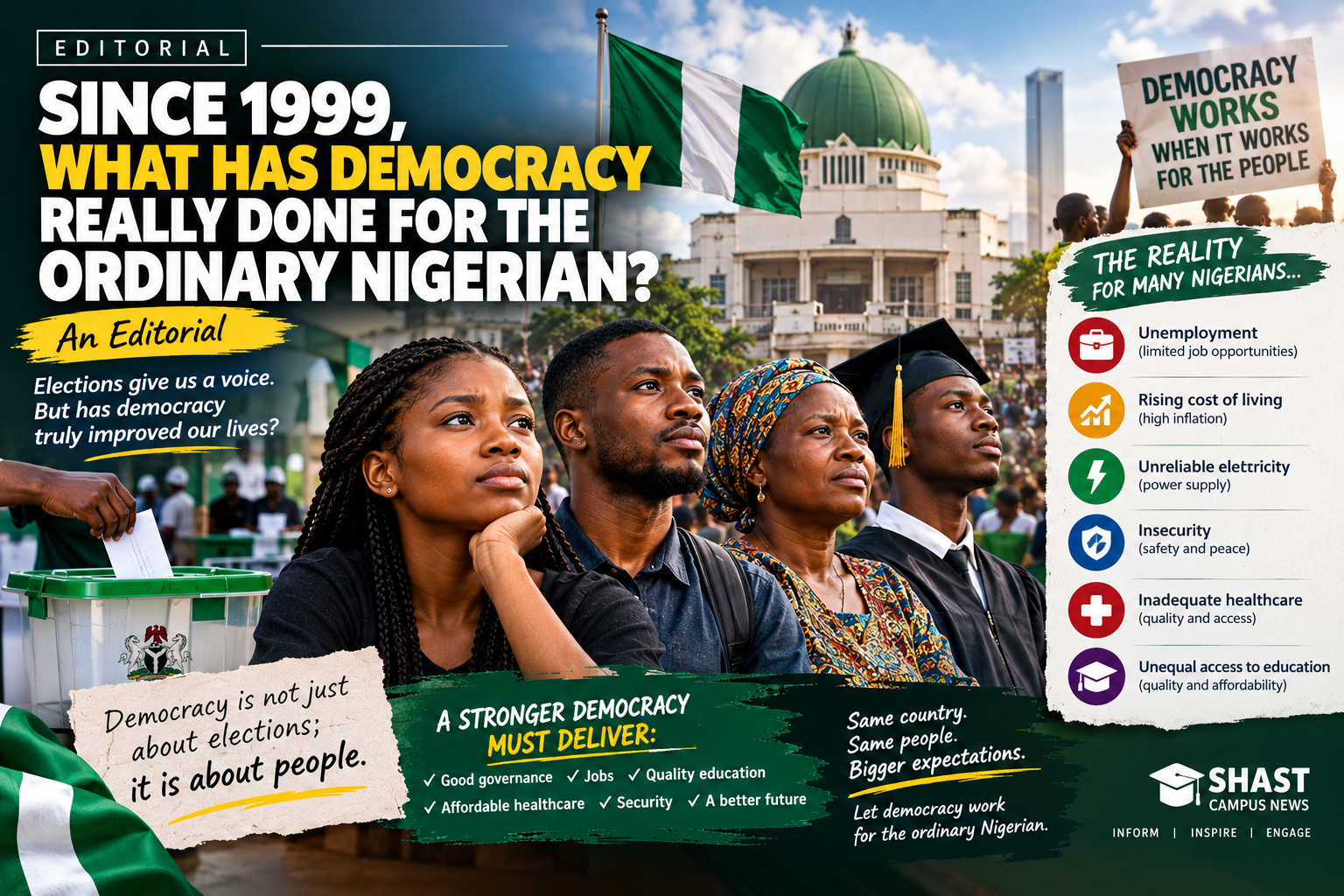
Every June 12, Nigeria marks the anniversary of its return to civilian democratic government in 1999, the occasion represents an important national achievement: the end of the latest period of prolonged military rule and the restoration of an elected civilian administration. Yet anniversaries should not become opportunities for celebration without reflection. They should also provide moments for citizens to evaluate whether the promises associated with democracy have translated into meaningful improvements in their lives. Since 1999, Nigeria has maintained a continuous period of civilian rule, surviving several presidential transitions and multiple changes in political leadership. Elections have become an established feature of national life, and citizens have greater formal opportunities to organise, criticise the government and participate in public debate than they did under many periods of military rule, these achievements should not be dismissed. Democratic government provides mechanisms through which citizens can replace leaders without military intervention, challenge public decisions and demand accountability. An independent judiciary, a free press and a functioning legislature can also help restrain the abuse of executive power. However, the existence of democratic institutions does not automatically guarantee effective governance. For many Nigerians, everyday life continues to be shaped by unemployment, rising living costs, unreliable electricity, insecurity, inadequate public healthcare and unequal access to quality education, these problems have persisted across successive administrations, although their severity and causes have varied over time. The question is not whether democracy is responsible for every difficulty Nigeria faces. It is whether the democratic system has developed the capacity to address these difficulties more effectively, Democracy must be judged by both its procedures and its outcomes. Credible elections matter because they give citizens a voice in determining who governs them. But elections are only the beginning. Once elected, public officials must manage public resources responsibly, implement sound policies and remain answerable to the people who entrusted them with power. Acountry cannot claim democratic success simply because it holds elections while large numbers of citizens struggle to meet basic needs. At the same time, economic hardship alone does not prove that democracy has failed. Development depends on many factors, including economic structure, global conditions, population growth, institutional capacity and the quality of public policy, the appropriate response is therefore not to romanticise military government or abandon constitutional rule. It is to demand better performance from democratic institutions. Political parties must develop stronger internal democracy and present candidates based on competence, integrity and credible programmes rather than patronage alone. The electoral process must be transparent enough to inspire public confidence. Where disputes arise, they must be resolved through impartial institutions and established legal procedures.Public officials must also face meaningful consequences for corruption and abuse of power. Accountability should not depend on political affiliation or whether an accused person belongs to the governing party. Nigeria’s legislature must take its oversight responsibilities seriously, while the judiciary must maintain public confidence through independence, fairness and timely justice, beyond political institutions, governments must make deliberate investments in education, healthcare, electricity, transport, agriculture and productive industries. These are not merely development projects. They are foundations of citizenship and economic opportunity, citizens also have responsibilities. Democracy cannot function effectively when voters sell their votes, spread disinformation or support political violence. Public participation must continue beyond election day through peaceful advocacy, community engagement and scrutiny of government performance, the youth population deserves particular attention. Young Nigerians need more than promises of future leadership. They need access to relevant education, decent employment, affordable housing and opportunities to build productive lives. The anniversary of June 12 should therefore be a day of both recognition and accountability. Nigeria’s return to civilian rule was a significant achievement, but the work of making democracy meaningful remains unfinished. Since 1999, Nigeria has made the transition from military government to sustained civilian rule. The next task is to ensure that democracy delivers more than the right to vote: it must also deliver justice, opportunity, security and a government that treats the welfare of ordinary citizens as its primary responsibility.
Similar Posts
How to Apply for the US Army as a Non-Citizen in 2026: Requirements, Green Card & Citizenship Process
Many Nigerians and other foreigners ask if it’s possible to join the United States Armywithout being a U.S. citizen.The short answer is yes, but with conditions. You don’t need to be a U.S. citizen to enlist, but you must be a legal U.S. resident. According to U.S. Army recruiting guidelines, non-citizens must meet these requirements:…
They Went Looking for Gold. They Never Came Home.
Thirty-seven suspected illegal miners died in NSCDC custody in Niger State. As investigations continue, the tragedy raises questions not only about what happened inside the detention facility, but about the conditions that pushed people into dangerous mining work in the first place.
NIGERIA DOES NOT LACK GRADUATES; IT LACKS ENOUGH OPPORTUNITIES TO PUT THEIR EDUCATION TO WORK
Every year, thousands of Nigerians graduate from universities with hopes of securing meaningful employment, becoming financially independent, and building better futures. Families sacrifice their resources to support their education, believing that a degree will open doors to opportunity. Yet, for many graduates, the journey becomes more difficult after graduation. Finding suitable employment can be challenging,…
Nigeria’s Heroes Deserve More Than a National Anthem
Every October 1, Nigeria remembers her heroes. We hear their names, we see their portraits, we repeat the familiar stories of independence, sacrifice and patriotism. Then the speeches end, the flags come down. And, too often, the lessons disappear with them. But Nigeria’s heroes deserve more than a few paragraphs in an Independence Day speech,…
THE PRESSURE TO LOOK SUCCESSFUL IS DESTROYING A GENERATION
We are living in a generation where looking successful sometimes matters more than actually becoming successful. People are struggling financially but presenting luxurious lifestyles online. Some borrow money to celebrate birthdays, rent expensive outfits to create an impression, travel to places they cannot comfortably afford and purchase things they do not need simply to convince…