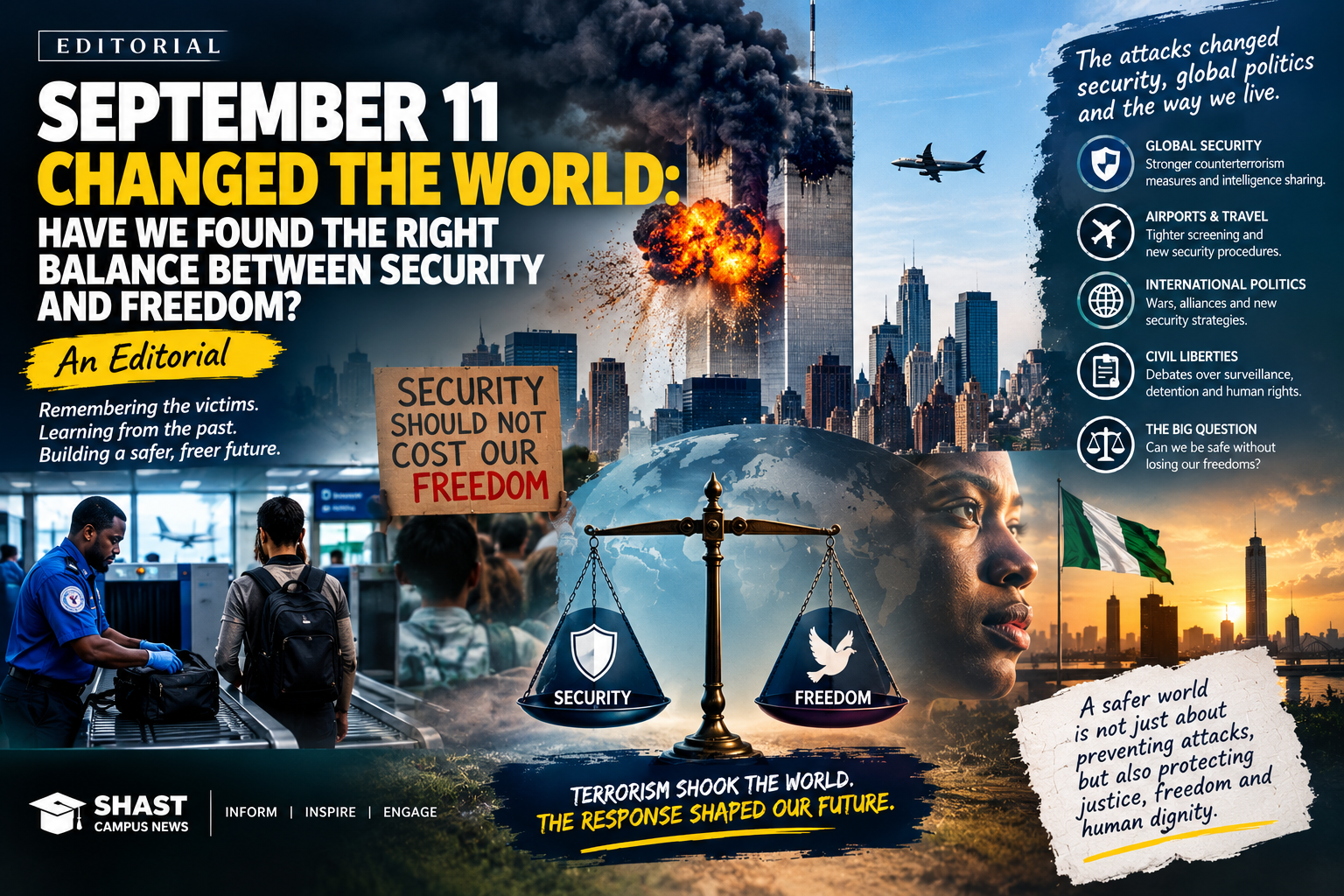
Some historical events alter not only the lives of those directly affected but also the policies, fears and political priorities of countries thousands of kilometres away. The terrorist attacks of September 11, 2001, did precisely that. The attacks killed nearly 3,000 people in the United States and reshaped international security policy, military strategy, airport screening, intelligence cooperation and debates about civil liberties. On that morning, members of the terrorist organisation al-Qaeda hijacked four commercial passenger aircraft. Two planes struck the World Trade Center towers in New York City, another struck the Pentagon near Washington, D.C., and the fourth crashed in Pennsylvania after passengers and crew resisted the hijackers, the attacks shocked the world and exposed vulnerabilities in the systems responsible for protecting civilians. The United States responded by launching a campaign against al-Qaeda and the Taliban government in Afghanistan, which had provided the group with a sanctuary. The attacks also contributed to a broader international campaign against terrorism, including expanded intelligence cooperation, new security legislation and changes to international travel procedures. In the years that followed, governments invested heavily in counterterrorism capabilities. Airports introduced more extensive screening procedures, intelligence agencies expanded cooperation, and authorities developed new methods for monitoring suspected threats, these measures reflected a genuine responsibility: governments must protect people from violence and prevent attacks wherever possible. However, the post-September 11 period also generated serious debates about civil liberties, surveillance, detention and the use of military force. The wars associated with the wider counterterrorism campaign caused enormous human suffering. The invasion of Iraq in 2003, for example, was justified by the United States government through claims about security threats and weapons of mass destruction. The central claims about Iraq’s possession of stockpiles of such weapons were not substantiated by the subsequent inspections and investigations, the conflict produced long-lasting instability and demonstrated the dangers of making major security decisions on the basis of flawed intelligence and contested assumptions. The wider period also exposed abuses involving detention and interrogation, including the treatment of detainees at Abu Ghraib and the use of torture and other coercive practices in counterterrorism operations, these developments raised a fundamental question: can governments protect national security without undermining the freedoms and legal principles they claim to defend? The answer must begin with the recognition that security and liberty are not necessarily opposing goals. Effective institutions can protect citizens while respecting due process, human rights and the rule of law. Surveillance powers should be subject to appropriate oversight. Suspected offenders should be investigated using reliable evidence, and detention should comply with legal safeguards. Security policies must also be assessed for their effectiveness rather than defended indefinitely because they were introduced during a crisis. Nigeria’s experience with terrorism and insurgency makes these questions particularly relevant. The country has faced grave security challenges, including attacks by Boko Haram and Islamic State West Africa Province, as well as other forms of organised violence, the state has a duty to protect civilians, investigate attacks and bring perpetrators to justice. But security operations must also protect innocent people and avoid abuses that can deepen resentment, weaken trust and complicate long-term peacebuilding. Counterterrorism is most effective when it combines intelligence, community cooperation, lawful enforcement, prevention and attention to the conditions that allow violent groups to recruit, citizens must also reject the idea that entire religious, ethnic or national communities should be blamed for the actions of extremist organisations. Collective suspicion undermines social cohesion and can create additional grievances. The anniversary of September 11 should therefore be an opportunity to remember the victims, recognise the suffering caused by terrorism and examine the consequences of the policies adopted in response. Security is essential, but fear must not become a permanent justification for unlimited power. A government that protects people from violence while disregarding their fundamental rights risks weakening the very principles it is meant to defend, september 11 demonstrated the devastating cost of terrorism. The decades that followed also demonstrated that the response to terrorism matters. The goal must be a world that is safer not only because attacks are prevented, but also because justice, freedom and human dignity remain protected.
Similar Posts
“When God Doesn’t Give You Something, Don’t Push”: Dangote Speaks on Not Having a Son.
For years, the idea of having a male child to carry on a family name and legacy has remained deeply rooted in many African societies. But for billionaire businessman Aliko Dangote, having a son is not something he considers a priority. Dangote made this known during an interview with ARISE News when he was asked…
Broke People Don’t Get to Philosophise About Money(So I Did It for Us)
I was having a conversation with a friend and I realised everything we talked about revolved around money. For any of our plans to work or even fail, it needed money. It got me thinking: how did the world become so dependent on money, or its modern equivalents? How did power get so tightly attached…
What the Girl Child Goes Through — And Why Nigeria Can No Longer Look Away
Before she becomes a woman, she is already at war. A war she did not start, for a body she did not choose, in a world that was not designed for her. Let us follow the life of a typical Nigerian girl child not the privileged one on Instagram, but the one in your street,…
WHEN ECONOMIES COLLAPSE, ORDINARY PEOPLE PAY THE HIGHEST PRICE
Economic crises are frequently discussed through statistics: falling markets, declining production, rising unemployment, shrinking national income and increasing government debt. Yet behind every economic indicator are human beings whose lives can be transformed by decisions they had little power to influence. The Great Depression, which began in 1929 and continued through much of the 1930s,…
Chinese Warehouses and Stores in Africa: A Blessing or a Threat to Local Businesses?
Walk into many major African cities today and there is a good chance you will come across shops, warehouses or businesses selling products imported from China. From electronics and phone accessories to clothes, household items, building materials and spare parts, Chinese products have become a familiar part of everyday life for many African consumers.For customers,…
NIGERIAN MARRIAGE LISTS: IS IT TIME FOR FAMILIES TO REDUCE THE COST OF TRADITION?
Marriage is supposed to be the beginning of a new chapter in the lives of two people. It represents love, commitment, responsibility and the willingness to build a future together. In Nigeria, however, before many couples can begin that journey, they must first navigate a traditional marriage process that can be financially demanding. Across different…