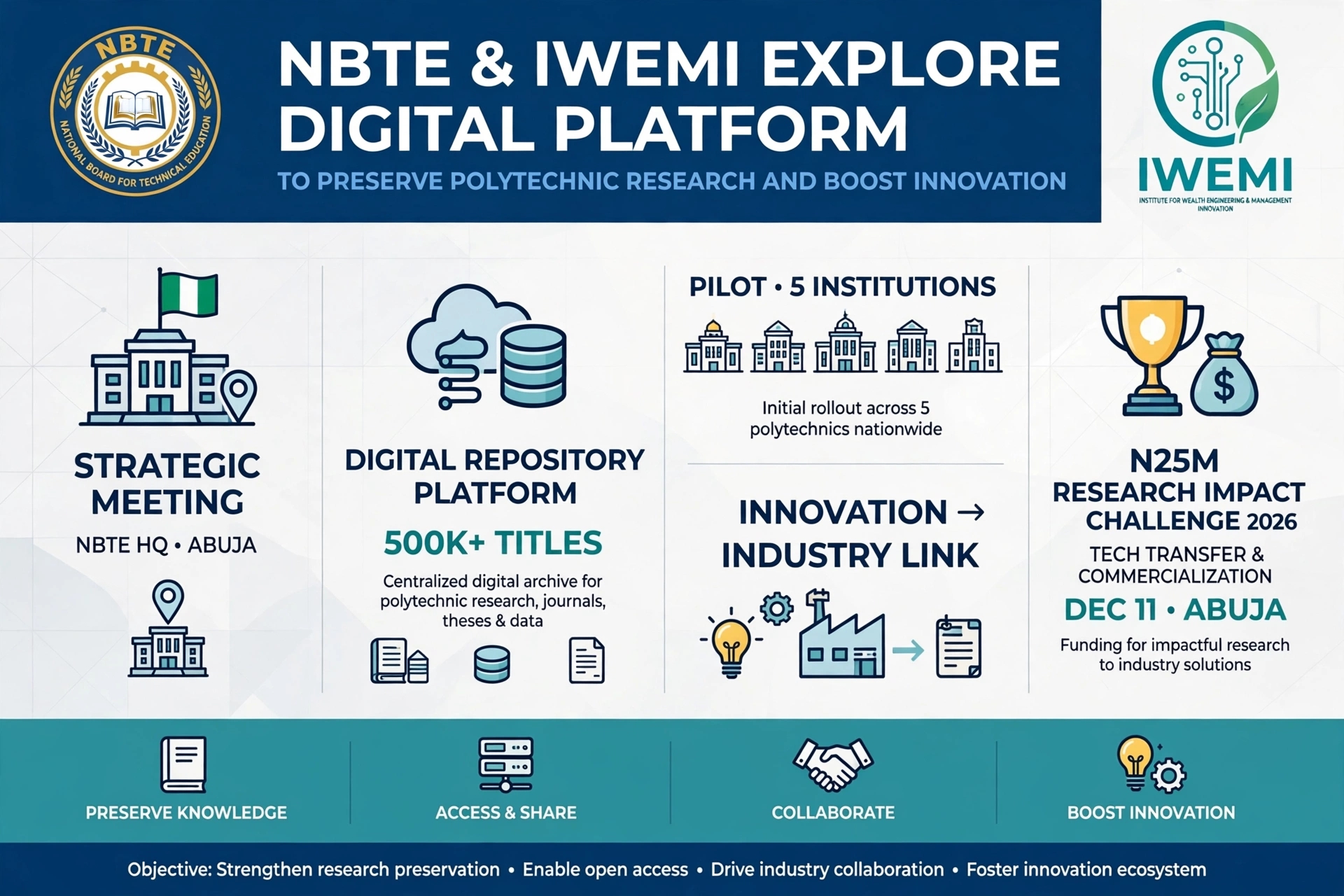
The National Board for Technical Education has held discussions with Iwemi, an academic publishing and research platform, on ways to preserve research produced by Nigerian polytechnics and technical institutions and make it more accessible. The discussions focused on digitising academic projects, improving the visibility of research and creating opportunities for technical knowledge to support innovation, enterprise development and employment. The engagement took place at the NBTE headquarters in Abuja when a delegation from Iwemi, owned by Retail Development and Investment Company, visited the board, the delegation was led by Iwemi founder and chief executive Ejimofor Akah, who presented the platform’s approach to managing and distributing academic research. The discussions reflect growing interest in using digital technology to preserve academic work and strengthen the relationship between education, research and industry. Polytechnic students produce research projects, theses and other academic materials as part of their studies. However, when such work exists only in physical copies or remains stored in separate institutional collections, it can be difficult for other students, researchers and businesses to discover and use it, digital repositories can make these materials easier to preserve, organise and search. During the engagement, Iwemi presented a system designed to provide digital repositories for research and academic records from technical institutions, the platform’s founder said the service was already operating in five tertiary institutions and hosted more than 500,000 titles. These figures were presented by the platform’s representatives and have not been independently verified in this report, the system is also intended to support the digital publication of textbooks and educational materials produced by lecturers. One of the major issues discussed was how technical education research could lead to practical results. Research can provide valuable knowledge, but its economic impact may be limited when findings are not translated into products, services or improvements in industrial processes. NBTE Executive Secretary Idris Bugaje emphasised that technical and vocational research should contribute to innovation, enterprise development and employable skills. The board’s position highlights the importance of connecting educational institutions with businesses that need practical solutions to operational and technological problems, for example, research conducted by engineering students could potentially support manufacturing processes, while agricultural and environmental projects might provide ideas for improving local production and resource management, realising these benefits would require cooperation between institutions, industry partners and researchers. According to the report, Iwemi’s services include digital research archiving, academic publishing, research indexing and online learning resources, the company also said it provides training for librarians and information technology officers in participating institutions. These services could help institutions manage research materials more efficiently and make their academic work more visible to wider audiences, the report also highlighted the Iwemi National Academic Research Impact Challenge 2026, which has a reported prize pool of ₦25 million. The programme is intended to encourage participation by students and staff from polytechnics, with a grand award ceremony scheduled for December 11, 2026, in Abuja, interested participants should confirm the competition’s eligibility requirements, application procedures and deadlines directly with the organisers. NBTE and Iwemi have agreed to continue discussions towards a possible formal partnership, beginning with a pilot phase involving institutions to be selected by the board, this means the discussions should not yet be interpreted as confirmation that a nationwide partnership has been fully implemented. If the proposed collaboration progresses, it could create additional opportunities to preserve student research, improve academic visibility and connect technical knowledge with employment and enterprise development, the success of the initiative will depend on implementation, institutional participation, accessibility and its ability to produce measurable benefits for students, lecturers and industry.
Similar Posts
Navy Recovers 80,000 Litres of Suspected Stolen Crude, Arrests Three
The Nigerian Navy has recovered approximately 80,000 litres of suspected stolen crude oil during operations in the Niger Delta and arrested three suspected drug traffickers in a separate operation. The operations involved personnel of the Nigerian Navy Ship Delta and the National Drug Law Enforcement Agency. According to the Navy, two anti-crude oil theft operations…
POLICE BEGIN TRAINING 10,000 OFFICERS AHEAD OF 2027 GENERAL ELECTION
The Nigeria Police Force has commenced a nationwide training programme for 10,000 police officers as part of preparations for the 2027 general election. The exercise, announced on October 23, 2026, is being conducted in collaboration with the Nigeria Police Trust Fund, the initiative is intended to strengthen the capacity of officers to manage election-related security…
INEC Under Fire: Is Nigeria’s Electoral Referee Playing for APC?
Nigeria’s electoral referee is facing a question that could define the 2027 elections: can INEC convince millions of Nigerians that it is truly independent — or are growing allegations of political bias becoming impossible to ignore? The Independent National Electoral Commission (INEC) was created to protect the integrity of Nigeria’s elections. But as the country…
Nigerian Banks Face January 2027 Deadline to Move Payment Data Home
Nigerian Banks Face January 2027 Deadline to Move Payment Data HomeNigerian banks, fintech companies and other payment operators are facing increasing pressure as the January 1, 2027 deadline for payment data localisation approaches. The Central Bank of Nigeria has directed financial institutions and payment service providers to ensure that payment transaction data generated in Nigeria…
Tinubu to Address Nigerians as Nigeria Marks 66th Independence Anniversary
President Bola Ahmed Tinubu will address Nigerians on Thursday, October 1, as the country marks its 66th Independence Anniversary. The nationwide broadcast is scheduled for 7:00 a.m. and will form a major part of activities commemorating Nigeria’s independence from British colonial rule in 1960. Presidential spokesman Bayo Onanuga announced the planned address on Wednesday, directing…
Scrap Dealers Begin 15-Day Nationwide Warning Strike
Scrap and waste dealers across Nigeria have commenced a 15-day nationwide warning strike over a dispute with iron-smelting companies. The industrial action began on Thursday, October 1, according to the National Association of Scrap and Waste Dealers Employers of Nigeria. The association said the dispute centres on the prices paid for scrap metals and the…