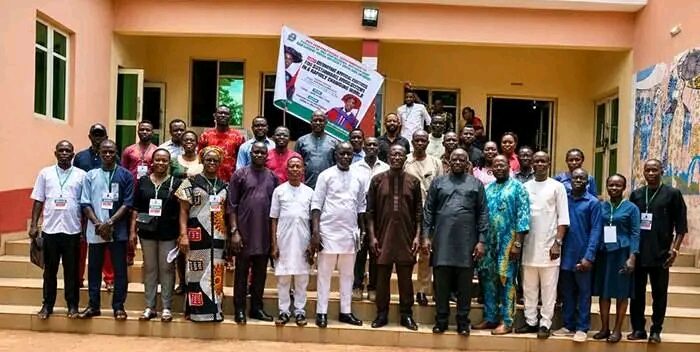
Alex Ekwueme Federal University Ndufu-Alike (AE-FUNAI) recently hosted the 2026 Faculty of Physical Sciences international conference, where researchers and stakeholders called for intensified scientific inquiry to address modern global challenges.
Commitment to Research and Excellence
Vice-Chancellor Professor Daniel Nwachukwu, represented by Deputy Vice-Chancellor (Academic) Professor Romanus Ejiaga, opened the event by emphasizing the university’s role as a growing hub for scientific excellence. He noted that the theme, “Advancing Physical Sciences for Sustainable Development in a Rapidly Changing World,” aligns with the institution’s goal of providing an environment that fosters critical thinking and problem-solving.
Nwachukwu urged participants to leverage the forum to build collaborations capable of driving both national and global development through innovative research.
Physical Sciences as the Backbone of Growth
Delivering the keynote address, Professor Godwin C.E. Mbah identified Physics and Chemistry as essential disciplines for tackling climate change, energy sustainability, and environmental degradation. He noted that specific technological outcomes of physical science research include:
Renewable Energy: Development of cleaner, more efficient power systems.
Battery Technology: Improvements in energy storage capacity.
Climate Modeling: Tools used to predict and analyze environmental shifts.
Professor Mbah stressed that sustainable development requires balancing economic progress with environmental protection. He called on governments to increase funding for scientific infrastructure, particularly in developing nations, to ensure scientists can contribute to global progress.
Interdisciplinary Approaches to Societal Issues
Earlier, the Dean of the Faculty of Physical Sciences, Professor Arthur Nwachukwu, stated that the conference was designed to move beyond theory and toward practical societal benefits. He highlighted the necessity of integrating Mathematics, Statistics, and Computer Science to interpret scientific data effectively.
The Dean emphasized that the gathering aimed to:
Apply physical science disciplines to energy and environmental issues.
Inspire younger scholars to pursue research relevant to national needs.
Facilitate knowledge exchange between established academics and students.
The conference concluded with a unanimous agreement among stakeholders that advancing the physical sciences is a prerequisite for building a resilient and sustainable future.