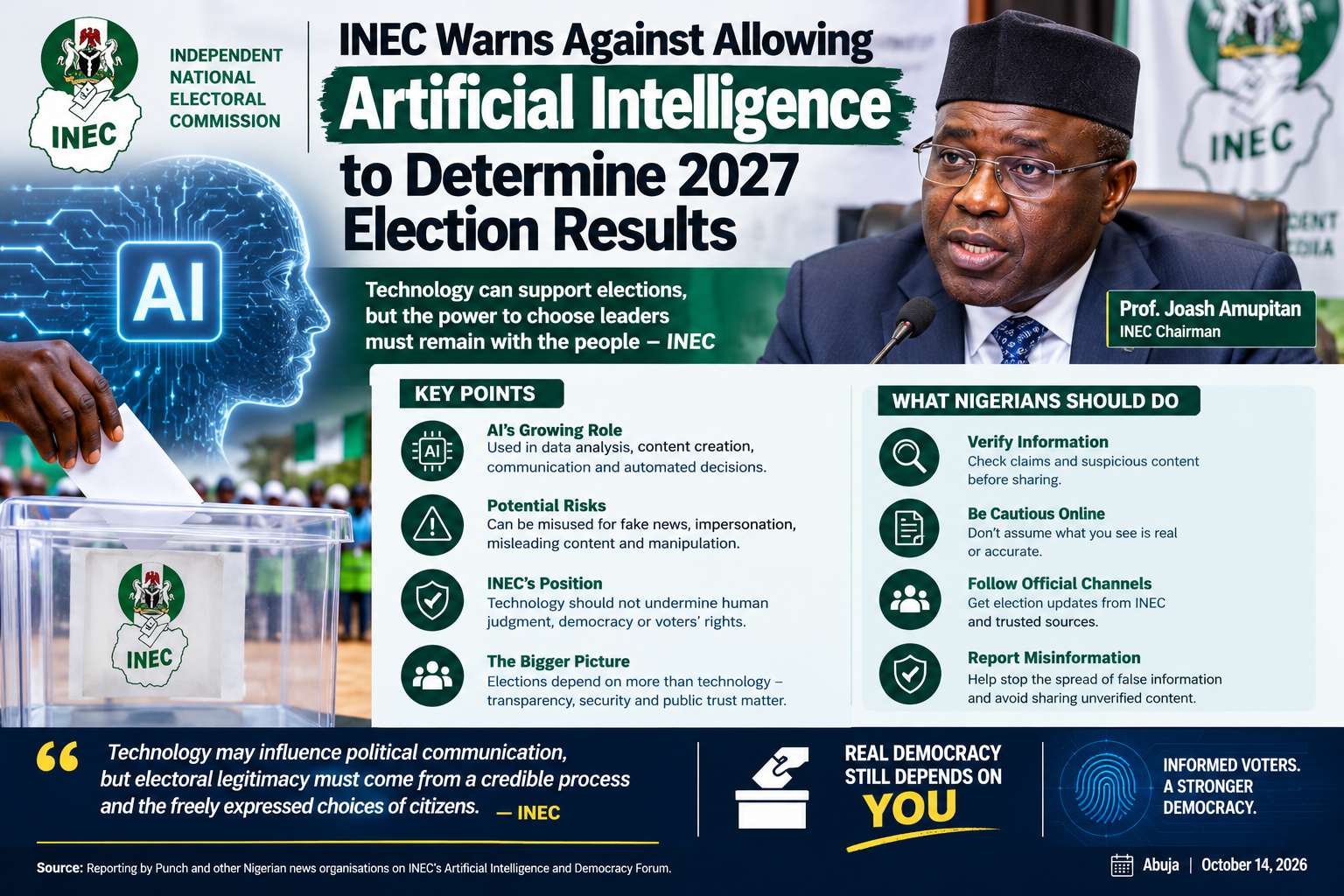
The Independent National Electoral Commission (INEC) has warned against allowing artificial intelligence and automated algorithms to determine the outcome of Nigeria’s 2027 general elections. The commission’s position comes amid growing concern about the potential influence of artificial intelligence on political campaigns, the spread of misinformation and the information available to voters. INEC Chairman Joash Amupitan reportedly delivered the warning at the Artificial Intelligence and Democracy Forum 2026 in Abuja on October 14, he stressed that while technology could influence several aspects of election administration, the authority to choose political leaders must remain with the electorate. The remarks have renewed attention on how Nigeria can benefit from technological innovation without compromising the integrity of its democratic process. Artificial intelligence is increasingly being used in areas such as data analysis, content creation, communication and automated decision-making. In an election environment, these tools can be used to analyse voter behaviour, distribute campaign messages, create political content and influence the information people encounter online. They can also support administrative activities when properly designed and supervised. However, the same technologies can be misused to produce misleading information, impersonate public figures and distribute fabricated images, audio or video. INEC has acknowledged that artificial intelligence could significantly affect the information environment in which voters make decisions, the commission’s concern is that technological tools must not be allowed to undermine human judgment, democratic institutions or the right of citizens to make their own electoral choices. Nigeria’s next general elections are expected to attract intense political competition. As parties, candidates and supporters expand their online activities, digital platforms are likely to remain important channels for political communication. Artificial intelligence could make it easier to produce campaign materials quickly and reach large audiences. At the same time, the technology could make it more difficult for voters to distinguish authentic information from manipulated content. For example, a fabricated video appearing to show a candidate making a controversial statement could spread widely before it is verified. Similarly, false claims about polling procedures or electoral results could create confusion if they are not addressed promptly, these risks make public awareness, independent verification and responsible political communication increasingly important. The debate is not necessarily about rejecting artificial intelligence altogether. Instead, it concerns how the technology should be used and what safeguards are needed to prevent abuse. Technology can support election logistics, information management and communication, but electoral decisions must remain subject to the law and established democratic procedures, clear accountability is particularly important when automated systems are used in processes that affect citizens’ rights. Voters also need access to reliable information about registration, polling arrangements and official election announcements. INEC’s warning reinforces the need for the commission, political parties, technology companies, civil society groups and the media to address emerging digital risks. Political parties should ensure that digital campaign materials are not used to deliberately mislead voters, media organisations should independently verify suspicious audio, video and claims before publishing them. Voters should also be cautious about sharing dramatic political content simply because it appears convincing or confirms their existing beliefs, where a claim concerns an election procedure or official result, the relevant electoral authority should be consulted.Social media users should remember that a widely shared post is not necessarily accurate. The credibility of an election depends on several factors, including transparent procedures, accurate voter information, effective logistics, security and public confidence in the electoral authority, Artificial intelligence introduces additional challenges, but it does not eliminate the importance of these established responsibilities. As preparations for the 2027 elections continue, the challenge will be to make appropriate use of technology while ensuring that it does not replace democratic accountability, for Nigerian voters, the central message is straightforward: technology may influence political communication, but electoral legitimacy must come from a credible process and the freely expressed choices of citizens.
Similar Posts
Tension in Imo as Reports of NYSC Prospective Corps Members’ Abduction Spark Panic
Tension has gripped families and prospective National Youth Service Corps members following reports that travellers heading towards NYSC orientation camps were allegedly abducted in Imo State. The reports emerged on Thursday, October 1, 2026, as Nigerians marked the country’s 66th Independence Anniversary, with social media users sharing claims that buses conveying prospective corps members had…
OYO LG CHAIRMAN SPONSORS 18 INDIGENES AT TECHNICAL UNIVERSITY
The Chairman of Iseyin Local Government Area in Oyo State, Rasaq Fadiran, has reportedly sponsored 18 indigenes to study at Abiola Ajimobi Technical University. The initiative, is part of an effort to support access to higher education among students from the local government area, the chairman said 18 indigenes had benefited from the sponsorship programme…
THREE KIDNAPPED ISLAMIC CLERICS RESCUED IN ZAMFARA, THREE OTHERS STILL IN CAPTIVITY
Security operatives have rescued three Islamic clerics who were abducted by armed bandits in Zamfara State, while three others remain in captivity. The rescue was confirmed by the Zamfara State Commissioner of Police, Muhammad Bello, following a coordinated security operation involving the Nigeria Police Force, the Department of State Services (DSS) and the Office of…
Lagos APC Takes Tinubu–Hamzat 2027 Mobilisation Campaign to Nigerians in US
The Lagos State chapter of the All Progressives Congress (APC) has taken its mobilisation campaign for the 2027 elections to Nigerians living in the United States. The party reportedly carried out the mobilisation activities in Chicago as it seeks support for President Bola Tinubu and Lagos Deputy Governor Obafemi Hamzat ahead of the 2027 elections….
INEC CLEAR PANTAMI FOR 2027 GOMBE GOVERNORSHIP RACE, REJECTS ADEBUTU’S PETITION
The Independent National Electoral Commission (INEC) has reportedly cleared former Minister of Communications and Digital Economy, Professor Isa Ali Pantami, to participate in the 2027 Gombe State governorship election, subject to the outcome of relevant court proceedings. The commission also rejected a petition submitted by the Peoples Democratic Party’s governorship candidate in Ogun State, Ladi…
NIGERIA TARGETS $1 BILLION IN ANNUAL FOREX SAVINGS THROUGH LOCAL SUGAR PRODUCTION
Nigeria could save approximately $1 billion in foreign exchange annually and create 110,000 direct jobs if the country achieves self-sufficiency in sugar production, according to projections attributed to the National Sugar Development Council. The council’s Executive Secretary and Chief Executive, Kamar Bakrin, outlined the potential benefits as the government seeks to reduce dependence on imported…