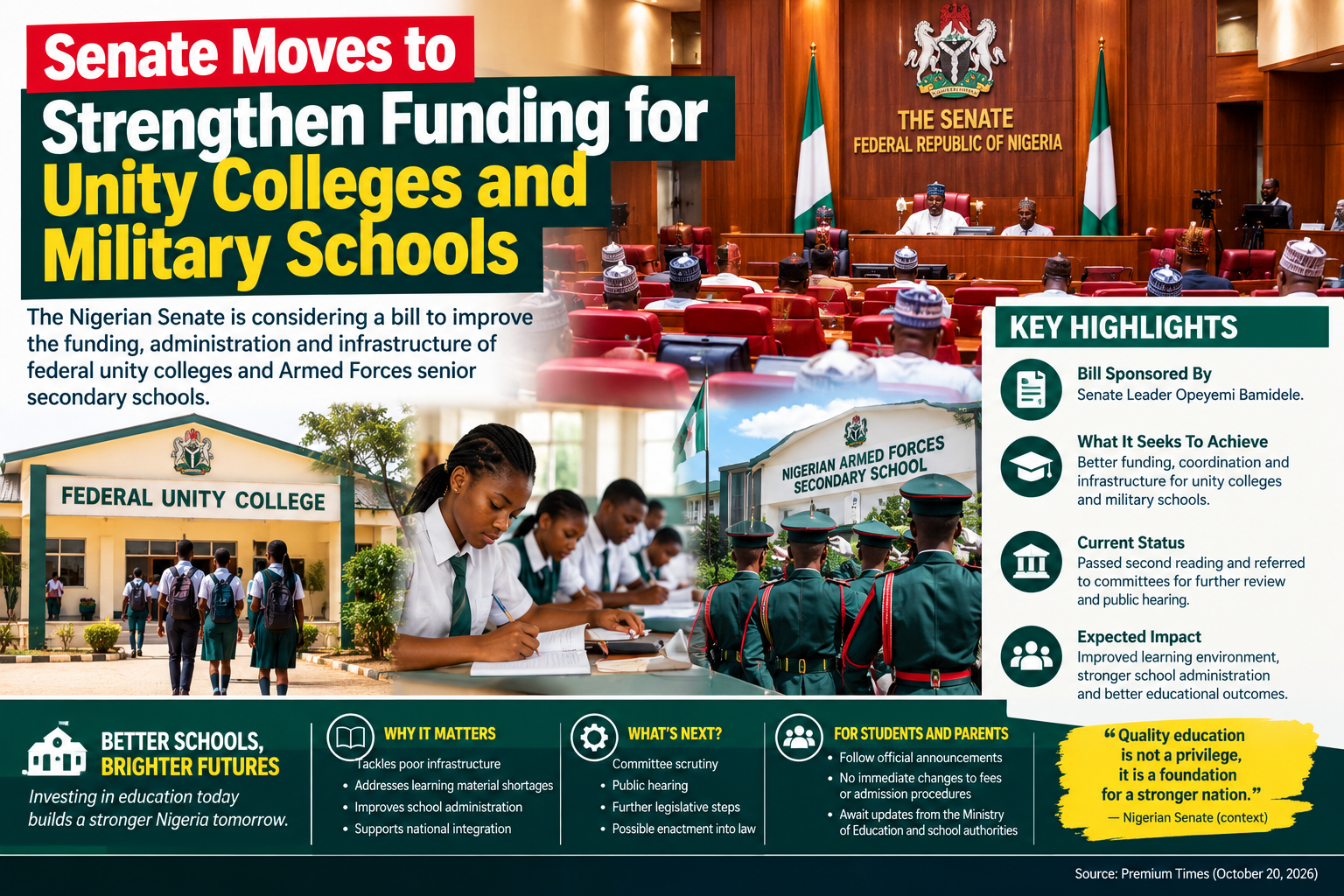
The Nigerian Senate is considering legislative changes aimed at improving the funding, administration and infrastructure of public senior secondary schools, including federal unity colleges and Armed Forces senior secondary schools. The proposal has renewed attention on the challenges confronting public education, particularly inadequate infrastructure, shortages of learning materials and concerns about the quality of school administration. The bill, which seeks to amend the National Senior Secondary Education Commission Act, passed its second reading in the Senate on October 20, 2026, following the vote, it was referred to the relevant Senate committees for further examination and public hearing. If the proposed changes eventually become law, they could provide a stronger framework for government intervention in senior secondary education, the bill is sponsored by Senate Leader Opeyemi Bamidele. According to reports of the Senate proceedings, the proposal seeks to strengthen the administration and coordination of public senior secondary schools across Nigeria’s 36 states and the Federal Capital Territory, it also seeks to establish a clearer framework for intervention in federal unity colleges and Armed Forces senior secondary schools, particularly in addressing infrastructure and learning-resource needs. The proposed changes are intended to improve the way government support is coordinated and delivered to schools, areas of concern include classroom facilities, instructional materials, laboratory equipment, school administration and the availability of qualified personnel. The bill’s sponsors have argued that improving education requires more than the establishment of a regulatory commission. It also requires appropriate funding, accountability and effective coordination among the different levels of government. Federal unity colleges were established to provide educational opportunities to students from different parts of Nigeria. Their role in promoting national integration makes their condition and administration matters of national interest. However, public secondary schools across the country face varying levels of infrastructure and funding challenges, where classrooms, laboratories, libraries and other facilities are inadequate, students may struggle to access the learning environment needed to compete academically. The proposed legislation seeks to provide a stronger framework for addressing some of these difficulties, it also brings renewed attention to the question of how federal intervention should be distributed and monitored to ensure that schools receive support according to their needs. During the debate, several senators reportedly supported the proposal, highlighting the need for improved school funding and more effective administration. Some contributions also focused on the importance of reviewing the secondary school curriculum to reflect changing educational and technological needs, the debate included calls for stronger accountability and improved access to quality education. These concerns reflect a wider recognition that educational reform requires investment in both infrastructure and the people responsible for teaching and managing schools, while increased funding could help address infrastructure gaps, the effectiveness of any intervention will depend on how resources are allocated and monitored. Clear guidelines would be needed to determine which schools qualify for particular interventions, how funding decisions are made and how results are measured. The proposed changes would also need to operate effectively alongside existing education policies and the responsibilities of federal and state authorities, without transparent implementation and proper oversight, additional funding may not translate into the improvements students need. The Senate’s debate has therefore placed accountability alongside funding as an important part of the proposed reform, the passage of the bill at second reading does not mean that the proposed changes have taken effect. The legislation must proceed through the remaining stages of consideration, including committee scrutiny and any further legislative steps required before it can become law, the outcome of that process will determine whether the proposal produces changes to the existing framework. For students, parents, teachers and school administrators, the key issue will be whether any eventual reform leads to better facilities, improved learning resources and stronger educational outcomes, students and parents should continue to follow official announcements from the Federal Ministry of Education and the relevant school authorities. The proposed legislation should not be interpreted as an immediate announcement of new fees, changes to admission procedures or automatic funding payments to individual schools, any concrete changes to school administration or funding arrangements would need to be communicated through official channels. The debate nevertheless highlights the importance of sustained investment in public education, for Nigeria to improve learning outcomes and prepare young people for a changing economy, funding must be accompanied by sound planning, qualified personnel and transparent management.
Similar Posts
VDM QUESTIONS SENATOR NATASHA OVER PURPORTED LEAKED VOICE NOTE: “IS THIS YOUR VOICE?”
Social media activist Martins Vincent Otse, popularly known as VeryDarkMan (VDM), has reacted to a purported leaked voice recording allegedly involving Senator Natasha Akpoti-Uduaghan, reigniting discussions surrounding the long-running controversy involving the senator, Senate President Godswill Akpabio and US-based activist Sandra Duru.In a video shared on social media, VDM addressed the recording after Duru released…
IMF RAISES GLOBAL GROWTH FORECAST TO 3.1% AS AI INVESTMENT COUNTERS ECONOMIC UNCERTAINTY
By XanderXO Entertainment | October 13, 2026 The global economy is projected to grow slightly faster than previously anticipated in 2026, as surging investment in artificial intelligence helps sustain economic activity despite mounting geopolitical tensions, elevated energy prices and growing concerns over public debt. In its latest World Economic Outlook, released on Tuesday, October 13,…
NIGERIA CALLS FOR GREATER AFRICAN ECONOMIC INDEPENDENCE, URGES INVESTMENT IN INFRASTRUCTURE
Nigeria’s delegation at the Berlin Global Dialogue says African countries must strengthen domestic resources, process raw materials locally and build strategic partnerships that support development. Nigeria has called for greater African economic independence, stronger domestic resource mobilisation and strategic investment in infrastructure as part of efforts to accelerate sustainable development across the continent. The position…
2027 ELECTIONS: EXPERTS WARN AGAINST AI DEEPFAKES, DEMANDS NATIONAL FRAMEWORK TO COMBAT MISINFORMATION
The Centre for Crisis Communication has called for the establishment of an integrated national framework to address misinformation, artificial intelligence-generated deepfakes and emerging cyber threats ahead of Nigeria’s 2027 general elections. The organisation warned that the increasing use of artificial intelligence to manipulate digital content could create serious challenges for election security, public trust and…
FG REPORTS ₦1.23 TRILLION PAYMENT TO POWER GENERATING COMPANIES
The Federal Government has reported paying ₦1.23 trillion out of approximately ₦3.3 trillion in outstanding debts owed to electricity generation companies, in a move aimed at easing financial pressures within Nigeria’s power sector. The payment was disclosed following a Federal Executive Council meeting in Abuja, according to a report published by Punch Newspapers. The report…
NIGERIA MAINTAINS EBOLA MONITORING MEASURES AS HEALTH AUTHORITIES TRACE CONTACTS
Nigerian health authorities are continuing to monitor people linked to the country’s confirmed Ebola case as part of efforts to prevent further transmission. The case has prompted renewed attention to public health preparedness, laboratory testing and coordination between health agencies, officials were tracking 53 contacts connected to the confirmed patient as of October 26, 2026….