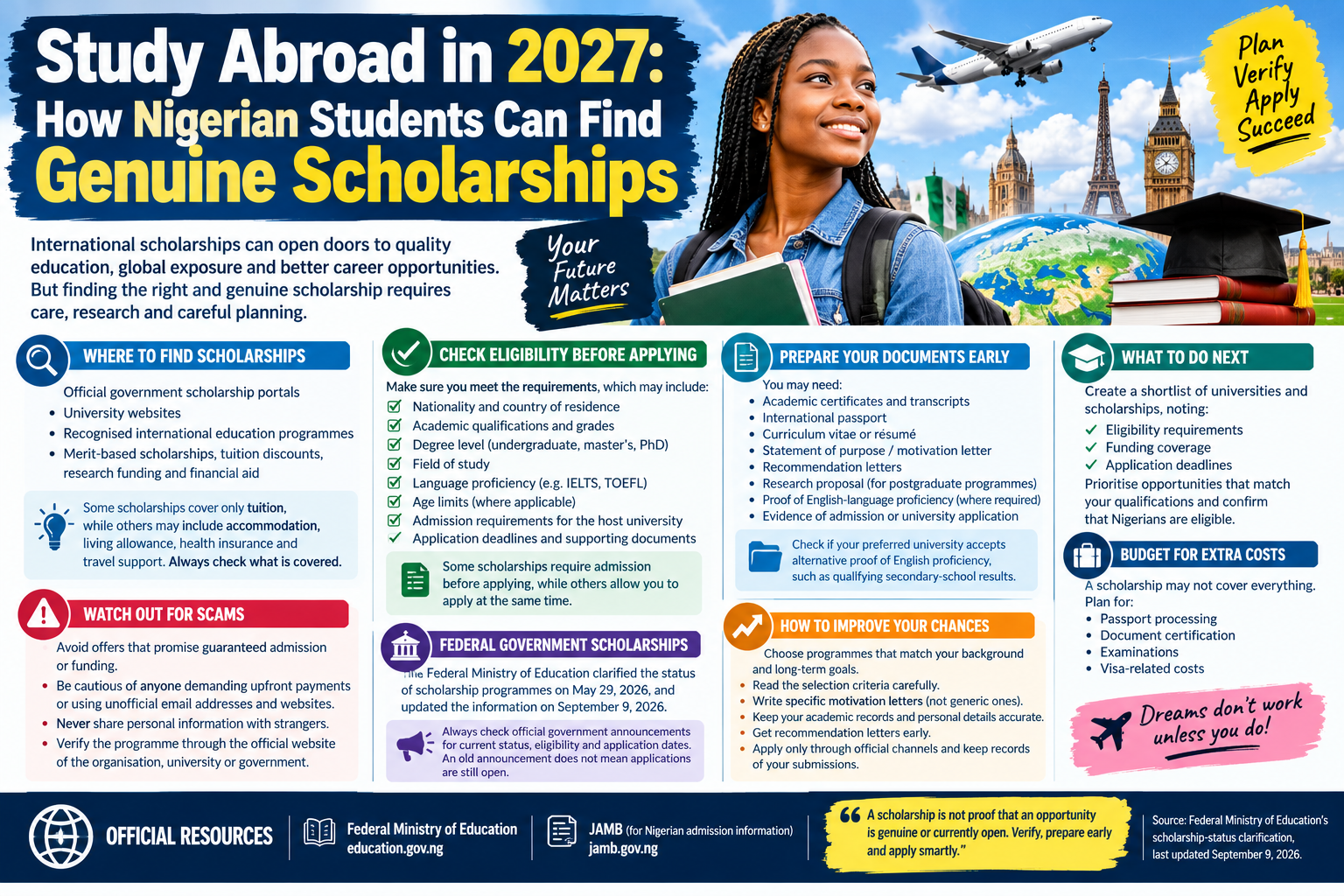
Nigerian students planning to study abroad in 2027 are being encouraged to approach scholarship applications carefully, verify opportunities through official sources and prepare their academic documents well ahead of application deadlines. International scholarships can provide opportunities for students to pursue undergraduate, master’s and doctoral degrees without carrying the full financial burden of overseas education. However, competition for funded places can be intense, and not every programme advertised online is genuine, fully funded or open to Nigerian applicants, for prospective students, the key is to identify legitimate opportunities and understand their eligibility requirements before investing time and money in an application, students can begin their search through official government scholarship portals, university websites and recognised international education programmes. Universities sometimes offer merit-based scholarships, tuition discounts, research funding or financial assistance to international students, government-sponsored programmes may provide funding for students from eligible countries, although the benefits and application rules vary, some opportunities cover tuition fees only, while others may also provide accommodation, a living allowance, health insurance and travel assistance. Applicants should never assume that a scholarship is fully funded simply because an advertisement uses that description. The official programme documentation should explain exactly what is covered. Before preparing an application, students should establish whether they meet the scholarship’s requirements.These may include:- Nationality and country of residence.- Previous academic qualifications.- Minimum grades or academic performance.- The degree level being offered.- Eligible fields of study.- Language proficiency requirements.- Age limits, where applicable.- Admission requirements for the host university.- Application deadlines and supporting documents.Some scholarships require applicants to secure admission before applying for funding. Others allow students to submit scholarship applications alongside university applications. Understanding the correct process can help applicants avoid missed deadlines and unnecessary expenses. Students interested in applying for the 2027 intake should begin organising their documents as early as possible.Depending on the programme, the required documents may include:- Academic certificates and transcripts.- A valid international passport.- Curriculum vitae or résumé.- Statement of purpose or motivation letter.- Recommendation letters.- Research proposal for relevant postgraduate programmes.- Proof of English-language proficiency, where required.- Evidence of admission or an application to the host university.Applicants should check whether their preferred universities accept alternative evidence of English proficiency, such as qualifying secondary-school results. Requirements vary, so students should not assume that a particular certificate will automatically satisfy every university. Scholarship scams can target students who are eager to secure overseas opportunities, some fraudulent advertisements promise guaranteed admission or funding in exchange for large upfront payments, others imitate genuine scholarship providers or use unofficial email addresses and websites to collect personal information. Applicants should be cautious when an opportunity promises guaranteed success, demands payment to a personal bank account or pressures them to submit money immediately, they should also be wary of individuals who claim to have special connections that can guarantee a scholarship. Before submitting documents, applicants should verify the programme through the official website of the government, university or organisation responsible for it. Nigeria’s Federal Ministry of Education issued a clarification on May 29, 2026, concerning the status of scholarship programmes and a false suspension notice. The ministry’s publication, subsequently updated on September 9, highlights the importance of checking official government information rather than relying on viral messages, students interested in Nigerian government scholarships should consult the ministry’s official announcements for current programme status, eligibility requirements and application dates. The existence of an old scholarship announcement does not necessarily mean that applications are still open.A strong scholarship application begins with choosing programmes that match the applicant’s academic background and long-term goals.Students should read the selection criteria carefully and explain clearly why their chosen course is relevant to their interests and career plans.Motivation letters should be specific to the programme rather than copied from generic templates.Applicants should also ensure that their academic records and personal details are accurate and consistent across all documents.Where recommendation letters are required, they should approach appropriate referees early enough to allow time for preparation.Most importantly, students should apply only through the prescribed channels and keep records of their submissions.Students planning to study abroad in 2027 should create a shortlist of universities and scholarships, noting each programme’s eligibility requirements, funding coverage and deadline.They should prioritise opportunities that match their qualifications and confirm that Nigerians are eligible before preparing full applications.Applicants should also budget for possible expenses that a scholarship does not cover, including passport processing, document certification, examinations and visa-related costs.Official resources:- Federal Ministry of Education: education.gov.ng- Joint Admissions and Matriculation Board, for relevant Nigerian admission information: jamb.gov.ngFor international scholarships, use the official website of the relevant government or university. A scholarship advertisement is not proof that an opportunity is genuine or currently open, students who verify eligibility, prepare their documents early and submit carefully tailored applications can avoid common mistakes and make better use of available opportunities, as the 2027 intake approaches, the best strategy is to rely on official announcements, prepare ahead and avoid anyone promising guaranteed funding in exchange for money.
Similar Posts
JAMB CAPS Begins Processing 2026/2027 Admissions as Over 133,000 Candidates Accept Offers
The Joint Admissions and Matriculation Board (JAMB) has commenced the processing of admissions for the 2026/2027 academic session through its Central Admissions Processing System (CAPS). The latest figures displayed on the official JAMB CAPS dashboard show that admission activities are already underway across Nigerian tertiary institutions, with thousands of candidates at different stages of the…
SSU RELEASES 2026/2027 FIRST BATCH ADMISSION LIST
Sokoto State University (SSU) has released its first batch admission list for the 2026/2027 academic session.The list contains candidates offered admission into undergraduate programmes for the new academic session.Candidates who participated in the university’s 2026/2027 Post-UTME screening exercise can check their admission status through the university’s official admission channels.Successful candidates are required to check their…
JAMB Sets Date for 2026 UTME Mop-Up Exam
Candidates affected during the 2026 Unified Tertiary Matriculation Examination (UTME) now have a final opportunity to participate in the examination exercise. The Joint Admissions and Matriculation Board (JAMB) has officially scheduled the 2026 UTME mop-up examination for Saturday, June 13, 2026. JAMB described the exercise as the final phase of the 2026 UTME process for…
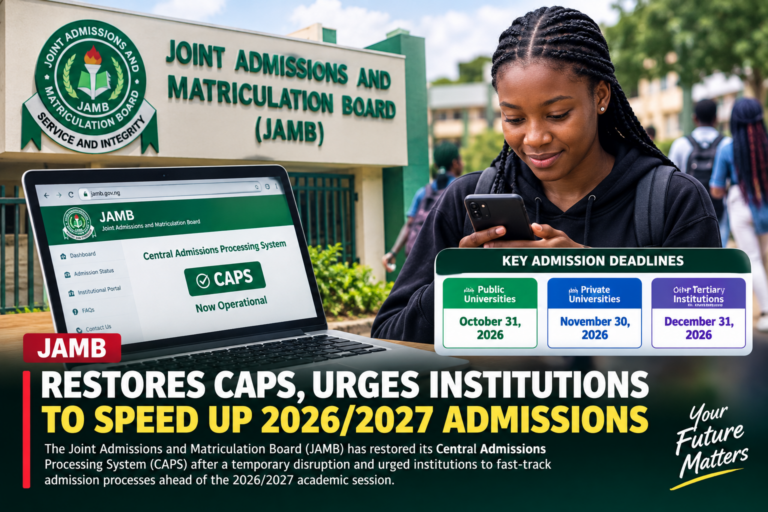
JAMB Restores CAPS, Urges Institutions to Speed Up 2026/2027 Admissions
The Joint Admissions and Matriculation Board has restored its Central Admissions Processing System, commonly known as CAPS, after a temporary disruption that affected admission processing. JAMB announced the restoration as it urged tertiary institutions across the country to accelerate their admission processes and recover lost time ahead of the approved deadlines for the 2026/2027 academic…
UNIOSUN RELEASES 2026/2027 UTME MERIT ADMISSION LIST
Osun State University (UNIOSUN) has released its 2026/2027 Unified Tertiary Matriculation Examination (UTME) merit admission list for candidates seeking admission into its undergraduate programmes. The university announced the development in October, inviting candidates who participated in the admission screening exercise to check their admission status through the institution’s undergraduate admission portal, the release is an…
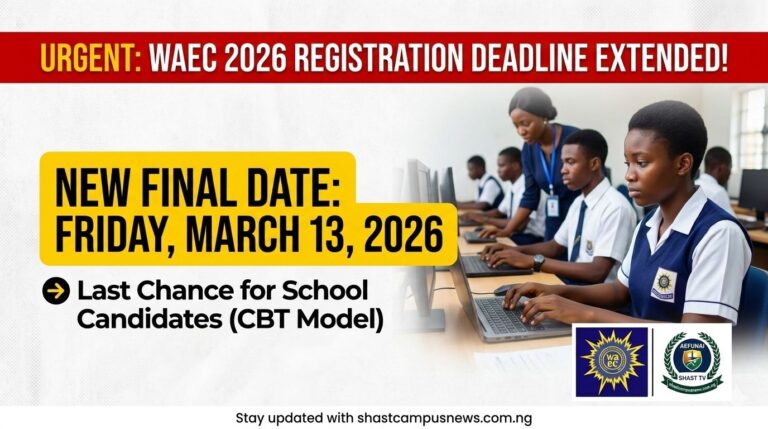
URGENT: WAEC Extends 2026 WASSCE Registration Deadline to March 13 – Final Warning for Candidates
The West African Examinations Council (WAEC) has officially announced an extension for the registration of the 2026 Computer-Based West African Senior School Certificate Examination (WASSCE) for school candidates. This announcement comes as a relief to thousands of students, parents, and school administrators across Nigeria who have been struggling with technical challenges and documentation issues during the first-ever…