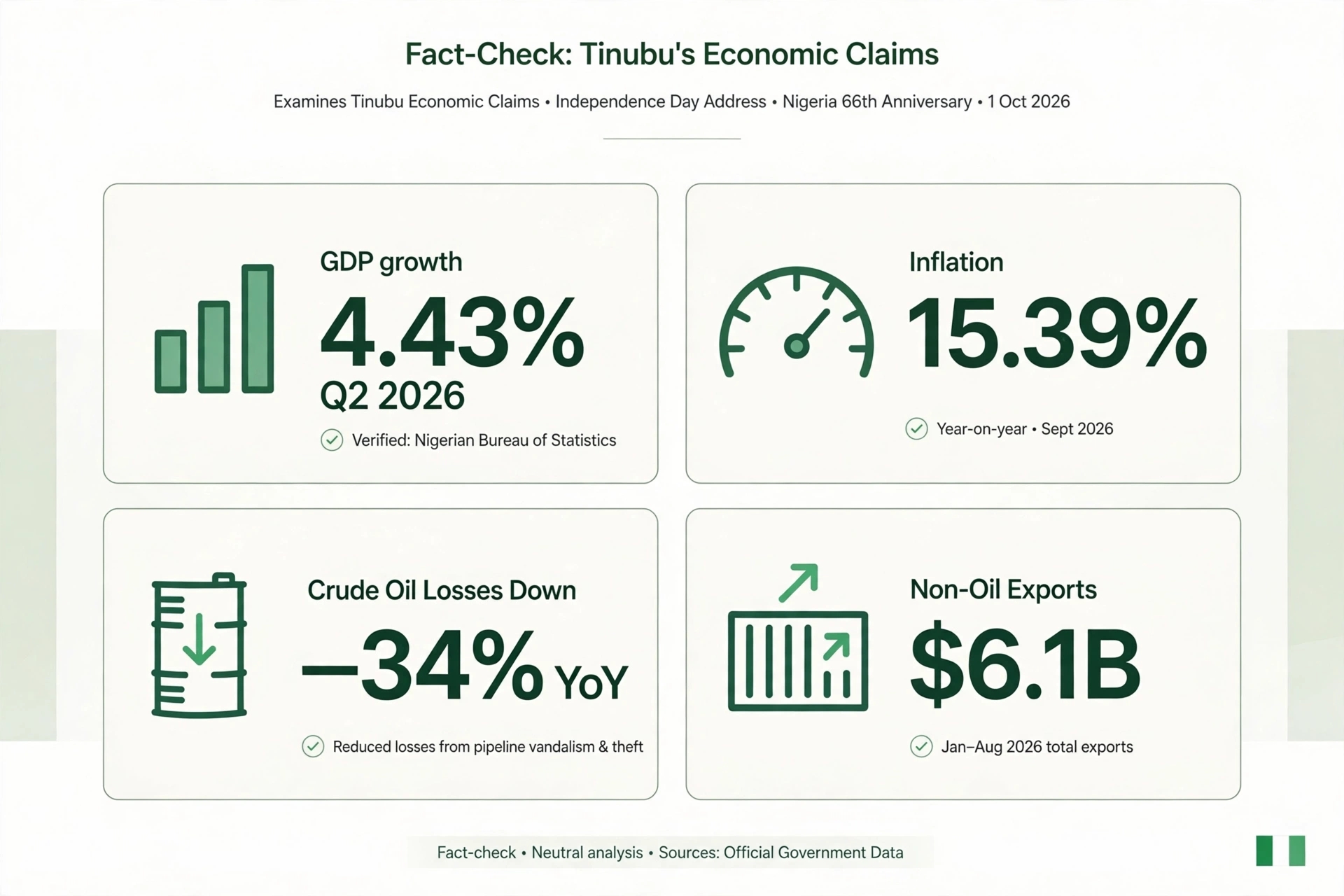
Several economic claims made by President Bola Tinubu during his October 1 Independence Day address have been examined against official statistics and other verifiable records. In his address marking Nigeria’s 66th Independence anniversary, Tinubu highlighted developments in economic growth, inflation, crude oil losses and non-oil exports. A review published by FactCheckHub examined four of the claims using data from institutions including the National Bureau of Statistics, the Nigerian Upstream Petroleum Regulatory Commission and the Nigerian Export Promotion Council. One of the claims examined was the President’s statement that Nigeria’s economy had grown by more than four per cent in 2026. According to the fact-check, NBS data showed that real GDP grew by 4.43 per cent year-on-year in the second quarter of 2026, compared with 3.89 per cent in the first quarter. FactCheckHub therefore found the claim supported by the available data, while noting that the 4.43 per cent figure referred specifically to second-quarter year-on-year growth rather than growth for the entire year. The fact-check also examined the President’s statement that inflation had fallen substantially from its peak. NBS figures cited in the review showed headline inflation at 15.39 per cent in August 2026, compared with 23.14 per cent in August 2025. However, the report noted an important distinction: a decline in the inflation rate does not mean that prices have returned to previous levels. Rather, it means prices are increasing at a slower rate. Food inflation remained higher than headline inflation, standing at 19.57 per cent year-on-year in August 2026, according to the figures cited. Another claim concerned crude oil losses attributed to theft and metering issues. Data from the Nigerian Upstream Petroleum Regulatory Commission cited by FactCheckHub showed a significant decline in reported crude oil losses over recent years, with average losses falling from much higher levels recorded earlier in the decade. The fourth claim examined Nigeria’s non-oil export earnings. The Nigerian Export Promotion Council reportedly recorded $6.1 billion in non-oil export receipts in 2025, up from $5.46 billion in 2024. The council described the 2025 figure as the highest formally documented non-oil export value in its records. FactCheckHub therefore rated all four claims examined in the report as supported by the evidence it reviewed. The findings also highlight the importance of context when interpreting economic figures. For example, lower inflation indicates a slower rate of price increases, rather than a reversal of previous price increases. The fact-check provides additional context to the competing narratives surrounding Nigeria’s economy following the President’s Independence Day address.
Similar Posts
Digital Literacy Drive Targets Women and Girls in Bauchi, Kano
A fresh digital literacy initiative is seeking stronger support for programmes designed to improve digital skills and economic opportunities for women and girls in Bauchi and Kano states. The Centre for Information Technology and Development is seeking partnerships to address what it describes as the gender digital divide. The initiative focuses on improving access to…
CBN Moves to Strengthen Bank Oversight After N4.65tn Recapitalisation
The Central Bank of Nigeria has announced plans for continued regulatory oversight of banks following the completion of the financial sector’s recapitalisation programme. The apex bank said greater attention would be placed on areas including corporate governance, asset quality, liquidity and large exposures as it continues to monitor the banking sector. The CBN disclosed that…
Nigeria Needs $10bn to Build Rail Network Connecting Major Cities — Experts
Nigeria may require at least $10 billion to develop an integrated railway network capable of connecting major parts of the country and supporting economic growth, transportation experts have said. The experts said the country’s existing railway system remains fragmented, limiting the ability of rail transportation to significantly reduce pressure on Nigeria’s roads and bring down…
National Assembly Extends 2025 Capital Budget Implementation to December 31
The National Assembly has approved another extension for the implementation of the capital component of Nigeria’s 2025 budget. The extension moves the deadline from September 30 to December 31, 2026, giving ministries, departments and agencies additional time to execute projects contained in the capital budget. The decision followed consideration of a request for more time…
Abiodun Deploys Traffic Officers to Tackle Kara Bridge Gridlock on Lagos-Ibadan Expressway
Ogun State Governor, Dapo Abiodun, has ordered the deployment of traffic officers to Kara Bridge and other affected sections of the Lagos-Ibadan Expressway as authorities intensify efforts to ease the worsening gridlock along the busy highway. The move is aimed at improving traffic flow and reducing the hardship being experienced by motorists and commuters travelling…
New Telecom Operator Enters Nigerian Market as Competition Grows
Nigeria’s telecommunications industry is welcoming a new operator following the issuance of a Unified Access Service Licence to Swift Telephone Network Limited. The licence became effective on October 1, 2026, giving the Nigerian-owned company regulatory approval to provide voice, data, fixed and mobile telecommunications services. The entry comes into a market dominated by a handful…