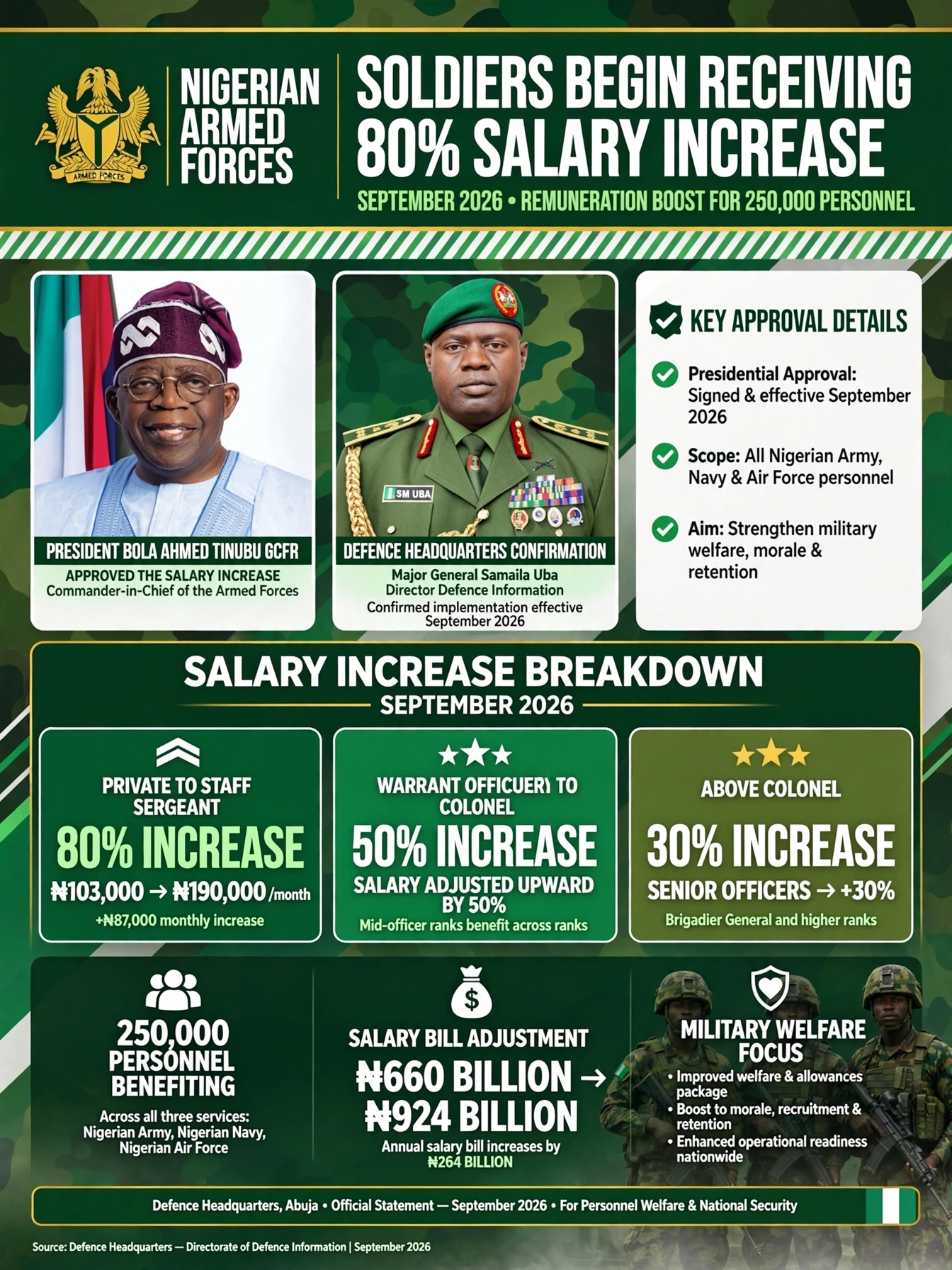
Personnel of the Nigerian Armed Forces have begun receiving their September salaries with the recently approved salary increases reflected in their payments, the Defence Headquarters has confirmed. The development comes after President Bola Tinubu approved salary adjustments of between 30 per cent and 80 per cent for military personnel, with the new structure taking effect from September 1, 2026. The Director of Defence Information, Major General Samaila Uba, confirmed that the salary review had started reflecting in the accounts of military personnel. According to reports, some soldiers have confirmed receiving their new salaries, with the highest percentage increase applying to junior personnel. Under the approved structure, personnel from the rank of Private to Staff Sergeant are to receive an 80 per cent increase. Personnel from Warrant Officer to Colonel are to receive a 50 per cent increase, while officers above the rank of Colonel are to receive a 30 per cent increase. Some soldiers reportedly said the new salaries began appearing in their accounts on Wednesday evening. A Private who previously earned approximately ₦103,000 was reported to now receive about ₦190,000, while a Lance Corporal previously earning about ₦110,000 was reported to be receiving approximately ₦202,000. The Federal Government had earlier said about 250,000 Armed Forces personnel would benefit from the salary adjustment. The Presidency also disclosed that the annual salary bill for military personnel would rise from approximately ₦660 billion to ₦924 billion as a result of the new pay structure. The salary review is part of broader measures announced by the administration to improve the welfare and conditions of service of members of the Armed Forces. The development is particularly significant as Nigerian troops continue to participate in security operations against terrorism, banditry, kidnapping and other threats across the country. The salary increase, however, comes at a time when organised public-sector workers have commenced a three-day warning strike over economic hardship and other demands. The Joint National Public Service Negotiating Council scheduled its warning strike for October 2 to October 4, citing concerns over the rising cost of living, fuel prices and the purchasing power of workers. While the military salary adjustment has now begun reflecting in accounts, attention is expected to remain on how the broader economic situation affects workers and households across Nigeria.
Similar Posts
2027: NRM Unveils 38-Member Presidential Campaign Council and Six-Pillar Agenda
The National Rescue Movement, NRM, has inaugurated a 38-member Presidential Campaign Council ahead of Nigeria’s 2027 general elections and unveiled a six-pillar policy agenda for its campaign. The council was inaugurated in Abuja by the party’s National Chairman, Prince Chinedu Obi. Muhammad Garba was named Director-General of the Presidential Campaign Council. The party’s presidential candidate,…
Nigeria Pushes for Bigger Role in Global AI Services
Nigeria is seeking to move beyond traditional outsourcing and position itself as a provider of higher-value artificial intelligence and technology-enabled services to the global market. The Director-General of the National Information Technology Development Agency, Kashifu Inuwa Abdullahi, highlighted the opportunity during discussions linked to the 81st United Nations General Assembly. According to him, Nigeria’s growing…
Nigeria Begins 66th Independence Anniversary Activities With Public Lecture
Nigeria is set to mark its 66th Independence Anniversary with a series of activities beginning with an Independence Day Public Lecture on Wednesday, September 30. The Federal Government has announced a relatively low-key programme for this year’s anniversary as the country prepares to commemorate 66 years since gaining independence from British colonial rule. Nigeria became…
More Than 80 Reportedly Abducted as Fresh Security Incidents Raise Concern Across Nigeria
Fresh reports of abductions in parts of northern Nigeria, alongside the discovery of suspected human remains in a separate police operation in Abia State, have renewed attention on the country’s security challenges. More than 80 people, including farmers and women, were reportedly abducted in separate incidents in Niger and Zamfara states, according to reports published…
Army Rescues Six Kidnapped Victims in Benue
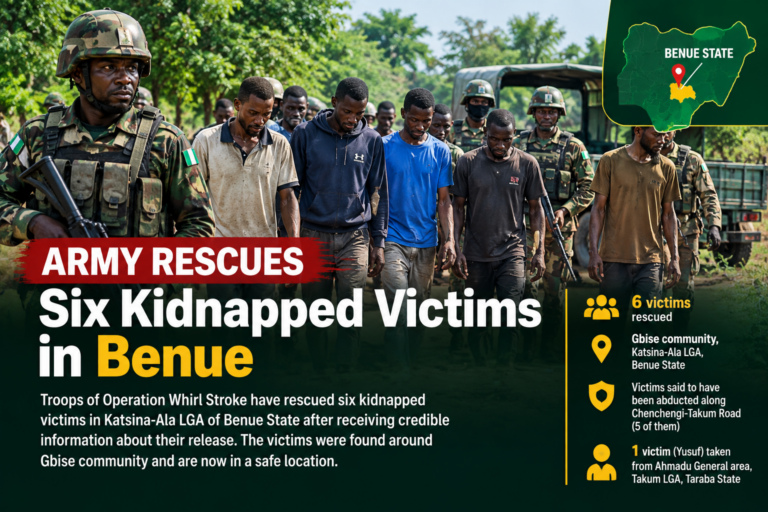
Troops of the Joint Task Force, Operation Whirl Stroke, have rescued six kidnapped victims in Katsina-Ala Local Government Area of Benue State. The victims were rescued around Gbise community on September 25 after troops reportedly received credible information about their release while conducting patrols in the area. The Acting Media Information Officer of the task…
Olu Jacobs Dies at 84: Nollywood Loses One of Its Most Celebrated Actors
Nigeria’s entertainment industry has been thrown into mourning following the death of veteran actor and film executive, Oludotun Baiyewun Jacobs, popularly known as Olu Jacobs, at the age of 84. The actor died on Wednesday, September 16, 2026. His family announced the news through a statement shared by his son, Olusoji Jacobs, bringing an end…