
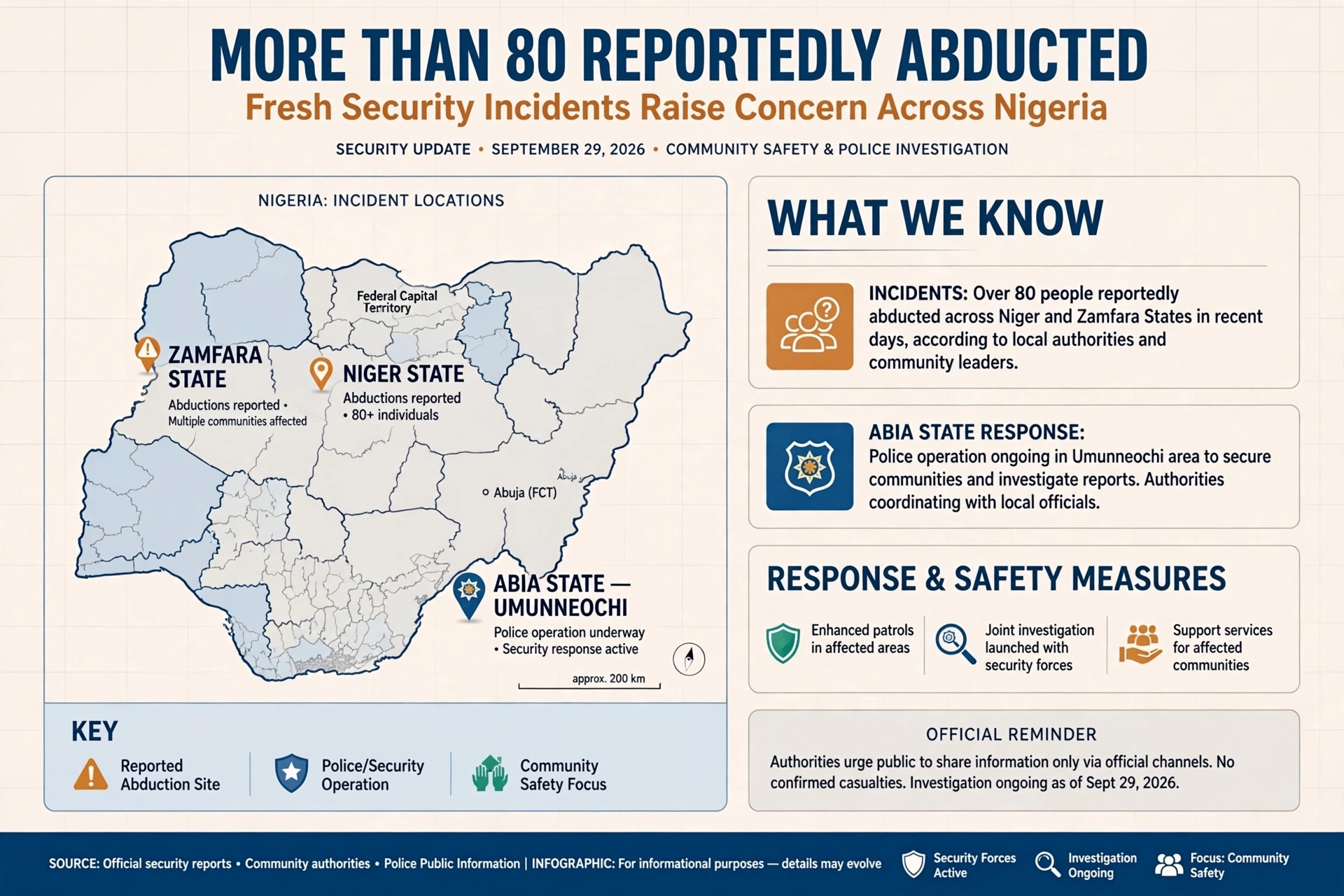
Fresh reports of abductions in parts of northern Nigeria, alongside the discovery of suspected human remains in a separate police operation in Abia State, have renewed attention on the country’s security challenges. More than 80 people, including farmers and women, were reportedly abducted in separate incidents in Niger and Zamfara states, according to reports published on Tuesday. The reported abductions have added to concerns over the safety of rural communities, particularly farmers and residents who depend on movement between villages and farms for their livelihoods. In a separate development in the South-East, police operatives in Abia State discovered 28 human skulls and other bones during a raid on suspected criminal camps in forests around Umuaku-Isuochi and Nneato in Umunneochi Local Government Area. The Abia State Police Command said tactical teams carried out intelligence-led operations targeting suspected criminal hideouts. According to the police, suspects reportedly fled before security operatives arrived at the camps. The officers subsequently searched the abandoned locations and recovered human remains, including 28 skulls and bones. The police said some of the remains were already decomposed and that investigations were ongoing to determine their identities and the circumstances surrounding the deaths. The police have not established publicly that the remains are connected to all of the recent abduction cases reported in northern Nigeria. That distinction is important because the reported abductions in Niger and Zamfara and the discovery in Abia occurred in different locations and were reported as separate security developments. The latest incidents nevertheless underline the continuing difficulties faced by security agencies in dealing with criminal networks operating across rural and forested areas. For residents of affected communities, the consequences go beyond the immediate fear of attacks. Farmers may avoid their farms, traders may reduce movement and families may be forced to change daily routines because of security concerns. In northern communities where farming remains a major source of income, repeated attacks and kidnappings can also affect agricultural activity. Security agencies have continued to conduct raids and rescue operations against criminal groups in different parts of the country. The latest developments are likely to increase pressure on authorities to improve intelligence gathering, protect vulnerable communities and ensure that suspected criminal networks are brought before the law. Meanwhile, investigations into the Abia discovery are expected to focus on identifying the remains and determining who occupied the abandoned camps. Authorities are also expected to continue searching for suspects who reportedly escaped during the operation. The separate incidents demonstrate why accurate identification of victims, locations and circumstances remains essential as security agencies investigate violent crimes across Nigeria.
Similar Posts
INEC Raises Fresh Alarm Over AI-Generated Misinformation Ahead of 2027 Elections
The Independent National Electoral Commission (INEC) has raised fresh concerns about the growing use of artificial intelligence to create and circulate misleading information ahead of Nigeria’s 2027 general elections. The electoral body said the increasing sophistication of artificial intelligence presents a new challenge for election communication, particularly with the ability to produce convincing fake videos,…
Nigerian Army Activates Three New Military Formations in Kebbi
The Nigerian Army has operationalised three new military formations in Kebbi State as part of efforts to strengthen security operations and tackle banditry in the North-West. The formations are the 28 Armoured Brigade and Garrison in Birnin Kebbi, the 281 Tank Battalion in Yauri and the 381 Artillery Regiment in Kaoje. The operationalisation is part…
Police Issue Nationwide Security Alert Over Planned Attacks on Schools, Churches and NYSC Camps
The Nigeria Police Force has placed its formations across the country on heightened alert following intelligence indicating possible coordinated terrorist attacks on schools, places of worship, NYSC orientation camps and other vulnerable locations. The security warning comes as schools prepare for the commencement of the 2026/2027 academic session, raising fresh concerns about the safety of…
Investors Pour Over ₦6 Trillion Into CBN OMO Bills as Demand Surges
Investors have shown strong appetite for Central Bank of Nigeria Open Market Operations securities, submitting more than ₦6 trillion in bids at the apex bank’s latest OMO auction. The development comes amid a changing interest-rate environment and increasing activity in Nigeria’s fixed-income market. At the September 24 OMO auction, investors submitted about ₦6.09 trillion in…
NDLEA Intercepts ₦3bn Worth of Opioids at Lagos Airport, Arrests Man With 72 Cocaine Wraps
The National Drug Law Enforcement Agency (NDLEA) has announced the interception of 2.55 million tablets of opioids valued at more than ₦3 billion at the Murtala Muhammed International Airport in Lagos. The agency said the drugs, weighing 1,640.55 kilogrammes, were seized on September 22 during the examination of three consignments at the airport’s import shed….
WHY APC GOVS ARE NOT HAPPY WITH ME _ WIKE
The Minister of the Federal Capital Territory, Nyesom Wike, has finally opened up on why APC Governors are not happy with him. Wike made this revelation during an interview on Arise TV Prime Time on Tuesday, September 16. According to him, the problem did not start today. Wike said APC governors were unhappy from the…