
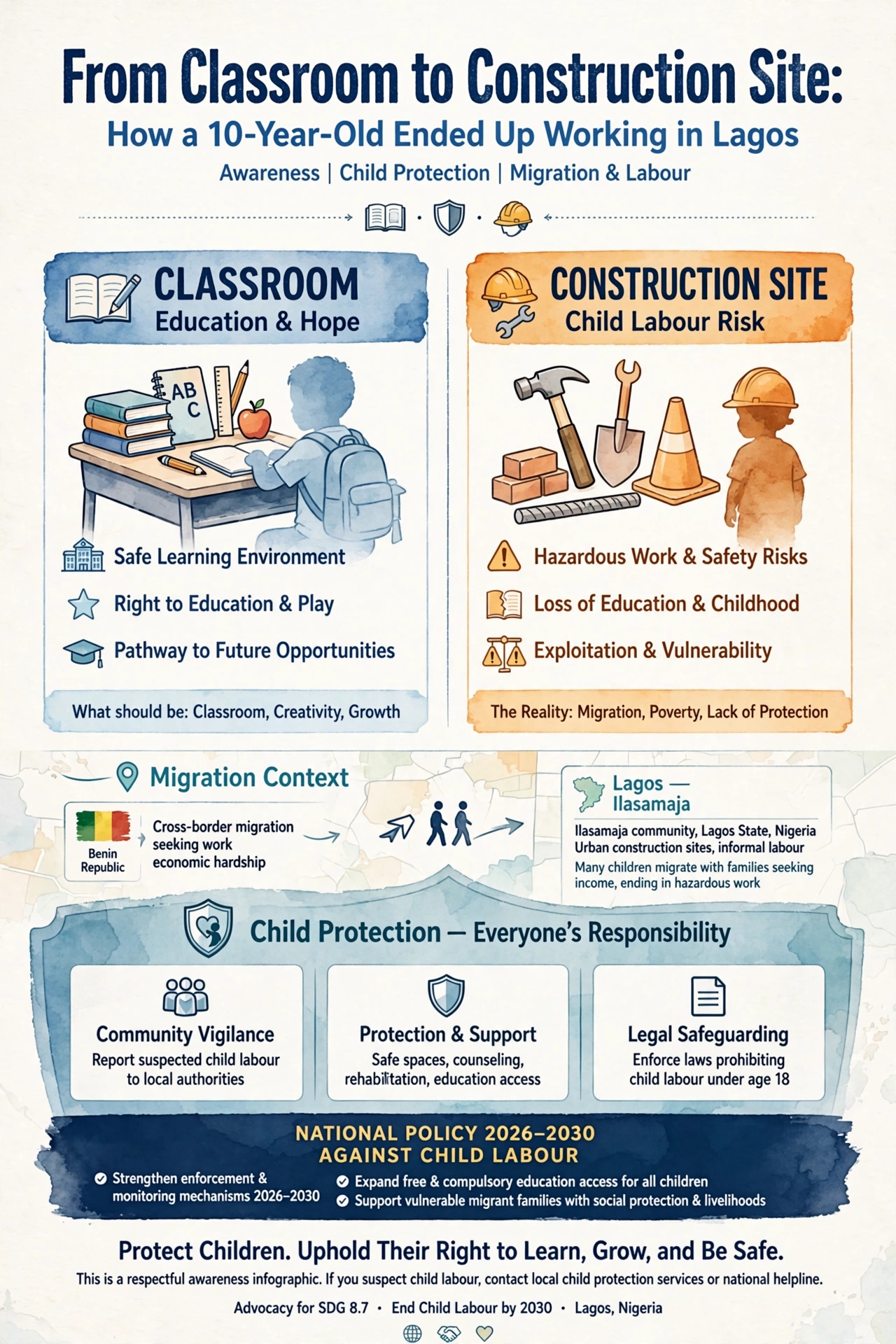
A report involving a 10-year-old boy from the Republic of Benin working at a construction site in Lagos has drawn fresh attention to the difficult line between informal apprenticeship and child labour. The boy, identified as Ojo Ibukun, was reportedly brought from Ifangni in south-eastern Benin Republic to Lagos by a master tiler. Instead of attending school, the child now spends his days on a construction site in Ilasamaja, Lagos, carrying out physically demanding tasks including mixing sand and cement. He reportedly sleeps on cardboard at the unfinished building where he works. The case has highlighted the way poverty, migration and informal apprenticeship can combine to leave children outside the formal education system and exposed to potentially dangerous working conditions. According to the report, Ibukun was brought to Lagos to learn tiling. His master, Kilamuwaye Alexandre, said the boy wanted to learn the trade and that his parents agreed to the arrangement. But the conditions under which the child is learning the trade have raised questions about whether the arrangement can still be considered apprenticeship when a 10-year-old is performing heavy manual labour and living at a construction site. Apprenticeship has traditionally played an important role in Nigeria and other West African societies. Young people can learn trades by working under experienced artisans, gaining practical skills that may eventually enable them to establish their own businesses. The challenge becomes more complicated when very young children are involved. There is a significant difference between learning a skill under safe and supervised conditions and being removed from school to carry out physically demanding work for long hours. Construction sites can expose children to heavy materials, dust, machinery and other hazards. The child’s experience also highlights the vulnerability of children who cross borders for informal work. Because Ibukun is from Benin Republic, his movement between countries adds another layer to the child-protection challenge. The case is particularly significant because Nigeria is currently pursuing renewed efforts to tackle child labour. A national policy and action plan covering 2026 to 2030 has been presented as part of efforts to eliminate child labour and strengthen child protection. Recent reporting on Nigeria’s child-labour situation has also pointed to poverty, weak social protection, limited access to education and the size of the informal economy as major factors behind the persistence of the problem. The challenge is therefore larger than simply removing children from workplaces. Families facing severe economic pressure may depend on children’s contributions, meaning that enforcement without addressing household vulnerability can leave the underlying problem unresolved. For children such as Ibukun, however, the immediate issue remains access to education and protection from hazardous work. His story demonstrates how quickly a decision described as “learning a trade” can turn into a situation where school, childhood and basic protection are pushed aside. As Nigeria continues its efforts to reduce child labour, cases like this are likely to keep attention focused on informal workplaces where children can be difficult to identify and protect. The broader question is whether families can receive enough economic and social support to allow children to remain in school while adults earn decent incomes. For Ibukun, the difference between a classroom and a construction site is more than a change of location. It represents two very different paths through childhood — one centred on education and the other on survival and work.
Similar Posts
WE WERE ASKED TO GET A DEGREE BUT NOBODY TOLD US THERE WOULD BE NO JOB AFTER GETTING A DEGREE
Growing up, I had one answer for everyone who asked me, “What do you want to be?” A doctor. A real medical doctor. I pictured myself in a white coat. Saving lives. Making my parents proud. But then there was mathematics. And blood. Math stood in the way like a wall I couldn’t climb. And…
The Future of Medical Education in the Light of Evolving Career Dynamics.
The roots of medical education in Nigeria can be dated back to 1930. Before the establishment of the MBBS programme, medical training was offered in Yaba Training College as a diploma course and it was run by the colonial masters- the British Colonial government. The graduates were awarded Licentiate of Medicine and Surgery (LMS) and…
HOW TO MAKE A GUY FALL IN LOVE IN 7 DAYS
The 7-Day Guide to Attraction, Emotional Connection & Love AUTHOR: CHIDI CHISOM She looked at her phone. 11:47 p.m. No message. She had checked the chat at least six times in the last ten minutes. Then, finally— “Hey, you still awake?” Her heart jumped. She smiled. Typed. Deleted. Typed again. Then she sent: “Maybe. Why?…
Addressing the 2026 Surge in Student Housing Rents
Nigeria’s student housing crisis has sharpened into a clear affordability emergency. National Bureau of Statistics (NBS) data for July 2026 show rent inflation surging to 33.74%, far outpacing headline inflation, which eased to 15.43%. While overall consumer prices have moderated, the cost of a roof over a student’s head continues to climb rapidly. Off-campus clusters…
FROM SUG TO ABUJA: ARE WE TRAINING THE LEADERS OR PROBLEMS OF TOMORROW?
Chime Chukwuagoziem J. LL.B (Hons). (chukwuagoziem2003@gmail.com , +2349130791717) Every country eventually produces the politics it has taught its citizens to practice. The Nigerian question, therefore, may not begin in the chambers of the National Assembly, the Executive Council or the corridors of power in Abuja. It may begin much closer to home, in our lecture…
When Ile-Ife Becomes a Living Story: Inside the Ancient Olojo Festival
There is a particular kind of anticipation that comes over Ile-Ife when Olojo draws near. It is not simply the excitement that comes with a festival, for the people of the ancient city, Olojo is a period when history, royalty, spirituality and cultural identity seem to come together in one place. This year, the atmosphere…