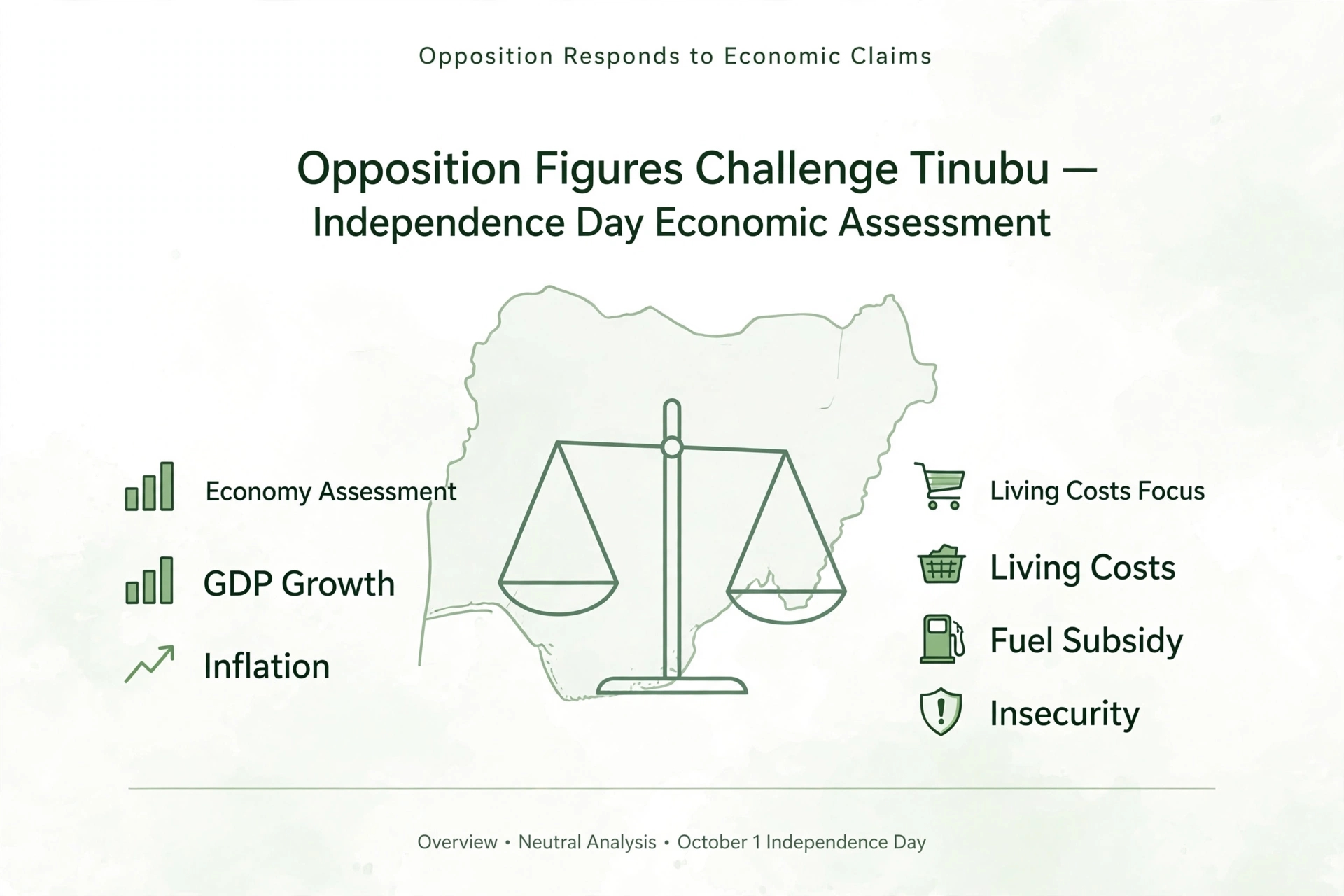
President Bola Tinubu’s Independence Day address has triggered contrasting reactions from opposition figures, with critics questioning the administration’s assessment of Nigeria’s economic progress. In his October 1 address marking the country’s 66th Independence anniversary, Tinubu said Nigeria had moved beyond a difficult period of economic reforms and was entering what he described as an “age of prosperity.” The President highlighted economic growth, lower inflation, improved oil-sector performance and other indicators as evidence of progress. However, opposition figures offered a different assessment of the situation facing Nigerians. Former Vice President and African Democratic Congress presidential candidate Atiku Abubakar challenged the President’s description of the economy, pointing to continued concerns over living costs, insecurity and household purchasing power. Atiku also questioned some of the social and economic interventions referenced by the Federal Government and called for evidence concerning reported conditional cash transfers. He further challenged claims that transportation costs were falling, asking the government to provide details showing where and how Nigerians were benefiting from lower fares. The opposition figure also criticised the removal of the petrol subsidy, arguing that the policy contributed to higher fuel, transportation and food costs. Atiku proposed a capped and budgeted production subsidy tied to petrol refined in Nigeria, including fuel produced by modular refineries. He also called for independent auditing of the proposed programme. Peter Obi, another opposition political figure, also reacted to the President’s address, focusing on insecurity, poverty, leadership and accountability. Obi said Independence Day should provide an opportunity for Nigerians to assess the country’s direction and examine whether national development is matching the aspirations of the country’s founders. Other critics, including former Minister of Youth and Sports Solomon Dalung, also faulted the President’s address. Dalung described the speech as disappointing and argued that it did not sufficiently demonstrate the administration’s achievements. The reactions contrast with the economic data cited by FactCheckHub, which found that several specific claims made by Tinubu concerning GDP growth, inflation, oil losses and non-oil exports were supported by available official statistics. The differing responses therefore reflect two separate questions: what the economic indicators show and how those indicators translate into living conditions for households. Nigeria’s economy can record higher GDP growth or lower inflation while citizens continue to face high prices, making both macroeconomic indicators and household purchasing power relevant to the wider debate. The contrasting reactions are expected to remain part of political discussions as Nigeria approaches the 2027 general elections.
Similar Posts
Dam Overflow Floods Edo Community as Residents Fear Bigger Disaster
Residents of Enwan community in Akoko-Edo Local Government Area of Edo State are counting their losses after heavy rainfall caused the Ojirami Dam to overflow, flooding parts of the community and disrupting daily activities. The flooding has reportedly destroyed property and businesses, while residents are now worried that continued rainfall could worsen the situation and…
Tragedy in Jigawa as Four Teenage Girls Die After Boat Capsizes
Four teenage girls have died after a boat carrying eight passengers capsized at Dudduru Pond in Dutse Local Government Area of Jigawa State. The incident occurred at about 4:00 p.m. on Wednesday, September 23, 2026, while the passengers were travelling from Kwadige Village to Chai Chai Sabuwa Market. The Nigeria Security and Civil Defence Corps…
Smartphone Ownership Rises to 75% in Nigeria as Digital Economy Expands
Smartphone ownership in Nigeria has risen significantly, reaching 75 percent in 2025 compared with 64 percent in 2023, according to findings from a nationwide study. The increase represents an 11-percentage-point rise over the two-year period and highlights the growing role of smartphones in Nigerians’ daily lives. The findings were contained in the Nigeria Smartphone Study:…
Nigeria’s 2026 budget stands at N68.32 trillion.
Bagudu said the Federal Government’s ambition of building a $1 trillion economy would require greater revenue mobilisation, investment and, where necessary, borrowing supported by public confidence. The minister also called for a more informed public conversation about Nigeria’s fiscal capacity and the resources required to fund development. At the workshop, Bagudu urged journalists to scrutinise…
Tinubu Returns to Nigeria After Four-Week Working Vacation in Europe
President Bola Ahmed Tinubu has returned to Nigeria after spending about four weeks in Europe on what the Presidency described as a working vacation. The President arrived at the Presidential Wing of the Murtala Muhammed International Airport in Lagos on Tuesday evening, September 29. He departed Nigeria on August 30 and spent time in London…