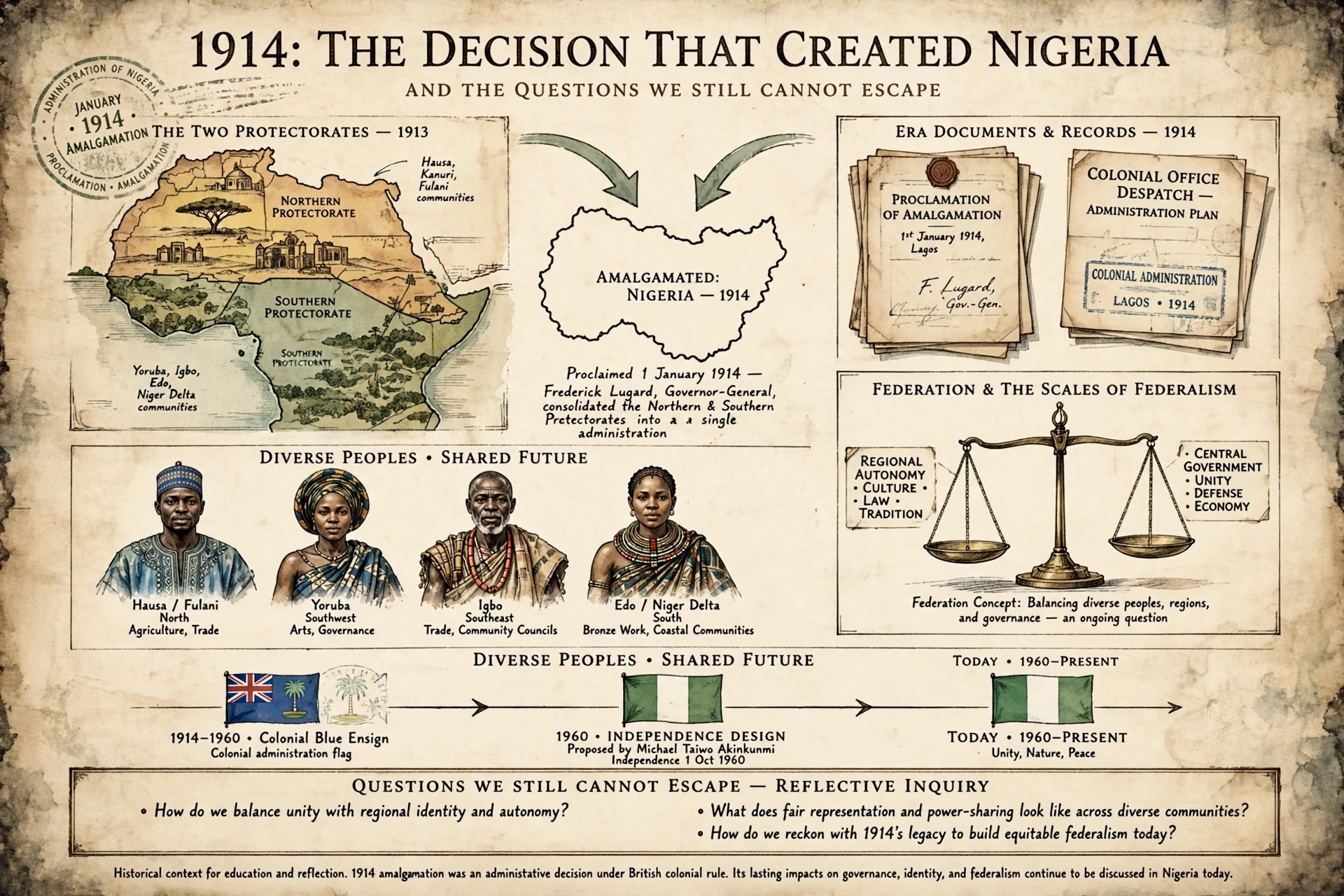
Few dates occupy as important a place in Nigeria’s political history as January 1, 1914. On that day, the British colonial administration amalgamated the Northern and Southern Protectorates, bringing the territories under a single colonial administration known as Nigeria. More than a century later, the decision continues to shape discussions about national identity, federalism, political representation and the future of the Nigerian state. The amalgamation took place under British colonial rule, with Frederick Lugard serving as governor-general. The decision was influenced by administrative and economic considerations, including the desire to manage the territories more efficiently and balance the financial arrangements of the northern and southern administrations. However, the territories brought together were not identical societies. They contained diverse ethnic groups, languages, religious traditions, political institutions and economic systems, some areas had long-established centralised kingdoms and emirates, while others operated through different forms of political organisation. British colonial rule interacted with these societies in different ways, including through systems of indirect rule. The amalgamation created a common colonial administrative structure, but it did not immediately produce a unified national identity shared equally by all the people within the new boundaries. Nigeria eventually gained independence on October 1, 1960. The country inherited the territorial framework created under colonial rule, together with institutions and political arrangements that would influence its post-independence development. The historical significance of 1914 therefore extends beyond the signing of an administrative decision. It raises questions about how a diverse population can build a functioning political community within a common state. Nigeria’s post-independence history has been shaped by efforts to answer these questions. Regional competition, constitutional disagreements, military coups, civil war and repeated debates over the distribution of political power have all influenced the country’s search for stability, the creation of additional states, the adoption of federal arrangements and subsequent constitutional changes reflected attempts to manage the country’s diversity and distribute political authority. Yet the underlying debates have not disappeared. Many Nigerians continue to question whether public resources are distributed fairly, whether political institutions adequately represent different communities and whether citizens enjoy equal opportunities regardless of where they come from. These concerns cannot be explained by the amalgamation alone. Nigeria’s present circumstances have also been shaped by decisions made by successive governments, economic developments, social change and the actions of citizens themselves. Nevertheless, the history of 1914 provides an important starting point for discussing national cohesion honestly. National unity cannot be sustained simply by declaring that a country must remain together. It requires institutions that make citizens believe they have a fair stake in the national project. A functional federation must balance national coordination with the needs of its constituent states and communities. It must also ensure that the central government does not become so dominant that local concerns are ignored, debates about restructuring, fiscal federalism, resource allocation and state responsibilities should therefore be approached through evidence, constitutional principles and serious public engagement. Mo single constitutional arrangement can resolve every national disagreement. However, a system that allows grievances to be expressed, considered and addressed peacefully is more likely to sustain public confidence than one that treats every demand for reform as a threat. Nigeria must also confront the temptation to reduce its complex history to a simplistic story of permanent conflict between ethnic or religious groups. Such narratives ignore the long history of cooperation, interdependence and shared aspirations among Nigerians. The country has produced remarkable achievements in education, commerce, culture, science, sports and international affairs. These accomplishments demonstrate that diversity does not make national cooperation impossible, the challenge is to build institutions that allow the country’s different communities to participate in a common political project without being forced to abandon their identities. Historical understanding is essential to this process. Citizens should learn how the Nigerian state was formed, how colonial policies influenced its development and how post-independence leaders shaped its institutions, but historical understanding must lead to constructive choices rather than endless recrimination. The question today is not simply whether the amalgamation was beneficial or harmful. It is whether Nigerians can build a political system that serves the people living within the country as it exists today, the amalgamation of 1914 created the administrative foundation of modern Nigeria, but it could not create national unity by decree. More than a century later, that responsibility belongs to Nigerians themselves: to build a fairer federation, strengthen public institutions and make citizenship a source of equal dignity and shared opportunity.
Similar Posts
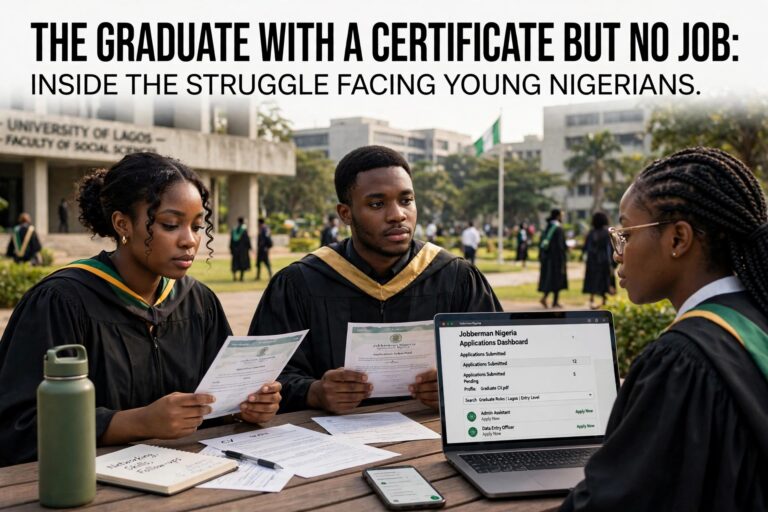
THE GRADUATE WITH A CERTIFICATE BUT NO JOB: INSIDE THE STRUGGLE FACING YOUNG NIGERIANS
Graduation is often presented as the beginning of a brighter chapter. After years of lectures, examinations, assignments, financial sacrifices, and personal challenges, obtaining a university degree is expected to bring a sense of achievement and open the door to new opportunities. For many Nigerian graduates, however, the period after graduation can introduce a different kind…
THE BERLIN WALL FELL: WHY EVERY SOCIETY MUST CONFRONT ITS OWN DIVISIONS
On November 9, 1989, an event unfolded in Europe that became one of the most recognisable symbols of political change in modern history. The Berlin Wall, which had divided East and West Berlin for nearly three decades, was opened, allowing people to cross a barrier that had separated families, restricted movement and symbolised the division…
7 Things Every 100-Level Student Should Know Before Their First Semester
100 Level Students, Freshers, University Life, Student Tips, Academic Success, First Semester, Study Tips, Undergraduate Students, Education, AE-FUNAI
LEARNING TO ADJUST WHEN THE PACE CHANGES
Something happened while I was writing my exams last semester.It was as if my lecturers and exam invigilators all had a problem with time or somewhere very important to be. Where did they all want to go?Where were they rushing to? On the exam paper, the duration would be clearly stated:2 HOURS.But somehow, most times,…
NOT EVERY POOR PERSON IS INNOCENT, AND NOT EVERY RICH PERSON IS WICKED
We have created a society where poverty automatically earns sympathy, while wealth often attracts suspicion. If someone is poor, we are quick to defend them. If someone is wealthy, we immediately begin questioning their source of income. But is that really a fair way to judge people? The truth is uncomfortable: poverty does not automatically…
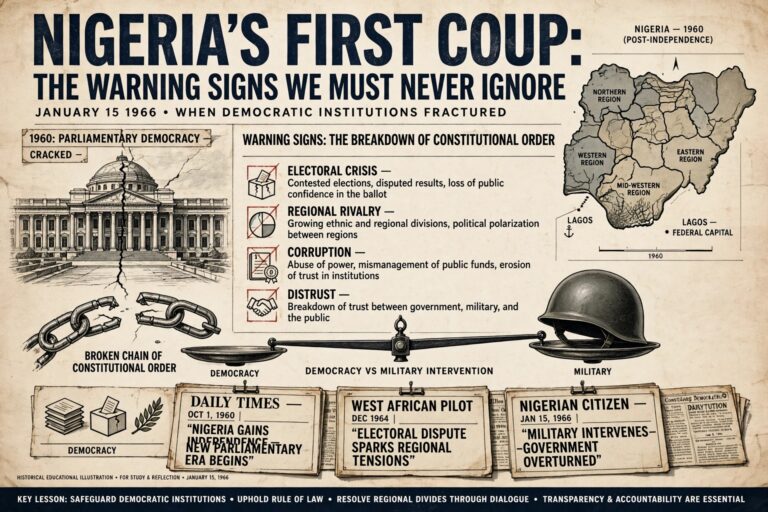
NIGERIA’S FIRST COUP: THE WARNING SIGNS WE MUST NEVER IGNORE
Democracy is rarely destroyed in a single moment. More often, it weakens through political crises, institutional failures, public distrust and the growing belief that constitutional government is incapable of solving society’s problems. Nigeria’s first military coup, carried out on January 15, 1966, remains a powerful historical warning about what can happen when a young democracy…