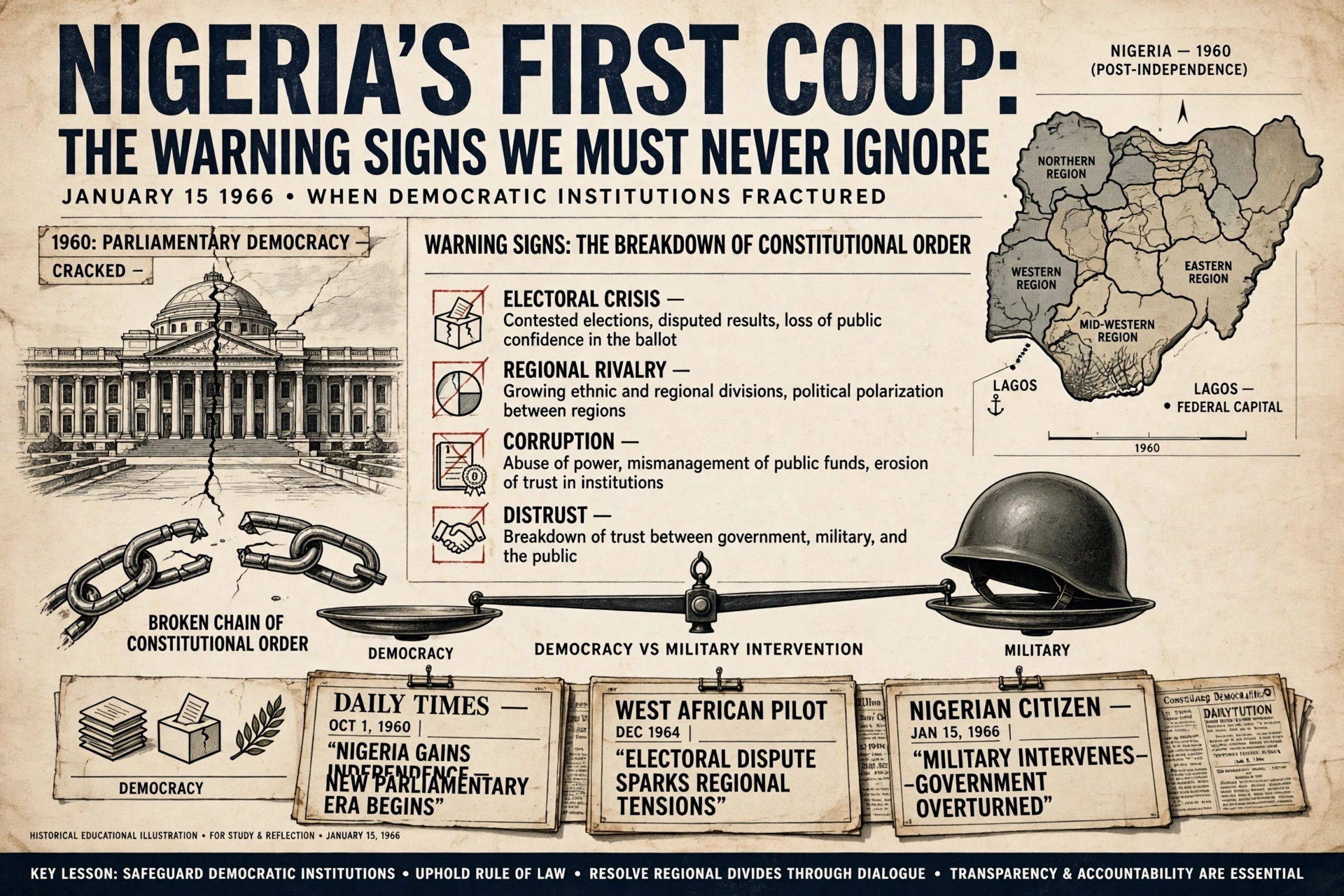
Democracy is rarely destroyed in a single moment. More often, it weakens through political crises, institutional failures, public distrust and the growing belief that constitutional government is incapable of solving society’s problems. Nigeria’s first military coup, carried out on January 15, 1966, remains a powerful historical warning about what can happen when a young democracy struggles to manage political instability. Nigeria became independent on October 1, 1960, inheriting a parliamentary political system and institutions shaped substantially by British colonial rule. The country’s early years were marked by political competition, regional rivalries, disputes over electoral credibility and disagreements among political leaders. The Western Region crisis of the early 1960s and the controversy surrounding the 1964 federal election and the 1965 Western Region election contributed to an increasingly tense political environment. On January 15, 1966, a group of military officers launched a coup that resulted in the deaths of several senior political and military figures, including Prime Minister Abubakar Tafawa Balewa and Northern Premier Ahmadu Bello. Major General Johnson Aguiyi-Ironsi subsequently emerged as head of state. The coup disrupted Nigeria’s constitutional order and created a new political reality in which the military assumed control of government. Although the coup plotters presented their intervention as a response to corruption and political disorder, the seizure of power by force did not establish a stable democratic alternative. Instead, the events deepened suspicions, intensified regional tensions and contributed to a chain of political developments that included the July 1966 counter-coup and, ultimately, the Nigerian Civil War, the historical lesson is important: political frustration does not automatically justify the destruction of constitutional government. When elected officials perform poorly, citizens have legitimate reasons to demand accountability. Corruption, electoral manipulation, economic mismanagement and abuse of power deserve serious criticism. But replacing constitutional institutions with military rule can create problems more difficult to resolve than the ones it claims to address. Military governments are not automatically more honest, efficient or patriotic than civilian administrations. Without meaningful democratic accountability, military rulers can concentrate power, restrict freedoms and suppress opposition. Nigeria’s subsequent experience of military government demonstrated the risks of allowing armed institutions to become direct competitors for political power. The return to civilian rule in 1979 and again in 1999 represented important steps towards constitutional government. However, the strength of democracy cannot be measured solely by the number of years since the last coup. It must also be measured by the health of political institutions and the willingness of public officials to obey the law. Today, Nigeria needs stronger democratic safeguards, transparent public institutions and political parties that take internal democracy seriously. Elections must be credible, courts must operate independently, and security institutions must remain professionally committed to their constitutional responsibilities, political leaders must also understand that public anger is not something to be ignored until it becomes a crisis. Governments that respond to citizens only through force, intimidation or propaganda create conditions in which distrust can spread. At the same time, citizens must resist romanticising military rule whenever democracy disappoints them. Historical memory should remind us that authoritarian government carries its own dangers and that political power is difficult to restrain when citizens lose the freedom to challenge it. The January 1966 coup should therefore be remembered neither as a simple solution to political failure nor as an event without historical context. It should be studied as part of a wider story of institutional weakness, elite rivalry and the consequences of abandoning constitutional processes. Nigeria does not need another interruption of democracy to prove that democracy can fail. It needs a democracy that works well enough to correct its own failures before frustration becomes a threat to the constitutional order.
Similar Posts
Clean Looking Water Is Not Always Safe Water
We drink water every day. When we are thirsty, we grab a bottle or sachet of water, open it and drink. Most times, we do not stop to think about where the water came from, how it was treated, or how it was handled before it reached us. It looks clean. It is sealed. So…
What the Girl Child Goes Through — And Why Nigeria Can No Longer Look Away
Before she becomes a woman, she is already at war. A war she did not start, for a body she did not choose, in a world that was not designed for her. Let us follow the life of a typical Nigerian girl child not the privileged one on Instagram, but the one in your street,…
Easywealth MediaHub Is Bringing Digital Media, E-commerce and Creator Opportunities Into One Platform
A Unified Digital Experience Easywealth MediaHub is a Nigerian digital platform designed to bring entertainment, content creation, online shopping and knowledge sharing into one ecosystem. Through its website, easywealthmediahub.com, the platform aims to give users access to videos, short-form content, informative articles, products and opportunities to develop as digital creators. Rather than separating these activities…
Sava Emerges from Stealth With $10 Million to Modernise Trust Administration
Sava, a next-generation trust company, has emerged from stealth with $10 million in funding to simplify trust creation and administration through modern software infrastructure. Investors Back Sava’s Vision The funding round was led by Gradient Ventures, with participation from Y Combinator, SV Angel, Instacart co-founder Max Mullen, Orange Collective, SurgePoint Capital and Tekedia Capital. The…
WHEN ECONOMIES COLLAPSE, ORDINARY PEOPLE PAY THE HIGHEST PRICE
Economic crises are frequently discussed through statistics: falling markets, declining production, rising unemployment, shrinking national income and increasing government debt. Yet behind every economic indicator are human beings whose lives can be transformed by decisions they had little power to influence. The Great Depression, which began in 1929 and continued through much of the 1930s,…
Chinese Warehouses and Stores in Africa: A Blessing or a Threat to Local Businesses?
Walk into many major African cities today and there is a good chance you will come across shops, warehouses or businesses selling products imported from China. From electronics and phone accessories to clothes, household items, building materials and spare parts, Chinese products have become a familiar part of everyday life for many African consumers.For customers,…