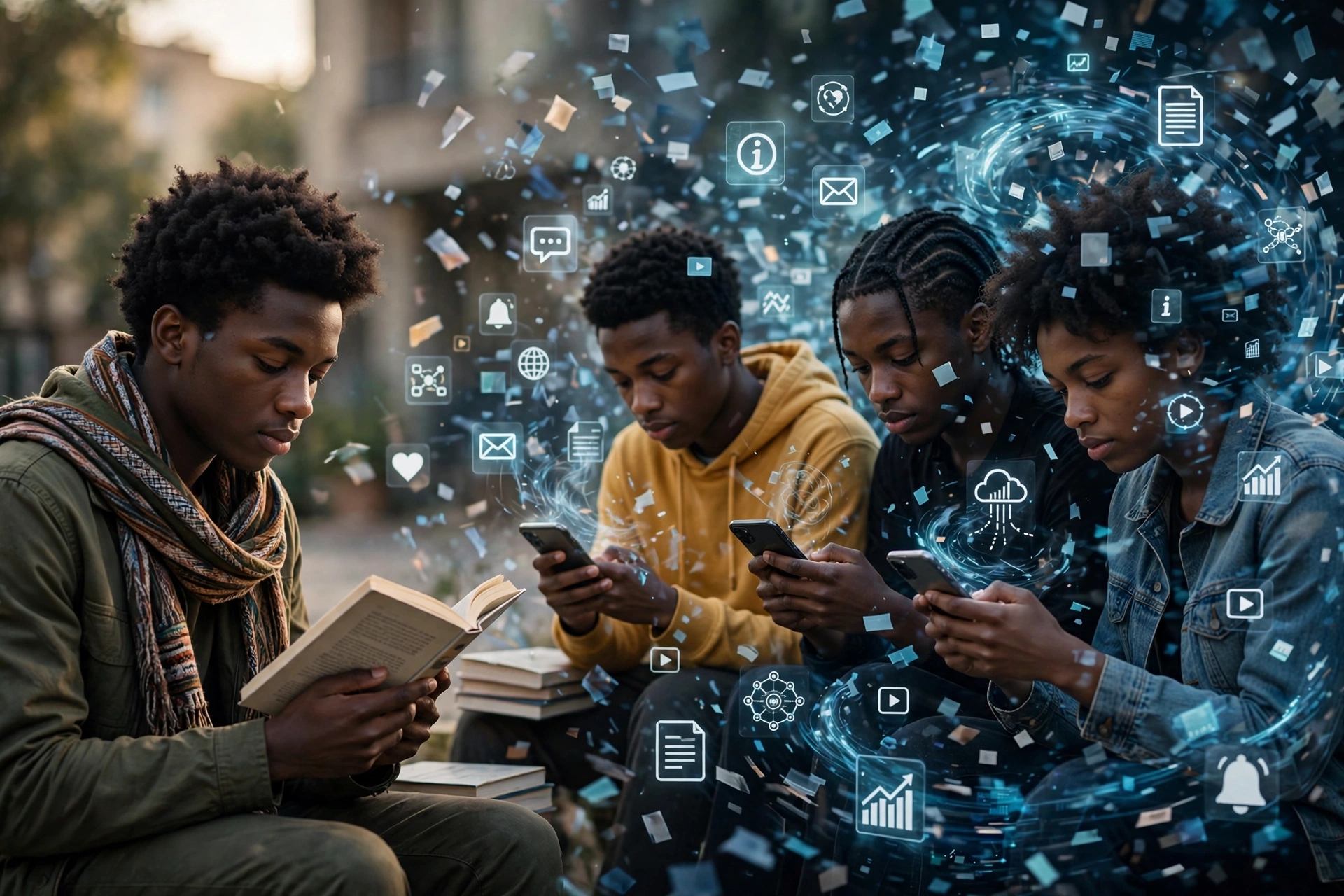
We live in a generation where information is everywhere, yet genuine understanding appears increasingly difficult to find. A person can wake up, scroll through social media for twenty minutes and encounter political arguments, celebrity controversies, relationship advice, financial lessons, religious debates, breaking news and opinions about almost every subject imaginable. Within a few minutes, they have seen hundreds of posts, watched several videos and participated in multiple conversations, but how much of what they have consumed do they actually understand? This is one of the most interesting contradictions of our time: we have access to more information than any previous generation, yet access to information does not necessarily translate into knowledge, wisdom or critical thinking, we are becoming increasingly familiar with everything but deeply knowledgeable about very little. The internet has transformed the way people learn, communicate and understand the world. Today, information that once required hours in a library can be accessed within seconds. Students can learn new skills online, entrepreneurs can study business strategies, and individuals can explore subjects beyond the limits of traditional education, atificial intelligence has made this access even easier. These developments are remarkable, and their benefits should not be dismissed. However, convenience comes with a responsibility: knowing how to distinguish reliable information from misleading content. Unfortunately, many people now mistake exposure to information for actual understanding. Wattching a thirty-second video about a complex political issue does not automatically make someone politically informed. Reading a social media thread about medicine does not make someone a medical expert. Seeing a motivational quote does not necessarily mean one understands the realities of personal development, information requires examination. Knowledge requires understanding. Wisdom requires the ability to apply what has been learned appropriately, these are not the same things. One disturbing feature of modern internet culture is the speed with which people adopt opinions. A particular issue becomes popular, and suddenly everybody has something to say about it. A controversial statement goes viral, and thousands of people rush to defend or condemn it without examining the full context. Today, people are arguing about politics. Tomorrow, they are debating relationships. The following day, another controversy takes over the internet, the problem is not that people have opinions. Having opinions is part of human expression. The problem arises when opinions are formed without sufficient knowledge, reflection or willingness to consider alternative perspectives, we have created an environment where being the first to react sometimes appears more important than taking the time to understand. In such an environment, thoughtful silence can be mistaken for ignorance, while confidence is easily mistaken for intelligence, another issue worth examining is our changing relationship with reading and concentration. Many people now struggle to spend extended periods engaging with long articles, books or detailed discussions without reaching for their phones, short videos, quick updates and constant notifications have changed how people consume information. There is nothing inherently wrong with short-form content. It can educate, entertain and communicate important information. However, when quick consumption becomes our only habit, we risk losing the patience required for deeper learning, some subjects cannot be understood through headlines alone. History requires context. Politics requires examination. Science requires evidence. Human relationships require emotional understanding. Not everything meaningful can be reduced to a thirty-second explanation. Artificial intelligence has introduced another important dimension to this conversation, students can now use AI tools to explain difficult concepts, organise research, improve writing and explore new ideas, these are valuable opportunities. However, there is a difference between using technology to improve one’s thinking and allowing technology to replace it entirely, when students submit assignments they have not understood, when individuals repeat AI-generated explanations without examining their accuracy, or when people become unwilling to solve even simple problems without automated assistance, an important question emerges: Are we using technology to become more capable, or are we gradually becoming dependent on it? Technology should expand human ability, not eliminate the desire to think, the responsibility remains with individuals to question, verify and understand the information they receive.
Perhaps one of the greatest ironies of this generation is how much attention people devote to the lives of strangers. We know who is dating whom, which celebrity is fighting another celebrity, who bought an expensive car, who travelled abroad and who is involved in the latest controversy. Yet some people know very little about their own financial decisions, professional development, personal responsibilities or the issues directly affecting their communities, we have become spectators of other people’s lives while sometimes neglecting the work required to improve our own, entertainment is not the enemy. Enjoyment is necessary. But a generation that spends more time monitoring strangers than developing itself must occasionally pause and reconsider its priorities. The solution is not to abandon social media, reject technology or pretend that previous generations were intellectually superior. Every generation has its weaknesses, and the current generation also possesses remarkable creativity, innovation and access to educational opportunities, what we need is a renewed commitment to intellectual discipline. We must learn to read beyond headlines, question information before accepting it, examine different perspectives and recognise that changing one’s opinion after encountering better evidence is not weakness, we must also encourage young people to ask questions rather than simply memorise answers. Most importantly, we must understand that having an opinion on everything is not a requirement for being intelligent. Sometimes, the most intelligent response is to admit that we do not know enough, the internet has given this generation an extraordinary opportunity. We can learn, create, communicate and access knowledge in ways that were unimaginable decades ago, but opportunity alone does not guarantee intellectual growth. A person can spend an entire day consuming information and still learn nothing meaningful. Another can spend an hour studying a single subject and develop an understanding that changes how they see the world, the difference is not necessarily access. It is the willingness to think. Perhaps the real crisis of our generation is not that we lack information, but that we sometimes lack the patience, discipline and intellectual curiosity required to make sense of it, we do not need a generation that has something to say about everything. We need a generation that understands what it is saying.
Similar Posts
Broke People Don’t Get to Philosophise About Money(So I Did It for Us)
I was having a conversation with a friend and I realised everything we talked about revolved around money. For any of our plans to work or even fail, it needed money. It got me thinking: how did the world become so dependent on money, or its modern equivalents? How did power get so tightly attached…
WOMEN DON’T LOVE, MEN DO? THE DANGEROUS MYTH WE HAVE MISTAKEN FOR TRUTH
There is a controversial belief that continues to divide conversations about relationships: women don’t truly love men; men are the ones who love deeply. According to this argument, men become attached to the person, while women become attached to what the person provides. Men mourn lost love, while women mourn lost comfort, security and status….
How to Apply for the US Army as a Non-Citizen in 2026: Requirements, Green Card & Citizenship Process
Many Nigerians and other foreigners ask if it’s possible to join the United States Armywithout being a U.S. citizen.The short answer is yes, but with conditions. You don’t need to be a U.S. citizen to enlist, but you must be a legal U.S. resident. According to U.S. Army recruiting guidelines, non-citizens must meet these requirements:…
Nigeria’s Heroes Deserve More Than a National Anthem
Every October 1, Nigeria remembers her heroes. We hear their names, we see their portraits, we repeat the familiar stories of independence, sacrifice and patriotism. Then the speeches end, the flags come down. And, too often, the lessons disappear with them. But Nigeria’s heroes deserve more than a few paragraphs in an Independence Day speech,…
Muse Spark vs ChatGPT: Which AI is Better for Writers in 2026?
As a writer who has already published 2 stories, I’m always testing new tools. I used AI for ideas and finding the right words, but not to write the whole thing.In April 2026 Meta dropped Muse Spark, and everyone started asking: “Is this better than ChatGPT?”I tested both. One gave me ideas fast. The other…
THE COLONIAL MASTERS LEFT: WHY ARE SO MANY AFRICAN DREAMS STILL UNFULFILLED?
When African countries began gaining independence in the mid-twentieth century, the moment carried enormous expectations. Political freedom promised the opportunity to determine national priorities, build institutions, expand education and use domestic resources for the benefit of citizens. Yet decades after the end of formal colonial rule, many African countries continue to struggle with poverty, unemployment,…