A new initiative announced by the Aliko Dangote Foundation could give eligible Nigerian tertiary institution students an opportunity to participate in the stock market through shares associated with the planned public offering of Dangote Refinery. The Aliko Dangote Foundation has announced plans to acquire initial public offering shares on behalf of eligible students in Nigerian tertiary institutions, with the initiative potentially reaching up to four million beneficiaries. The Federal Ministry of Information and National Orientation reported the development on October 19, 2026, describing it as an effort to promote financial literacy, youth empowerment and wealth creation. Under the announced proposal, eligible students aged 18 and above are expected to receive 10 IPO shares each without having to purchase the shares themselves. The announcement has attracted attention because it could introduce a large number of young Nigerians to formal investment and participation in the capital market. The proposed initiative centres on acquiring shares associated with the initial public offering of Dangote Refinery for eligible tertiary institution students. An IPO is the process through which a company offers shares to investors under an approved public offering. For students who might otherwise lack the funds or experience needed to begin investing, a sponsored allocation could provide an introduction to share ownership. However, the initiative’s eventual reach will depend on the final eligibility rules, implementation arrangements and other details announced by the foundation and relevant authorities. Students should not assume that every tertiary institution student will automatically receive shares until the full terms are formally published. Financial literacy involves understanding how money, savings, investment and financial risks work. Introducing young people to share ownership may provide an opportunity to learn about investment, company performance and the relationship between risk and potential returns. Such knowledge can be valuable beyond the immediate initiative, especially for graduates entering employment or starting businesses. However, receiving shares is not the same as receiving cash, the value of shares can rise or fall depending on the company’s performance, market conditions and investor demand. Shareholders may also face restrictions or other conditions depending on the terms of an offer. Students therefore need clear information about how the shares will be allocated, held and managed. The proposed programme could have a substantial reach if it is implemented at the scale announced. With millions of students potentially eligible, the initiative would require clear arrangements for identifying beneficiaries and distributing the shares. Institutions and students would need reliable information about registration, verification, eligibility and the steps required to participate. The foundation and relevant authorities would also need to communicate how the programme will be administered and how beneficiaries can confirm their allocations. Until those arrangements are fully published, students should avoid relying on unofficial registration links or individuals claiming to guarantee access. Nigeria’s capital market has long faced the challenge of encouraging broader participation among ordinary citizens. For many young people, the barriers include limited disposable income, insufficient investment knowledge and uncertainty about how to begin. A sponsored share-allocation initiative could help address some of those barriers while introducing students to the principles of investing. Its lasting value, however, will depend on whether beneficiaries receive adequate information and understand the risks associated with owning shares. Financial education should emphasise that stock-market investments can lose value and that past performance does not guarantee future returns. Students interested in the programme should follow official announcements from the Aliko Dangote Foundation, the Federal Ministry of Information and relevant capital-market authorities. They should wait for clear instructions about eligibility, registration, documentation and the allocation process. Anyone claiming to offer guaranteed access in exchange for an unofficial payment should be treated with caution. The initiative has the potential to introduce more students to investment, but its practical benefits will become clearer as the implementation details emerge. For now, the announcement represents a proposed opportunity for youth financial inclusion rather than proof that all intended beneficiaries have already received shares.

Similar Posts
The Independent National Electoral Commission has published final lists of governorship candidates for the 2027 general elections
The Independent National Electoral Commission has published final lists of governorship candidates for the 2027 general elections, providing voters with a clearer picture of the political figures expected to contest governorship positions across several states. The lists contain candidates’ names, political party affiliations and other relevant identifying information. Their publication represents an important stage in…
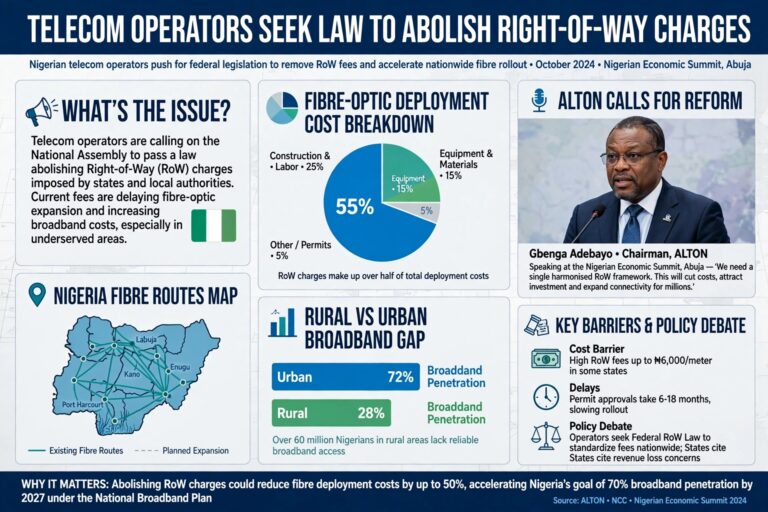
TELECOM OPERATORS SEEK LAW TO ABOLISH RIGHT-OF-WAY CHARGES
Telecommunications operators in Nigeria are calling for legislation to abolish right-of-way charges on fibre-optic infrastructure, arguing that the fees increase the cost of expanding broadband networks. The chairman of the Association of Licensed Telecommunications Operators of Nigeria, Gbenga Adebayo, made the call during discussions on investment and innovation at the Nigerian Economic Summit in Abuja….
Relief for Families as 20 Rescued Prospective NYSC Members Return to Ibadan
Twenty prospective members of the National Youth Service Corps who were abducted while travelling to their orientation camps have reportedly returned to Ibadan, bringing relief to families who had spent days worrying about their safety. The graduates were among a group of prospective corps members travelling from Oyo State to their assigned orientation camps in…
FG Domestic Borrowing Surges 90% to ₦24.7 Trillion in Eight Months
Nigeria’s Federal Government has dramatically increased its reliance on domestic borrowing, raising ₦24.7 trillion from local investors in the first eight months of 2026 — a staggering 90.5% increase compared with the same period last year. The figure, reported from government public-finance data, represents a sharp jump from the ₦12.98 trillion borrowed between January and…
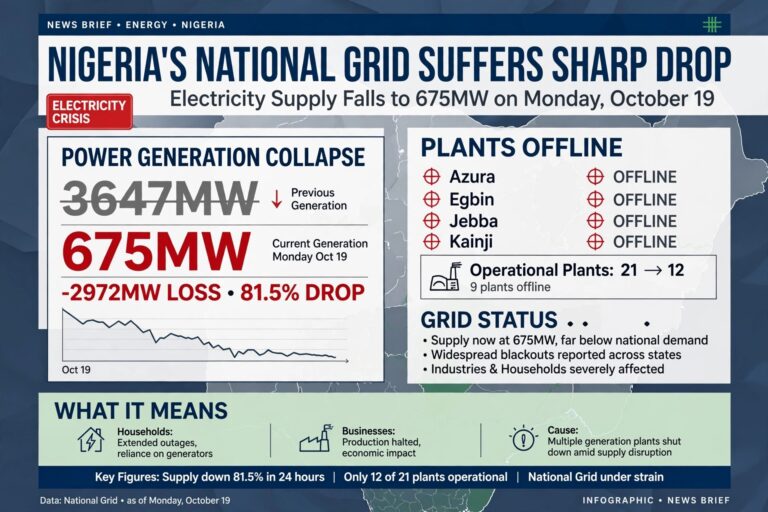
NIGERIA’S NATIONAL GRID SUFFERS SHARP DROP AS ELECTRICITY SUPPLY FALLS TO 675MW
Nigeria experienced a sharp decline in electricity supplied to the national grid on Monday, October 19, after several power plants went offline, raising fresh concerns about the reliability of the country’s electricity supply. Nigeria’s electricity supply suffered a major setback on Monday after power generation connected to the national grid fell sharply to 675 megawatts…
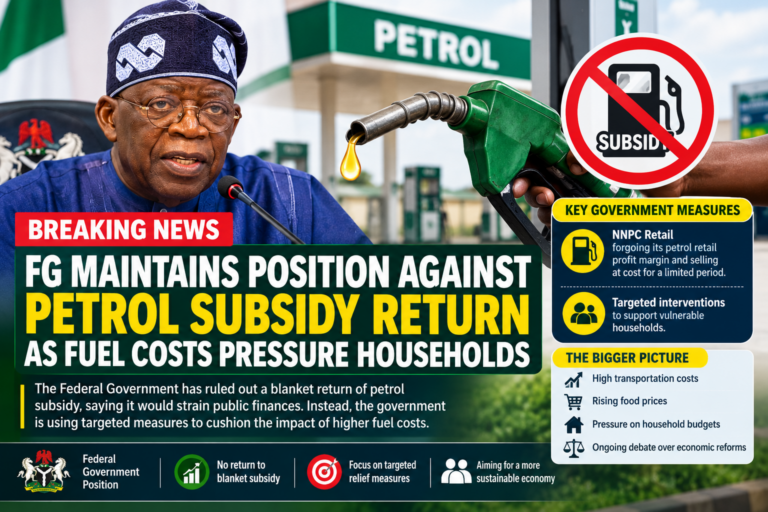
FG MAINTAINS POSITION AGAINST PETROL SUBSIDY RETURN AS FUEL COSTS PRESSURE HOUSEHOLDS
The Federal Government has maintained its opposition to restoring a blanket petrol subsidy, arguing that a return to the previous arrangement would place additional pressure on public finances. The position comes amid continuing concerns about petrol prices and the rising cost of transportation, food and other essential goods. In a statement published by the State…