The Universal Basic Education Commission has unveiled a digital system designed to improve the monitoring of basic education projects and intervention funds across Nigeria. The development forms part of UBEC’s preparations for the implementation of its 10-year Universal Basic Education Roadmap covering 2026 to 2035. The commission says the new approach will move away from fragmented interventions and place greater emphasis on understanding the overall needs of individual schools. One of the key developments is a digital workflow intended to improve the management and tracking of intervention funds. The system is also expected to make it easier for parents and communities to monitor basic education projects in their areas. The initiative comes amid longstanding concerns about the implementation and monitoring of education projects across the country. Under the new roadmap, UBEC says interventions will be planned around the broader needs of schools rather than treating individual projects such as classroom construction or furniture supply as isolated activities. The commission is expected to begin full implementation of the new roadmap in the first week of October. The 10-year plan is intended to provide a more coordinated approach to basic education development and improve planning and utilisation of available resources. Greater access to information about education projects could also give communities a stronger role in monitoring projects meant to benefit local schools. The success of the system will ultimately depend on the quality of data entered into it, how frequently information is updated and whether identified problems are acted upon. UBEC says the new digital approach is part of its broader effort to strengthen transparency, accountability and planning in Nigeria’s basic education sector.

Similar Posts
NELFUND Expands Student Loan Scheme, Extends Support to TVET Students Nationwide
The Nigerian Education Loan Fund (NELFUND) has unveiled a nationwide expansion strategy aimed at increasing awareness and access to its student loan programme, as efforts intensify to support more Nigerian students pursuing higher education and vocational training. The initiative, being implemented in collaboration with key stakeholders, including members of the National Assembly, seeks to broaden…
Reps Move to Resolve Law School Admission Crisis Affecting NOUN Graduates
The House of Representatives has commenced efforts to address the longstanding dispute over the admission of law graduates from the National Open University of Nigeria into the Nigerian Law School. The issue affects more than 5,000 graduates who have completed their law degree programmes at NOUN but have faced difficulties progressing to the professional training…
Global Recognition and Elite Funding Advantages Unlocked as 24 Nigerian Universities Dominate Sub-Saharan Rankings
Nigerian higher education has achieved its most decisive international breakthrough, completely rewriting the academic leaderboard across the continent. According to a high-profile national briefing finalized this week by the Minister of Education, Dr. Maruf Tunji Alausa, a record-breaking 24 Nigerian universities have aggressively scaled structural barriers to secure placement on the newly released 2026 Times…
Barau Jibrin Rallies Students for Tinubu Re-election at NANS 45th Anniversary
The Deputy President of the Senate, Senator Barau Jibrin, has called on Nigerian students to support President Bola Tinubu’s re-election bid to ensure the continuity of ongoing education reforms. Speaking on Friday in Abuja while chairing the 45th-anniversary celebration of the National Association of Nigerian Students (NANS), Barau emphasized that the administration has demonstrated a…
Ebonyi State Police Confirm Killing of Traditional Ruler, Ezeogo Francis Igwe; 9 Suspects Arrested in Ikwo Operation
The Ebonyi State Police Command has officially confirmed the tragic death of Ezeogo Francis Igwe, the traditional ruler of the Ndufu-Alike community in Ikwo Local Government Area. The deceased was the father of the former Deputy Governor of Ebonyi State, Dr. Kelechi Igwe. Verified Incident Details Police Operations and Arrests In a statement released on Friday, March 6, 2026, Police…
BREAKING: AEFUNAI SHIFTS FIRST SEMESTER EXAMS JUST DAYS TO FEBRUARY 23 START DATE
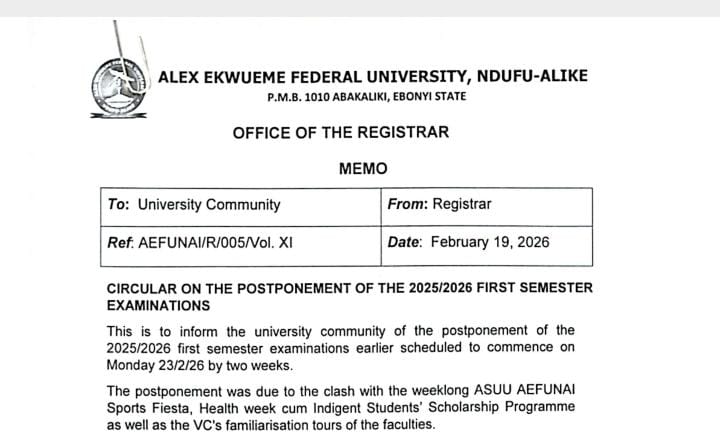
The management of Alex Ekwueme Federal University, Ndufu-Alike (AEFUNAI) has postponed the 2025/2026 first semester examinations earlier scheduled to commence on Monday, February 23, 2026. The announcement was contained in a memo issued on February 19, 2026, by the Registrar, T. Ifeanyi Igwe, Esq. According to the circular, the postponement is due to a clash…