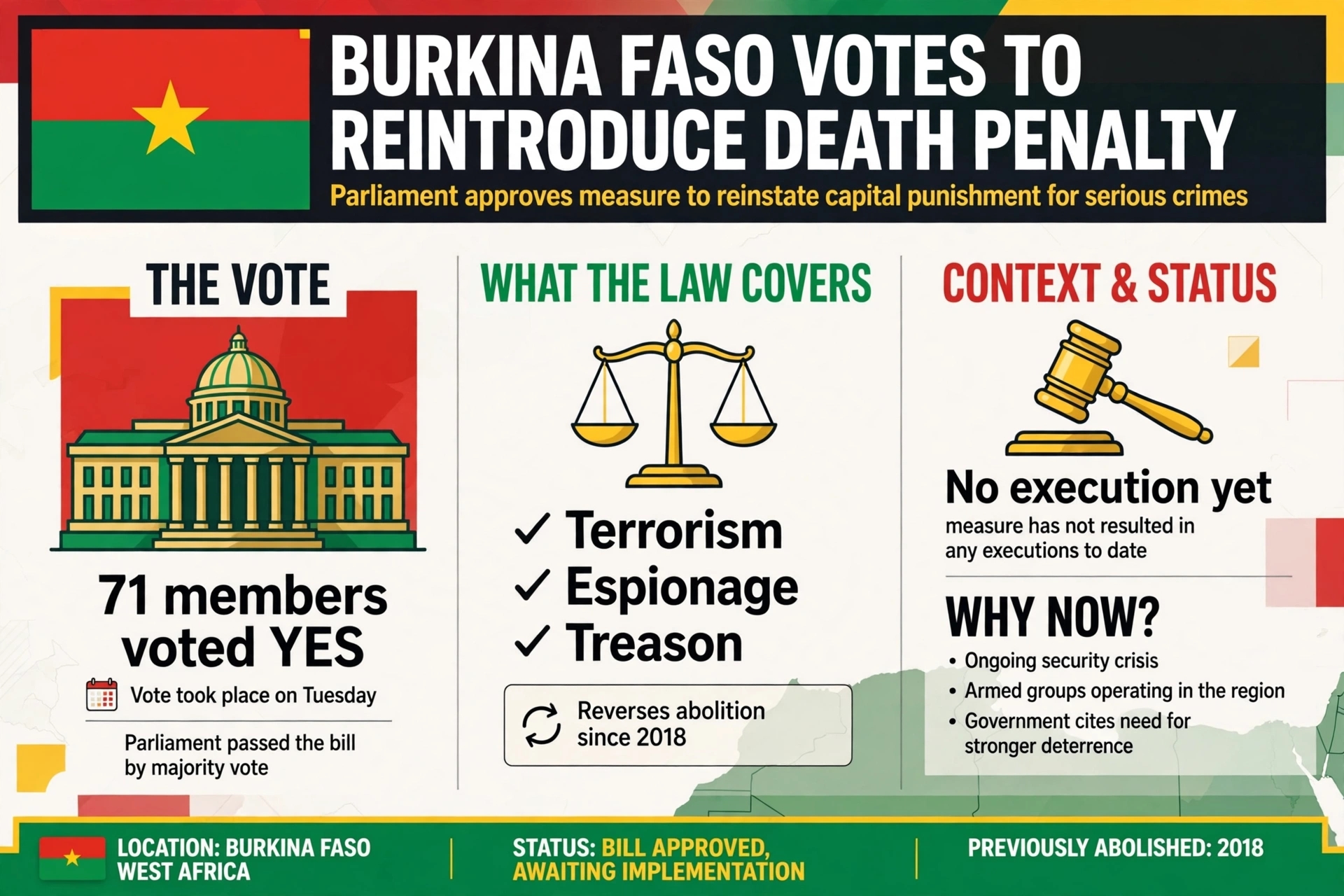
Burkina Faso’s parliament has voted to reinstate the death penalty for certain serious offences, including terrorism, espionage and treason, in a development that has drawn international attention to the country’s criminal justice system. The decision marks a major change in the country’s approach to capital punishment and comes as Burkina Faso continues to face a serious security crisis involving armed groups. All 71 members of the country’s legislature voted in favour of adopting the new penal code on Tuesday, the decision reverses the abolition of capital punishment that had been in place since 2018. The reinstatement forms part of a wider approach to criminal justice under the country’s current military-led authorities, the offences covered by the reported measure include terrorism, espionage and treason. However, the precise legal implementation and the procedures required before any sentence could be carried out should be distinguished from the parliamentary vote itself, the change does not mean that executions have immediately taken place. The decision has attracted criticism from human rights advocates, who argue that capital punishment raises serious concerns about the right to life and the risk of irreversible judicial errors, Human Rights Watch has criticised the move, arguing that the death penalty has not been demonstrated to be an effective deterrent to serious crime. The debate is especially significant in Burkina Faso, where authorities are fighting armed groups linked to al-Qaeda and the Islamic State, the country has experienced years of insecurity, displacement and violence affecting civilians. Critics argue that restoring capital punishment will not, by itself, address the deeper security problems facing the country. The development places Burkina Faso at the centre of a broader regional debate about security, military rule, criminal justice and human rights, supporters of tougher punishment may argue that severe penalties are necessary to confront terrorism and threats to national security, opponents counter that effective law enforcement, fair trials, accountable security institutions and protection of civilians are essential to lasting stability. The practical consequences of the new penal code will depend on its implementation and the wider legal framework governing criminal proceedings.
Similar Posts
NIGERIA AND GERMANY STRENGTHEN ECONOMIC PARTNERSHIP, PRIORITISE FOOD SECURITY AND INDUSTRIAL DEVELOPMENT
Nigeria and Germany have reaffirmed their commitment to strengthening bilateral relations, with renewed emphasis on economic reforms, food security, industrial development, renewable energy and job creation. The commitment was highlighted during a high-level meeting in Abuja between Nigerian government officials and a delegation from the German Bundestag Committee on Economic Cooperation and Development, the German…
Navy Recovers 80,000 Litres of Suspected Stolen Crude, Arrests Three
The Nigerian Navy has recovered approximately 80,000 litres of suspected stolen crude oil during operations in the Niger Delta and arrested three suspected drug traffickers in a separate operation. The operations involved personnel of the Nigerian Navy Ship Delta and the National Drug Law Enforcement Agency. According to the Navy, two anti-crude oil theft operations…
FG Proposes ₦1,350 Petrol Price Ceiling as Nigerians Face Rising Costs
The Federal Government has proposed negotiating a ceiling of ₦1,350 per litre on petrol’s ex-gantry price as part of efforts to reduce fluctuations in domestic fuel prices. The proposal was disclosed by the Minister of Finance and Coordinating Minister of the Economy, Taiwo Oyedele, during a press conference in Abuja on Thursday. According to reports…
Dangote Refinery Increases Diesel Gantry Price by ₦100 to ₦1,800 per Litre
Dangote Petroleum Refinery has increased its gantry price for automotive gas oil, commonly known as diesel, by ₦100 per litre. According to a notice from the refinery’s Group Commercial Operations, reviewed by http://Petroleumprice.ng, the price was raised from ₦1,700 to ₦1,800 per litre, effective Saturday, October 10, 2026. The adjustment represents a 5.88% increase. Customers…
Osun Orders 24-Hour Security Alert, Sets Up Joint Task Force Amid Fresh Threats
The Osun State Government has ordered security agencies to maintain a 24-hour red alert across the state and approved the establishment of a Joint Security Task Force following recent security alerts and concerns over threats to lives and property. The decision was reached at a State Security Council meeting attended by the newly deployed Commissioner…
Police Rescue Nine Kidnap Victims in 24-Hour Nationwide Operations
The Nigeria Police Force has rescued nine kidnapped victims and arrested suspects during a series of operations conducted across several states. The operations were carried out between September 17 and 18 as police formations in different parts of the country intensified efforts against kidnapping, armed robbery and other violent crimes. One of the major operations…