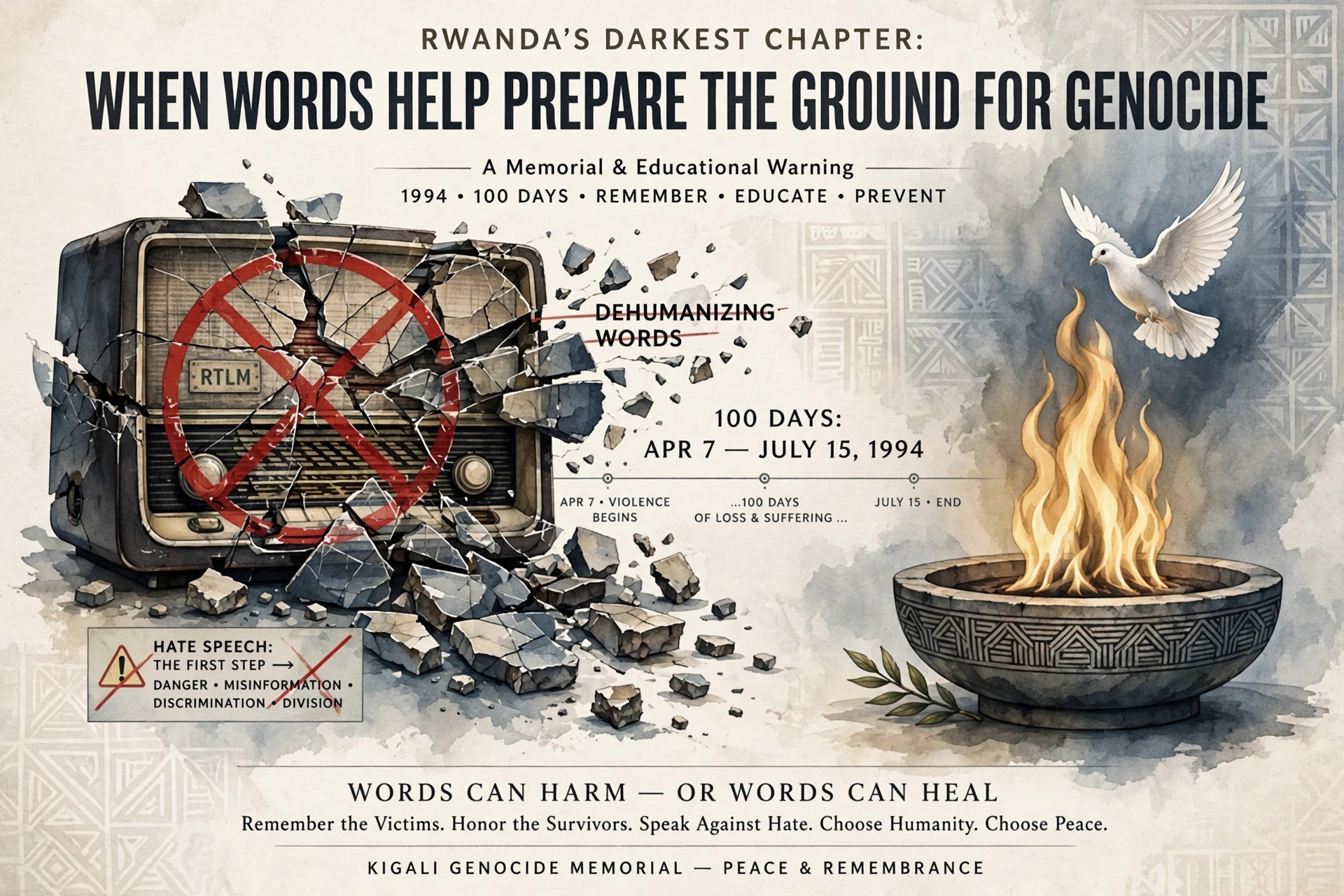
Genocide does not begin only when people are killed. Long before mass violence reaches its most horrific stage, societies may experience the spread of dehumanising language, organised propaganda, political manipulation and the gradual normalisation of hatred. The 1994 genocide against the Tutsi in Rwanda remains one of the clearest and most painful demonstrations of this danger. Over approximately 100 days in 1994, extremist forces and their collaborators murdered an estimated 800,000 people, predominantly Tutsi, alongside Hutu and others who opposed the genocide. The killings were organised and carried out on a devastating scale, destroying families and communities. The genocide occurred against a background of historical political tensions, discrimination, civil war and extremist mobilisation. Rwanda’s colonial history contributed to the rigid racialised categorisation of Hutu and Tutsi identities, although the origins and development of these identities were more complex than a simple colonial explanation. Following independence, political upheaval and cycles of violence contributed to repeated displacement and deep divisions. In 1990, the Rwandan Patriotic Front launched an offensive from neighbouring Uganda, beginning a civil war with the Rwandan government. A peace agreement signed in 1993 offered the possibility of a political settlement, but extremist forces opposed concessions and sought to portray the Tutsi population as an enemy. On April 6, 1994, the plane carrying Rwandan President Juvénal Habyarimana was shot down near Kigali. The circumstances surrounding the attack remain disputed. Within hours, organised killings and roadblocks appeared, and the genocide began, Radio broadcasts and other forms of propaganda played a significant role in spreading extremist messages and encouraging violence. However, the genocide was not simply the result of hateful speech. It involved organised political and military structures, armed groups, local participation, coercion and the failure of international actors to prevent or stop the slaughter in time. The international community’s response remains a subject of profound criticism. Despite warnings and evidence of escalating violence, the United Nations and powerful governments failed to take effective action capable of preventing the catastrophe. The Rwandan Patriotic Front captured Kigali in July 1994, bringing the genocide to an end as it defeated the government forces responsible for organising and supporting it. The historical lessons remain urgent. First, dehumanising language should never be dismissed automatically as harmless political exaggeration. When leaders or media repeatedly portray a group as dangerous, subhuman or collectively guilty, they can help create an environment in which discrimination and violence become easier to justify. Second, early warnings must be taken seriously. Governments, regional organisations and international institutions should respond to credible evidence of organised violence before atrocities reach their most destructive stage. Third, responsibility must be established through evidence and lawful processes. Collective punishment and indiscriminate blame can deepen divisions and undermine the principles of justice that societies need after mass violence. For Nigeria and other diverse countries, Rwanda’s history is a warning about the dangers of political rhetoric that turns ethnic, religious or regional differences into permanent hostility, citizens, journalists and political leaders must recognise the difference between legitimate criticism and language designed to encourage hatred against an entire community. Social media has made the rapid circulation of inflammatory claims easier. False allegations, manipulated images and calls for revenge can spread before facts are established. Platforms, public institutions and citizens all have roles in reducing the risk of incitement. Nevertheless, the answer is not to silence every difficult discussion. Freedom of expression remains essential. The challenge is to protect open debate while confronting direct incitement, organised persecution and threats of violence through fair and effective legal measures, remembering Rwanda must also involve honouring survivors, supporting the preservation of evidence and ensuring that education about genocide is accurate and responsible. History cannot guarantee that atrocities will never happen again. But ignorance, denial and indifference make prevention more difficult, Rwanda’s darkest chapter reminds humanity that hatred becomes especially dangerous when political power organises it, institutions tolerate it and the world chooses to look away. Preventing genocide requires the courage to recognise warning signs and act before the next tragedy becomes history.
Similar Posts
BEYOND COMPLAINTS
HOW YOUNG NIGERIANS CAN HELP BUILD THE CHANGE THEY WANT TO SEE. Young people are often the most vocal about the challenges facing their country, ranging from unemployment and economic hardship to corruption, insecurity, and poor leadership.They complain and raise concerns to express their dissatisfaction and how they want things to be better.While these concerns…
Addressing the 2026 Surge in Student Housing Rents
Nigeria’s student housing crisis has sharpened into a clear affordability emergency. National Bureau of Statistics (NBS) data for July 2026 show rent inflation surging to 33.74%, far outpacing headline inflation, which eased to 15.43%. While overall consumer prices have moderated, the cost of a roof over a student’s head continues to climb rapidly. Off-campus clusters…
The Wrong Train: AEFUNAI SUG Director Of Welfare Ovu Obinna Peter Shares a Powerful Message About Knowing When to Walk Away
Sen. Ovu Obinna Peter, SUG Director of Welfare, shares a powerful message about knowing when to walk away from the wrong situations, embracing personal growth, and finding the courage to choose a better path.
BEFORE THE FIRST SHOT: THE OPPORTUNITIES NIGERIA LOST TO PREVENT WAR
Wars are often remembered through their most dramatic moments: the declaration of hostilities, the first gunshots, the advance of armies and the eventual surrender of one side. Yet the most important lessons of many conflicts lie in the days and months before the fighting begins, when peaceful alternatives still exist, the Nigerian Civil War offers…
LEARNING TO ADJUST WHEN THE PACE CHANGES
Something happened while I was writing my exams last semester.It was as if my lecturers and exam invigilators all had a problem with time or somewhere very important to be. Where did they all want to go?Where were they rushing to? On the exam paper, the duration would be clearly stated:2 HOURS.But somehow, most times,…
THE DANGEROUS NORMALISATION OF SUFFERING IN NIGERIA: WHEN DID WE BECOME SO COMFORTABLE WITH ABNORMALITY?
There is something deeply troubling about a country where suffering has become so familiar that people no longer find it unusual. A country where kidnapping has become a recurring headline, where families constantly worry about the safety of their loved ones, and where travelling from one location to another sometimes comes with the fear of…