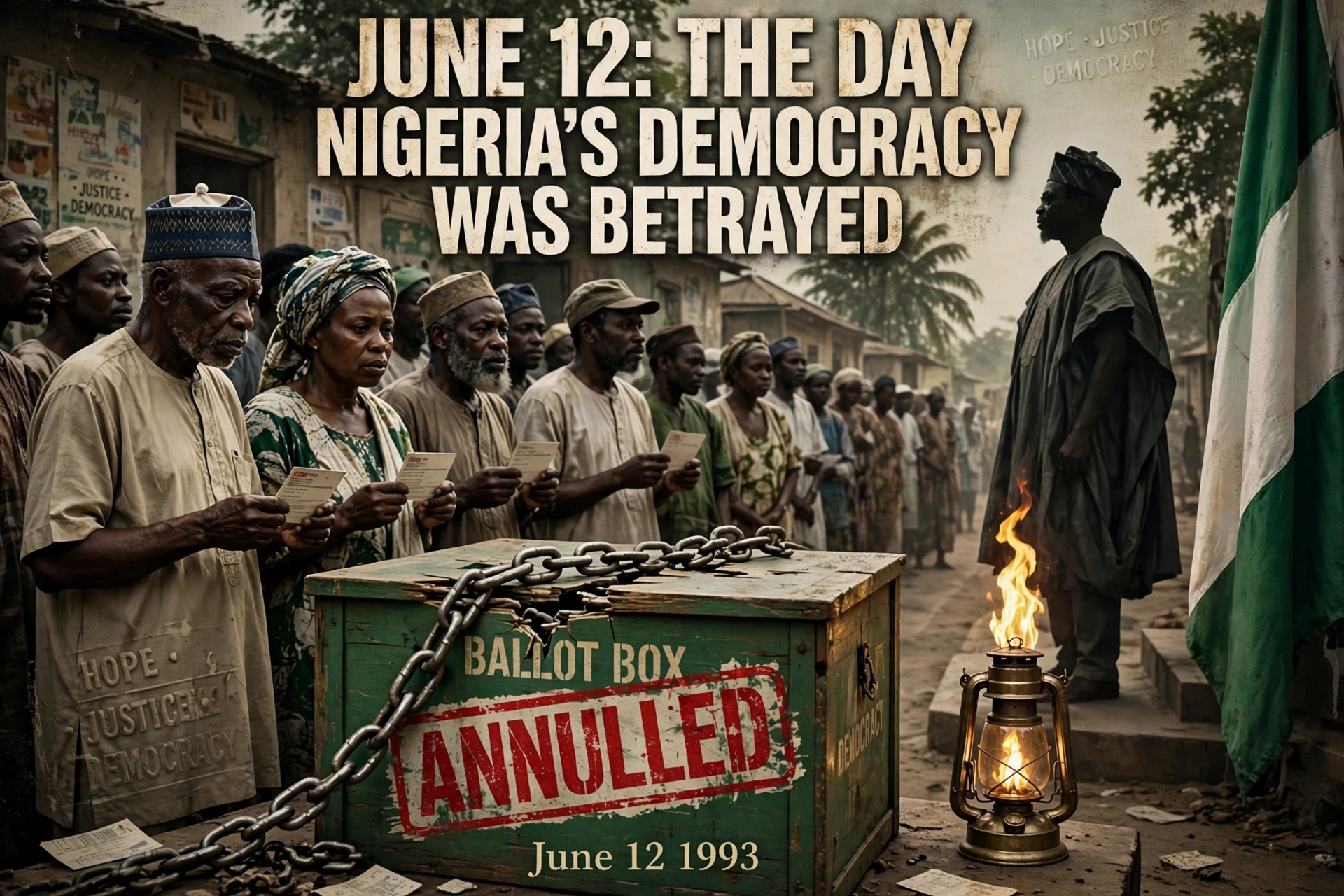
Democracy is built on a simple principle: political power belongs to the people, and the authority to govern must ultimately come from their consent. Yet history repeatedly demonstrates that the greatest threats to democracy sometimes come not from those who reject elections openly, but from those who refuse to accept the consequences of an election. Nigeria’s June 12, 1993, presidential election remains one of the clearest illustrations of this contradiction. The election, widely regarded as one of the most credible in Nigeria’s history, was contested by Moshood Kashimawo Olawale Abiola of the Social Democratic Party and Bashir Tofa of the National Republican Convention. Before the official results could be fully concluded and announced, the military government of General Ibrahim Babangida annulled the election, the decision triggered a national political crisis and became a defining moment in Nigeria’s struggle for democratic government. For millions of Nigerians, June 12 represented more than a contest between two candidates. It represented the possibility that citizens from different ethnic, religious and regional backgrounds could participate in a common democratic process. Abiola’s support crossed many of the divisions that had historically complicated Nigerian politics. The election challenged the assumption that national political competition must always be determined by ethnic or regional loyalties. Its annulment therefore damaged more than the credibility of a particular election. It weakened public confidence in the political process and demonstrated how easily the wishes of voters could be subordinated to the calculations of those holding power. The consequences were profound. Pro-democracy activists, journalists, students and civil society organisations resisted military rule. Many faced intimidation, detention and other forms of repression. Abiola was later arrested after declaring himself the winner and asserting his democratic mandate. He died in detention on July 7, 1998, shortly after the death of General Sani Abacha, whose government had held him in custody. Nigeria eventually returned to civilian democratic rule on May 29, 1999. In 2018, President Muhammadu Buhari officially designated June 12 as Democracy Day, replacing May 29 as the date of its national observance. These developments acknowledged the importance of the struggle for democratic government. But recognition of history must lead to more than ceremonies, speeches and public holidays, the central question is whether Nigeria has built an electoral system capable of preventing a similar betrayal of the people’s mandate. Democracy cannot thrive when political parties treat elections as battles to be won at any cost. It cannot flourish when public officials undermine electoral institutions, when violence intimidates voters or when allegations of irregularities are not addressed transparently. An election is not credible merely because ballot boxes are present and voters queue at polling stations. Credibility requires an independent electoral commission, transparent procedures, reliable results, effective dispute resolution and public confidence in the outcome. Political leaders must also accept that losing an election is part of democratic life. A candidate who wins through a credible process has a mandate to govern, while a candidate who loses must have access to lawful avenues for challenging the result. Equally, electoral bodies must understand that their legitimacy depends not only on the legal authority they possess but also on the confidence citizens place in their decisions. The lesson of June 12 is not that one political figure should be permanently elevated above criticism. It is that no individual or institution should possess the power to erase the collective political choice of citizens without lawful justification and accountability, Nigeria must never allow the memory of June 12 to become an empty political slogan. The ballot must remain stronger than the ambition of any politician. Until every Nigerian can vote with confidence that their choice will be respected, the democratic promise of June 12 will remain unfinished.
Similar Posts
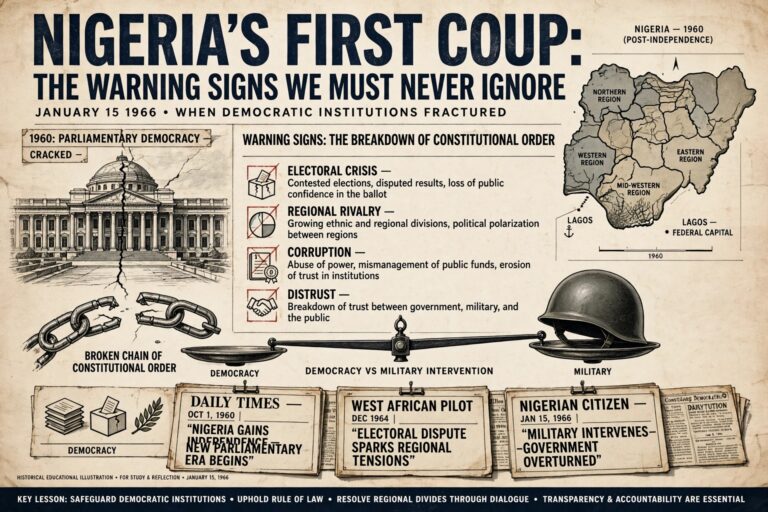
NIGERIA’S FIRST COUP: THE WARNING SIGNS WE MUST NEVER IGNORE
Democracy is rarely destroyed in a single moment. More often, it weakens through political crises, institutional failures, public distrust and the growing belief that constitutional government is incapable of solving society’s problems. Nigeria’s first military coup, carried out on January 15, 1966, remains a powerful historical warning about what can happen when a young democracy…
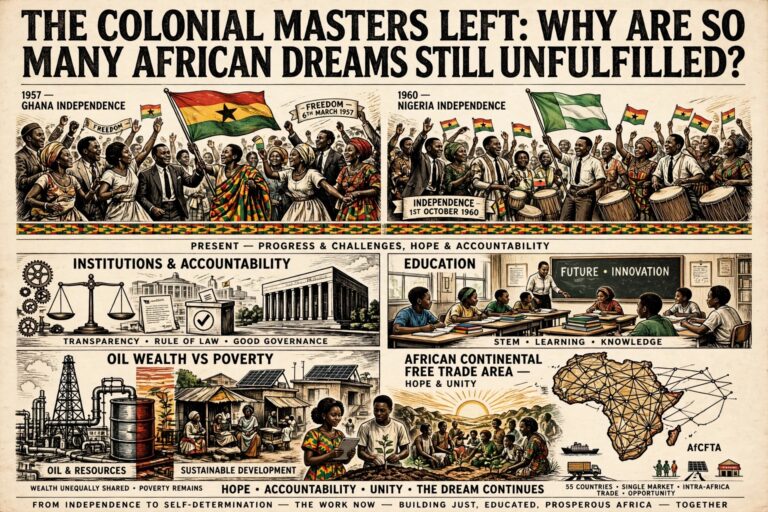
THE COLONIAL MASTERS LEFT: WHY ARE SO MANY AFRICAN DREAMS STILL UNFULFILLED?
When African countries began gaining independence in the mid-twentieth century, the moment carried enormous expectations. Political freedom promised the opportunity to determine national priorities, build institutions, expand education and use domestic resources for the benefit of citizens. Yet decades after the end of formal colonial rule, many African countries continue to struggle with poverty, unemployment,…
Broke People Don’t Get to Philosophise About Money(So I Did It for Us)
I was having a conversation with a friend and I realised everything we talked about revolved around money. For any of our plans to work or even fail, it needed money. It got me thinking: how did the world become so dependent on money, or its modern equivalents? How did power get so tightly attached…
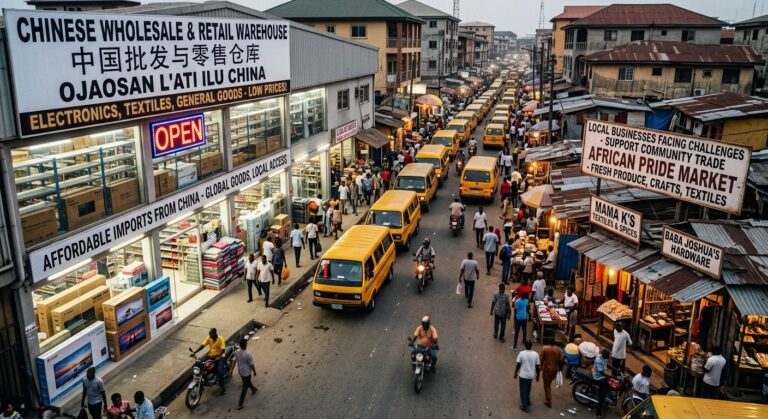
Chinese Warehouses and Stores in Africa: A Blessing or a Threat to Local Businesses?
Walk into many major African cities today and there is a good chance you will come across shops, warehouses or businesses selling products imported from China. From electronics and phone accessories to clothes, household items, building materials and spare parts, Chinese products have become a familiar part of everyday life for many African consumers.For customers,…
Did You Know TECNO, Infinix and itel Are Owned by the Same Company?
If you have ever used a TECNO, Infinix or itel phone, you might be surprised to discover that the three brands are actually part of the same company.Behind these familiar names is Transsion Holdings, a Chinese technology company that operates several brands targeting different markets and types of consumers One Company, Different Brands Transsion’s smartphone…
SLAVERY WAS ABOLISHED, BUT HAS HUMAN EXPLOITATION REALLY ENDED?
Human history contains achievements that deserve celebration and tragedies that demand permanent remembrance. The abolition of the transatlantic slave trade and the eventual legal abolition of slavery in many countries belong to both categories: they demonstrate the possibility of moral progress while reminding humanity of the extraordinary cruelty it once normalised, but a difficult question…