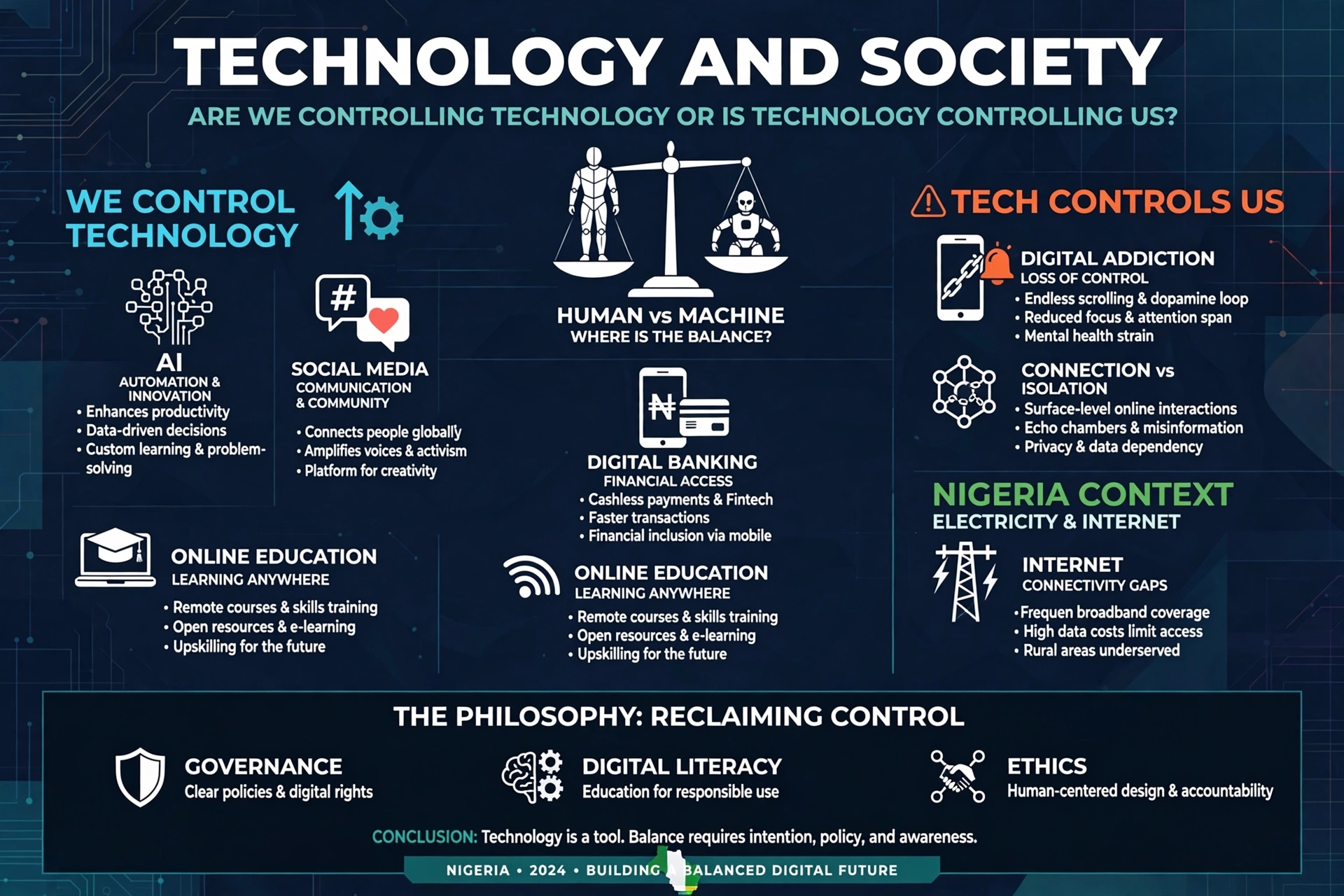
Technology was created to make life easier, improve communication, solve problems, and expand human possibilities. Today, artificial intelligence, social media, digital banking, and online education have transformed how we live, work, learn, and interact. However, beneath these remarkable achievements lies an important question: Are we using technology to improve our lives, or are we gradually allowing it to control us? There is no doubt that technology has created enormous opportunities. Students can access educational resources online, businesses can reach international customers, and individuals can work remotely without leaving their countries. In healthcare, technological innovations support medical diagnosis and improve access to services. Yet, every advancement comes with challenges that society must not ignore. Social media, for instance, has connected millions of people while encouraging unhealthy comparisons, online bullying, misinformation, and an excessive desire for public approval. Many people now measure their happiness by likes, followers, and the seemingly perfect lives displayed on their screens. Ironically, we have become more digitally connected while sometimes growing emotionally distant from those around us. Artificial intelligence presents another challenge. Although it can improve productivity and support learning, it also raises concerns about job displacement, privacy, misinformation, and excessive dependence on automated systems. Technology should assist human thinking, not replace our ability to reason independently. In countries such as Nigeria, technological progress offers opportunities for young people to acquire digital skills, access remote employment, and establish online businesses. However, unreliable electricity, expensive internet access, and limited digital education continue to prevent many people from benefiting fully, governments must therefore invest in digital infrastructure, affordable internet, and relevant education. Technology companies must prioritise privacy and security, while individuals must learn to identify misinformation and protect themselves against online fraud. More importantly, society must recognise that technological advancement alone does not guarantee human progress. A country may possess sophisticated technology and still struggle with poverty, inequality, dishonesty, and a lack of compassion. Machines can process information, but human beings must remain responsible for moral decisions and the consequences of their actions. The solution is not to reject technology but to use it wisely. We must establish boundaries, protect human relationships, and ensure that innovation serves the public interest rather than creating new forms of inequality and dependence, technology should be our servant, not our master. Ultimately, the success of technological advancement should not be measured solely by the intelligence of our machines but by the positive difference they make in human lives. The future will undoubtedly be shaped by technology. The question is whether we will be wise enough to shape that future responsibly. After all, what is the value of creating machines that become increasingly intelligent if the people using them gradually lose the ability to think for themselves?
Similar Posts
Did You Know TECNO, Infinix and itel Are Owned by the Same Company?
If you have ever used a TECNO, Infinix or itel phone, you might be surprised to discover that the three brands are actually part of the same company.Behind these familiar names is Transsion Holdings, a Chinese technology company that operates several brands targeting different markets and types of consumers One Company, Different Brands Transsion’s smartphone…
THE GENERATION THAT IS TIRED OF SURVIVING: WHEN DID LIVING BECOME A LUXURY?
There is something deeply disturbing about a generation that has become so accustomed to hardship that simply having a peaceful day feels like an achievement. People wake up every morning, not necessarily because they are excited about what life has to offer, but because they have responsibilities they cannot escape. Bills must be paid. Families…
NIGERIA’S FIRST COUP: THE WARNING SIGNS WE MUST NEVER IGNORE
Democracy is rarely destroyed in a single moment. More often, it weakens through political crises, institutional failures, public distrust and the growing belief that constitutional government is incapable of solving society’s problems. Nigeria’s first military coup, carried out on January 15, 1966, remains a powerful historical warning about what can happen when a young democracy…
Chinese Warehouses and Stores in Africa: A Blessing or a Threat to Local Businesses?
Walk into many major African cities today and there is a good chance you will come across shops, warehouses or businesses selling products imported from China. From electronics and phone accessories to clothes, household items, building materials and spare parts, Chinese products have become a familiar part of everyday life for many African consumers.For customers,…
From Classroom to Construction Site: How a 10-Year-Old Ended Up Working in Lagos
A report involving a 10-year-old boy from the Republic of Benin working at a construction site in Lagos has drawn fresh attention to the difficult line between informal apprenticeship and child labour. The boy, identified as Ojo Ibukun, was reportedly brought from Ifangni in south-eastern Benin Republic to Lagos by a master tiler. Instead of…
NIGERIA’S CIVIL WAR: HAVE WE LEARNT ANYTHING FROM THE BLOODSHED?
History has a painful way of returning to societies that refuse to learn from their past. For Nigeria, few historical experiences carry as much weight as the Nigerian Civil War of 1967–1970, a conflict that left countless families grieving, communities devastated and an entire generation scarred by loss. More than five decades after the war…